
Event management software market
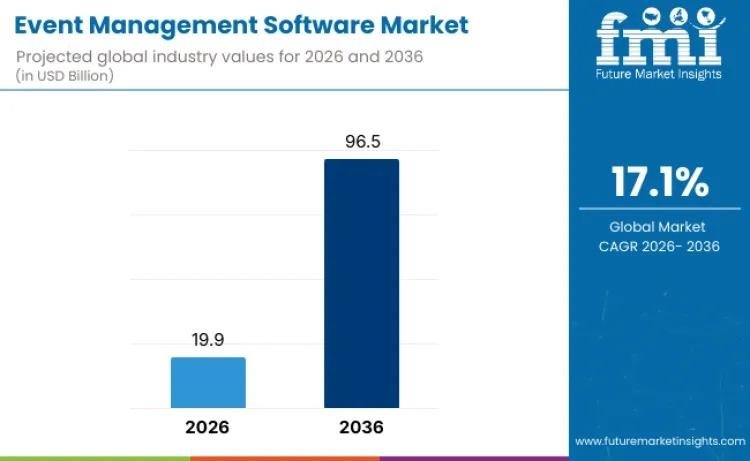
According to the latest analysis from Future Market Insights (FMI), the global event management software market is expected to reach a value of $19.9 billion by 2026 and grow at a robust CAGR of 17.1% by 2036, eventually reaching a valuation of $96.5 billion.
The expansion reflects a structural shift in the way organizations plan, execute and measure events. Companies are increasingly investing in integrated software platforms that unite planning, registration, ticketing, communications, sponsorship management and post-event analytics within a single ecosystem. The migration from manual workflows and fragmented tools to centralized, cloud-based solutions continues to accelerate in enterprise, public sector and institutional environments.
Request sample report | Customize report | Buy full report
https://www.futuremarketinsights.com/reports/sample/rep-gb-1849
Market snapshot
• Industry value (2026): USD 19.9 billion
• Projected value (2036): USD 96.5 billion
• CAGR (2026-2036): 17.1%
• Leading deployment model: cloud-based (55.2% share in 2026)
• Largest business segment: large enterprises (61.5% share)
• Large end-user group: event management companies (32.8% share)
• Fastest growing markets: India (18.3%), China (17.6%), Brazil (16.8%)
Integrated platforms replace standalone tools
The market is undergoing a clear transition from single registration systems to comprehensive event suites. Combining modern platforms:
• Participant lifecycle management
• Content delivery and virtual streaming
• Lead capture and sponsorship tools
• Engagement analytics and reporting dashboards
• Integration of CRM and marketing automation
Cloud-native architectures enable faster deployment across regions, real-time scalability for high registration volumes, and simplified integration with enterprise technology stacks. As hybrid formats become the standard, organizations need platforms that can manage in-person and virtual experiences simultaneously within unified workflows.
Cloud implementation remains the structural growth engine
Cloud-based deployments are expected to maintain a 55.2% market share by 2026, supported by enterprise IT policies that prioritize software-as-a-service adoption.
The main benefits include:
• Elastic scaling during peak traffic times
• Lower infrastructure and maintenance overhead
• Centralized governance and user management
• Rapid deployment across multiple regions
Advances in microservices and serverless architecture further improve uptime reliability and integration flexibility. API management layers enable deeper connectivity with CRM systems, identity access platforms, analytics engines, and collaboration tools.
Large companies anchor turnover growth
Large enterprises are expected to account for 61.5% of total demand by 2026, driven by higher event volumes and stricter governance requirements.
These organizations prioritize:
• Compliance and security features
• Advanced analytics and ROI measurement
• Multi-event reporting at scale
• Deep integration of business software
Event programs are increasingly linked to revenue pipelines, customer engagement metrics and brand performance dashboards. As a result, analytics and automation capabilities become critical differentiators in supplier selection.
AI, Blockchain and Automation are reshaping product roadmaps
Artificial intelligence integration is redefining event operations. Software developers are embedding:
• Predictive analysis of visitor behavior
• Personalized content recommendations
• AI-powered workflow automation
• Chatbots that use natural language processing
• Sentiment analysis and computer vision tools
Behavioral analytics improves visitor engagement profiling, while blockchain-enabled ticketing addresses security and fraud concerns in digital registration processes.
FMI notes that vendors that position platforms as AI-enabled will gain stronger visibility among enterprise buyers focused on efficiency and personalization outcomes.
Regional growth momentum is strengthening
India – 18.3% CAGR
The rapid growth of the startup ecosystem, expanding corporate event budgets and digital transformation policies are accelerating adoption. Mobile-first platform strategies and expanding connectivity further support cloud penetration.
China – 17.6% CAGR
Government support for domestic software innovation and the increasing number of corporate events are strengthening the adoption of indigenous and international platforms.
Brazil – 16.8% CAGR
Investments in business technology and digital economy initiatives are increasing enterprise demand for scalable event management systems.
United States – 16.2% CAGR
Mature business ecosystems and widespread hybrid working models support the demand for AI-powered automation and advanced analytics integration.
Germany – 15.4% CAGR
Strong regulatory compliance frameworks and an emphasis on data protection support the adoption of platforms at the enterprise level.
Extensive market report: a complete investigation
https://www.futuremarketinsights.com/reports/event-management-software-market
Competitive landscape is evolving towards ecosystem integration
Competition is increasingly focusing on platform depth, integration capabilities and user experience rather than basic ticketing functionality.
Leading suppliers include:
• Cvent Inc.
• Eventbrite
• Aventri Inc.
• InEvent
• Ungerboeck
Partnership strategies expand integration ecosystems, linking event platforms with CRM, payment, analytics and marketing automation systems. Consolidation continues as established vendors acquire specialized startups to accelerate feature expansion and shorten innovation cycles.
Industry prospects
The projected increase from $19.9 billion in 2026 to $96.5 billion in 2036 underlines a long-term shift toward data-driven event ecosystems.
Important structural catalysts include:
• Standardization of hybrid and multi-format events
• AI-driven personalization and analytics adoption
• Cloud-first IT purchasing policy
• Corporate governance and compliance requirements
• Expansion into emerging digital economies
As organizations elevate events from isolated marketing activities to strategic engagement and revenue streams, the demand for integrated, scalable and analytics-rich software platforms will continue to increase.
Similar industry reports
Korean event management software market
https://www.futuremarketinsights.com/reports/event-management-software-industry-analysis-in-korea
Japanese event management software market
https://www.futuremarketinsights.com/reports/event-management-software-industry-analysis-in-japan
Western European event management software market
https://www.futuremarketinsights.com/reports/event-management-software-industry-analysis-in-western-europe
Future Market Insights Inc.
Christiana Business, 200 Continental Drive,
Suite 401, Newark, Delaware – 19713, USA
T: +1-845-579-5705
For sales questions: [email protected]
Website: https://www.futuremarketinsights.com
Future Market Insights, Inc. (FMI) is an ESOMAR-certified, ISO 9001:2015 market research and consulting organization trusted by Fortune 500 clients and global corporations. With operations in the US, UK, India and Dubai, FMI provides data-backed insights and strategic intelligence across more than 30 industries and 1,200 markets worldwide.
This release was published on openPR.