
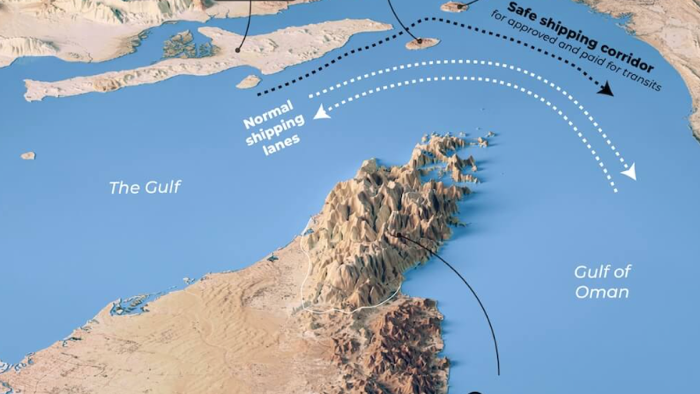
The US and Iran exchanged another round of strikes overnight, extending a weeklong surge in fighting and casting dark clouds of uncertainty over whether the Strait of Hormuz remains open to commercial shipping.
US Central Command revealed US forces unleashed air-delivered munitions on dozens of Iranian air-defense systems, coastal radar systems, missile launch sites, and drone capabilities, bringing the weekend total to about 140 targets. This move aimed to degrade the IRGC’s ability to threaten commercial shipping in the Hormuz chokepoint, which it has done over the past week.
Iran responded with attacks on US-linked facilities in Kuwait, Bahrain, Jordan, and Oman, while also claiming it intercepted two vessels using what it called an “illegal route” through Hormuz.
Early Monday, Iranian state TV reported that IRGC forces fired “warning shots” at multiple ships attempting to transit the Hormuz chokepoint.
“This morning, two ships that were attempting to cross the Strait of Hormuz illegally were targeted and stopped by warning shots fired by the navy of the Revolutionary Guards,” said a correspondent on state TV.
Tehran has declared the strait closed until further notice, but the US military, President Trump, and maritime monitors say the southern route remains passable.
Bloomberg data shows the LNG tanker Al Hamra safely transited the Hormuz chokepoint over the weekend and is now full steam ahead in the Gulf of Oman. Axios noted earlier that 20 commercial ships managed to transit the Hormuz chokepoint in coordination with the US military.
Bloomberg data only tracks ships with transponders on.

Brent crude futures traded up 3.5% to the midpoint of $78 a barrel, while WTI futures are up around 3.4% to $73.85 amid increasingly heated tit-for-tat attacks.
Here is Deutsche Bank equity research analyst Chris Robertson’s summary of developments last week and through the weekend:
Last week, Iran declared that the Strait of Hormuz is closed until further notice. Iran attacked a commercial container ship attempting to transit the region, causing a fire aboard the vessel.
The Joint Maritime Information Center (JIMC) said on Sunday that the southern Omani route remains available, but that the threat level is rated as “severe”.
Regardless of any claims around the Strait being closed or open, what matters is that commercial ship owners are likely not willing to risk transit in an active war zone, putting ships and crews at risk of attack.
We reiterate our initial concerns that despite major destruction of traditional Iranian naval vessels and assets, the ongoing threat that shipowners face is asymmetric warfare technologies such as drones and missiles. These types of threats are much harder to predict or plan for, thereby maximizing uncertainty related to mitigating voyage risks.
We expect transit activity will slow, especially as it relates to vessels planning to enter the Gulf through the Strait which, unlike exiting activity, is the real sign that conditions are normalizing. We believe that an ongoing closure of the Strait of Hormuz will lead to downward pressure on shortterm tanker rates as ships remain in other regions, thereby increasing effective supply of those ships.
As of Monday morning, it is clear that US-Iran diplomacy is unraveling, while US forces are systematically degrading the IRGC’s ability to close the maritime chokepoint. Commercial ships continue to transit the waterway, undermining Tehran’s claim that the critical waterway is effectively shut.
Tehran must also recognize the longer-term strategic risk: every disruption accelerates global investment in pipelines, export terminals, and other infrastructure designed to bypass Hormuz. Once those alternatives are operational (Read Here), Tehran’s greatest source of geopolitical leverage will evaporate. Then what?