

Address poisoning attacks have become a persistent issue on Ethereum, and ironically, they have contributed to the recent record-breaking daily transaction counts.
According to ScamSniffer, there has already been a victim of address poisoning this year, and that loss cost $12.25 million. It happened in January when the victim copied the wrong address from their transaction history, not noticing until it was too late.
A similar story emerged in December when one user lost a whopping $50 million in the same way. That makes it two victims across two months with a total loss of $62 million.
According to a ScamSniffer’s January report, signature phishing also went up, with a total of $6.27M stolen across 4,741 victims in January. The two cases involved a user losing $3.02M and another losing $1.08M and accounted for 65% of all phishing losses.
Why address poisoning attacks have become rampant in recent months
Address poisoning is a kind of scam that depends heavily on social engineering, where attackers monitor the target’s transaction histories, create lookalike addresses, and then send tiny amounts of $ETH, called dust transactions, effectively poisoning the target’s history.
What follows is a waiting game until the victim makes a mistake. The most important part of the whole operation, the dust transactions, were too expensive on Ethereum, so those address poisoning attacks were never as common before now.
However, in late 2025, Ethereum’s Fusaka upgrade came through, and it improved scalability while reducing the transaction fees, causing gas costs to drop sharply. The upgrade has done many great things for the ecosystem, but it also made these low-value dust transactions economically viable for bad actors at scale for the first time.
Address poisoning contributes to daily transaction record on Ethereum
As earlier stated, address poisoning attacks depend heavily on dust transactions that the attackers send to poison the target’s history.
These dust transactions are a prerequisite to the attack itself and are often numerous, and they are set like traps. But not all of them catch prey. Nevertheless, these dust transfers count as real transactions on-chain, and they have been inflating Ethereum’s metrics.
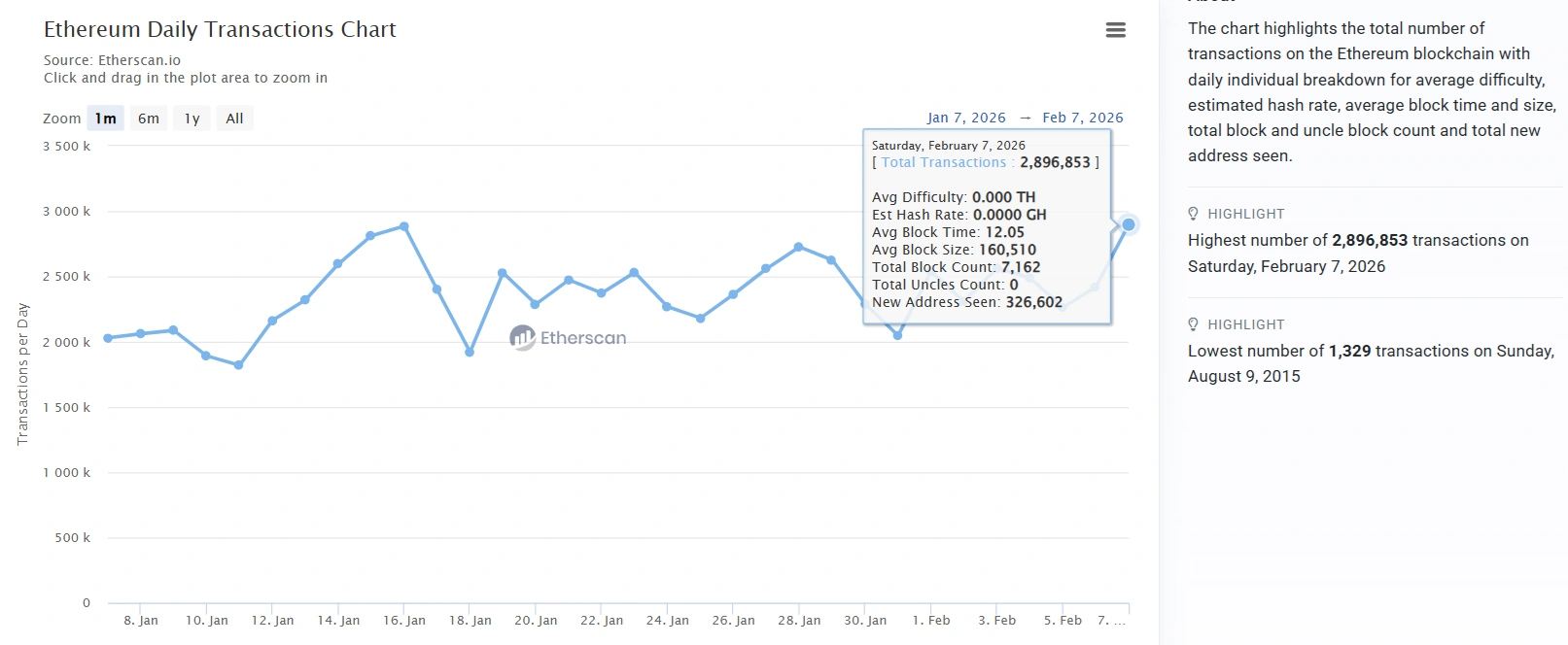
Ethereum daily transaction chart. Source: Etherscan
After the Fusaka upgrade, the network saw massive surges in activity that lasted into 2026. Daily transactions hit all-time highs, and active/new addresses spiked dramatically.
However, analysts and researchers have pointed out that a substantial portion of the surge is linked to mass address poisoning campaigns rather than organic adoption or usage.
The fact that the $ETH price barely had a bullish reaction to all these new records further justifies talk of artificial inflation. However, the Ethereum maxis are not nitpicking over where the traffic is coming from.
They have celebrated the new records, and the Fusaka upgrade has been widely hailed as a great implementation. Never mind that low-value spam transactions dominated the records or that many of the new active addresses received such qualification because they received tiny stablecoin transfers as their first activity.