
This article first appeared in Miner Weekly, a weekly newsletter by BlocksBridge Consulting curating the latest news in energy, compute, infrastructure, and data analysis from TheEnergyMag. Subscribe to receive in your inbox once a week.
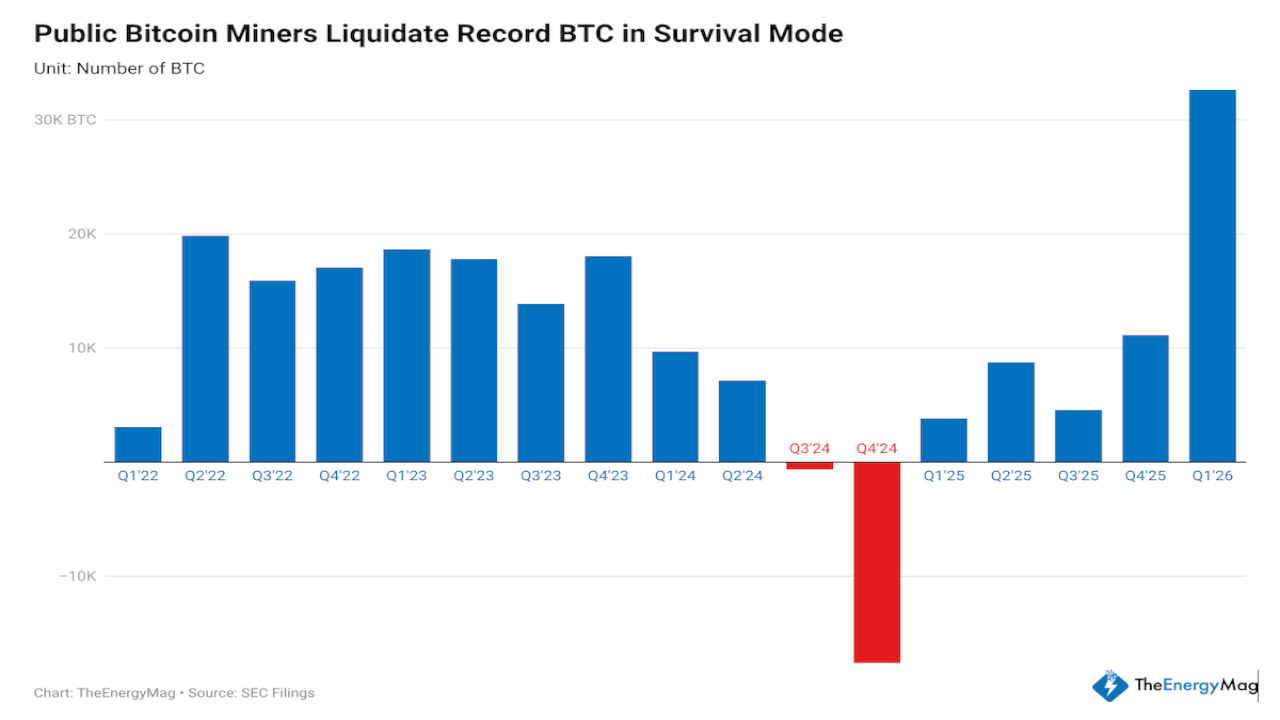
Several major public miners, including MARA, CleanSpark, Riot, Cango, Core Scientific (NASDAQ: CORZ), and Bitdeer (NASDAQ: BTDR), have already sold more than 32,000 BTC in the first quarter of 2026, according to data analyzed by TheEnergyMag. The dataset remains incomplete, as first-quarter earnings reports are still pending.
Even so, the figure already exceeds total net sales across all four quarters of 2025 and sets a new industry record, surpassing the roughly 20,000 BTC that public miners liquidated in the second quarter of 2022 during the market turmoil triggered by the Terra-Luna collapse.
The reversal is striking. Just over a year ago, miners were accumulating aggressively, ending 2024 with a net addition of 17,593 BTC and pushing combined reserves above 100,000 BTC.
The shift comes as hashprice — a key industry metric measuring expected mining revenue per unit of computing power — hovers in the low $30/PH/s range, near all-time lows. At those levels, margins are either compressed or outright negative, especially for operators running older, less efficient fleets or paying higher power costs.
The root of today’s pressure can be traced to the industry’s aggressive hashrate expansion following China’s mining ban in 2021 — a period that, in hindsight, fueled exponential growth at each company’s own expense.
For context, bitcoin’s current price — despite retreating from its all-time high above $120,000 — remains higher than the previous cycle peak. Yet network difficulty is now roughly 10 times higher than in 2021, and block rewards were cut in half in 2024. In effect, mining profitability has compressed by an order of magnitude, helping explain the wave of recent selling.
But the record liquidation does not tell a uniform story. Instead, it reveals an industry beginning to diverge — with some operators forced to sell into weakness, while others lean on structural advantages or capital discipline to ride out the downturn.
For many, the immediate priority is liquidity. Selling bitcoin remains the fastest way to shore up balance sheets, fund operations, and meet debt obligations in a financing environment that is both selective and expensive.
Others are taking a more measured approach. American Bitcoin (ABTC), the proprietary mining carve-out of Hut 8 (NASDAQ: HUT), has doubled down on accumulating bitcoin through both mining and market purchases. As of early April, it had built reserves of more than 7,000 BTC, up from zero a year earlier, while ramping its proprietary hashrate to 28 EH/s.
But the company is not repeating the hashrate-at-all-costs playbook of the previous cycle. Matt Prusak, president and interim CFO of ABTC, told TheEnergyMag that its focus is on quality growth under current market conditions.
“We won’t do deals that we don’t think will win. … When you see people chasing hashrate and chasing big exahash numbers, that’s never been our style,” Prusak said. “Having the biggest fleet doesn’t make a difference to me.”
Unlike many publicly traded peers, ABTC expanded its hardware fleet when demand for ASICs had already cooled. In the summer of 2025, it acquired roughly 15 EH/s of Antminer S21 series from Bitmain by pledging about 3,000 BTC — redeemable within 24 months — rather than paying cash. Such a structure would have been unlikely in prior market conditions. The value of the pledged bitcoin has since declined by about 40%, and Bitmain cannot liquidate the collateral unless ABTC chooses not to redeem it.
Based on Q4 2025 data analyzed by TheEnergyMag, ABTC’s all-in cash cost of production was around $55,000 per bitcoin, or roughly $25/PH/s — among the lowest in the public mining cohort. That allows it to accumulate newly mined bitcoin at a discount to prevailing market prices.
Even if bitcoin falls below that level, Prusak said the company retains the flexibility to allocate capital dynamically. ABTC raised $240 million through at-the-market offerings in 2025 and another $110 million in the first quarter of this year.
“We don’t have to flip into AI. We are a bitcoin allocator. If bitcoin’s expensive relative to the cost to mine, we mine. If bitcoin’s cheap relative to mining, then we buy.” he said, adding: “ At this time, we have no intent ot sell. … We are accumulating.”
But for private operators without comparable access to capital, the divergence in strategy is increasingly shaped by one of the industry’s oldest variables: power costs.
Sean McDonough, president and CEO of New West Data, a Canadian oil producer that mines bitcoin using off-grid power generated by flared natural gas from its own oil sites, said the company’s effective power cost is below $0.02 per kilowatt-hour. That is, in some cases, roughly one-third of what large-scale public miners pay.
At that level, even less efficient machines remain profitable. With hashprice around $30/PH/s, a miner paying $0.02/kWh can sustain fleet efficiencies of roughly 60 J/TH. McDonough said this enables the company to acquire older-generation equipment at lower upfront costs while maintaining margins, especially as ASIC prices have fallen alongside hashprice.
That cost advantage has allowed New West Data to expand despite the downturn. The company tripled both its oil production and bitcoin compute capacity in 2025 and expects to triple again this year. It currently operates about 15 MW of computing capacity, all powered by flared gas from its own sites.
Still, flared gas represents a niche model, requiring expertise in upstream oil production rather than traditional power procurement through utilities or long-term power purchase agreements.
Absent ultra-low-cost power, miner operators are also turning to operational optimization to preserve margins.
Luxor, a bitcoin mining pool operator, ASIC broker, and software provider, launched a fleet management tool called Commander earlier this month. The platform uses automated algorithms to evaluate hashrate and power market conditions every five minutes, dynamically adjusting power settings across a fleet based on real-time economics.
The goal is to optimize output from existing infrastructure. Luxor says internal benchmarks show an 8% to 14% improvement in profitability compared with traditional on/off curtailment strategies.
The shift toward software reflects a broader recalibration across the industry. With hashprice under pressure, upgrading to the latest generation of machines often requires capital outlays that are difficult to justify on a standalone return basis.
Instead, operators are focusing on extracting better margins from existing fleets — gaining incremental efficiency wherever possible.
Ethan Vera, Luxor’s chief operating officer, said the Commander platform has scaled to about 5 EH/s of customer hashrate since launch. It complements LuxorOS, the company’s firmware solution introduced in 2022, which now supports roughly 45 EH/s, or about 5% of the global network.
In one recent case study, Luxor claimed that Soluna, a publicly traded bitcoin miner with colocation and proprietary mining in Texas, was able to speed up the recovery time via LuxorOS for its 1.1 EH/s fleet by 50% after curtailment events, improving uptime without additional operational expenditure.
All told, the industry is no longer moving in lockstep. What was once a relatively uniform business model defined by scale and hashrate growth is fragmenting into a range of survival and quality growth strategies shaped by power economics, balance sheet flexibility, and operational sophistication.
Read the original article here.