

Industry incident reports and blockchain analysis published by industry sites and security analysts reported a $1.78 million loss at decentralized finance protocol (DeFi) Moonwell following a critical oracle pricing error that briefly underpriced Coinbase Wrapped Staked. $ETH token (cbETH) at around $1.12 compared to its real market value of around 2,200.
The mispricing due to the misconfigured oracle integration resulted in immediate liquidations and immediate seizure of collateral from automated market participants. As a result of the event, over 1,096 cbETH were liquidated by liquidation bots and arbitrage participants, increasing the total bad debts recorded by the protocol.
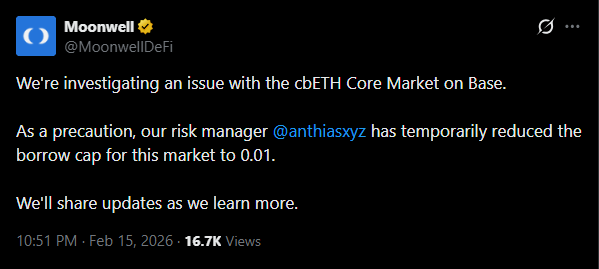
Source: X
This catastrophe was based on a flaw in the Oracle framework that arose when Moonwell submitted a governance proposal on February 15, 2026 around 6:01 PM UTC to enable nascent Chainlink OEV (Oracle Extractable Value) wrapper agreements on its base network markets. The system ignored the fact that to calculate an accurate price of the cbETH in USD, the exchange rate between cbETH and $ETH should have been multiplied by the $ETH/USD price by miscalculating cbETH raw rate/$ETH exchange rate (whose value is approximately 1.12) and represents it as a dollar price.
This error caused a price error of over 99.9, causing cbETH’s on-chain USD valuation to drop significantly from its true market value of nearly $2,200 to an on-chain valuation of approximately 1.12.
Fast liquidations and losses in minutes
Because the price feeds that determine the health of collateral on DeFi lending platforms are real-time, the price distortion immediately caused many positions backed by cbETH to become collateralized. In just four minutes the oracle update had taken place. Bots and automated trustees responded to the erroneous valuation, repaying small debts and withdrawing huge amounts of cbETH collateral at such inequitable terms.
Because Anthias Labs, Moonwell’s risk manager, had set emergency limits on lending and delivering to the affected markets, the system had already documented: 1,779,044.83 bad debts across asset markets; 1,096,317 cbETH liquidated; Additional losses in various assets such as WETH, USDC, EURC and cbBTC, among others.
These secondary effects turned what was initially a misconfiguration of prices in the protocol into a financial drain on the entire protocol.
When updating the code, third-party analysts and Smart Contract auditors also cited development artifacts indicating that some of the faulty code was co-authored by an AI model, namely Claude Opus 4.6. The auditor Pashov, active on social media, highlighted the commitments and suggested that the intervention of AI could have been the reason behind the logical error.
But Moonwell himself has not publicly supported the belief that AI itself caused the error and other critics note that it is the human review and audit process that ultimately caused the error and not the tools applied to create the code.
This fact has raised concerns in the industry regarding the risks and audit responsibility related to AI-assisted encryption, especially regarding mission-critical financial infrastructure, but not every source is convinced that AI caused the exploit in the area.
Managerial response and market impact
After the adventure, the governance community in Moonwell began taking the recovery course. A recovery plan was presented to the protocol’s governance forum, detailing how they would compensate affected users and restructure part of the decentralized autonomous organizational structure (DAO).
Some mitigation measures include setting lending and supply limits at approximately zero in the cbETH market in the meantime, to avoid further negative consequences of the situation under the circumstances of the ongoing governance process.
The incident did not appear to impact markets in the Optimism network as it was limited to the core cbETH market in Base.
One of the strongest weaknesses of the DeFi lending platforms has always been seen as flaws in oracle pricing, as they inject real asset price data into the chain’s logic. This incident is not the first major mispricing incident in recent years and it demonstrates the importance of proper oracle integration for protocol stability.
The industry analysts who evaluated the Moonwell data point out that even minor configuration errors can facilitate outsized financial effects in automated markets, especially when liquidation processes occur without human intervention and within seconds.
A board votes will follow the required five-day time slot set by the DAO’s Moonwell Rules, which prevents in-chain fixes from being made. Community proposals have debated whether compensation should be calculated in the event of their net losses rather than full compensation based on the collateral lost, which is a subtle measure to ensure fairness and sustainability.
It is noted that the incident can be used as a case study of the risk of automated development tools and the irreversible effects of oracle misconfigurations in financial smart contracts, which could encourage other DeFi projects to improve their code review and testing processes.