
Aave users can now borrow against wrapped Ether again via the decentralized finance protocol, as the Kelp DAO exploit recovery plan progresses.
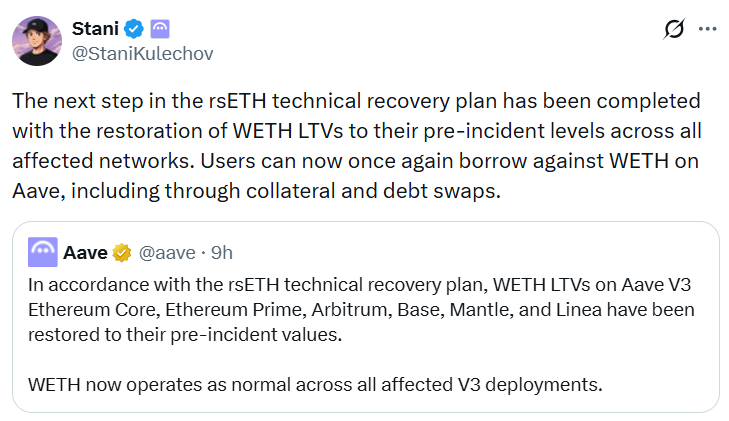
Aave founder Stani Kulechov said in an
“The next step in rsETH’s technical recovery plan has been completed with the restoration of WETH LTVs to pre-incident levels in all affected networks. Users can now once again borrow against WETH on Aave, including through collateral and debt swaps,” Kulechov said.
The temporary freezing of WETH, according to Aave, was a precautionary measure taken in response to the exploit, in addition to the freezing of the rSETH and wrsETH reserves. However, in an administration proposal adopted on Saturday, the protocol states that given the demonstrated progress in recovery, the freeze “can now be lifted without compromising user protection.”
The development marks the final part of “Phase II” of the rsETH recovery plan, which also included restoring rsETH’s support using the Ether frozen after the exploit and donated tokens from the DeFi United coalition and allowing withdrawals.
Source: Stani Kulekhov
Total value locked on Aave after Kelp exploit
Hackers believed to be connected to North Korean state-backed actors stole 116,500 Kelp DAO Restaked Ether tokens from Kelp DAO’s LayerZero-powered bridge on April 18 and then used them as collateral on Aave V3 to borrow wrapped Ether, resulting in approximately $195 million in bad debt on Aave.
According to DefiLlama, the total value (TVL) on Aave dropped by more than $8 billion after the exploit. As of Monday, TVL is about $14.8 billion, up from $23.5 billion in March.
Tom Wan, head of data at consultancy Entropy Advisors, which works with the Arbitrum DAO, said that since the hack, wrapped stETH and wrapped Ether deposits have fallen.
However, there is now more unused Ether liquidity in the system, and the annualized lending rate has fallen to 1.9%, which he said could bring back traders interested in leveraged Ether return strategies.
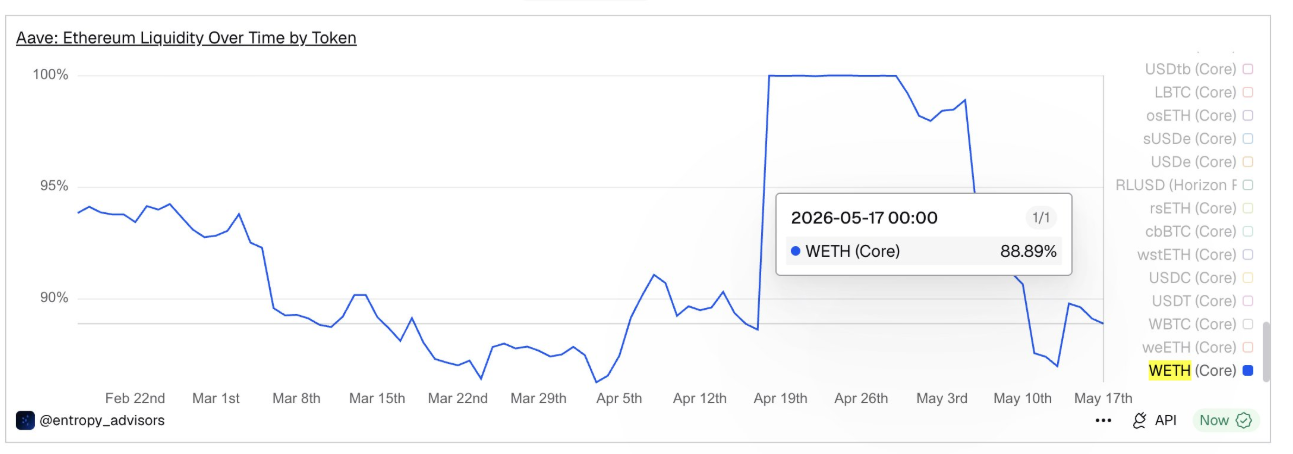
The use of ether has fallen to below 90%. Source: Tom Wan
“$ETH The occupancy rate has fallen below 90% and the APY for loans is now 1.9%. Since the rsETH LZ hack, wstETH and weETH deposits have fallen by $1.2 billion and $1.76 billion respectively,” Wan said.
“With wstETH/weETH on $ETH Is now returning to profitability, the question is whether $ETH demand for the loop returns or if capital remains on the sidelines/flows to Spark/Morpho,” he added.
Kelp sunset bridges rSETH on some networks
Meanwhile, Kelp DAO is also busy with its own recovery efforts. On Sunday, the protocol said it is “consolidating our supported networks to ensure the highest security standards for rsETH based on usage and integrations,” by discontinuing rsETH bridging in select networks after June 15, including Optimism, HyperEVM, Unichain, Avalanche and MegaETH.
After the deadline, recovering the money costs 100 $USDC ($USDC) per address, according to Kelp.
Earlier this month, Kelp DAO migrated its reprized token, rsETH, to the Chainlink oracle platform, while continuing to blame the attack on the cross-chain infrastructure of LayerZero, the previous provider.