
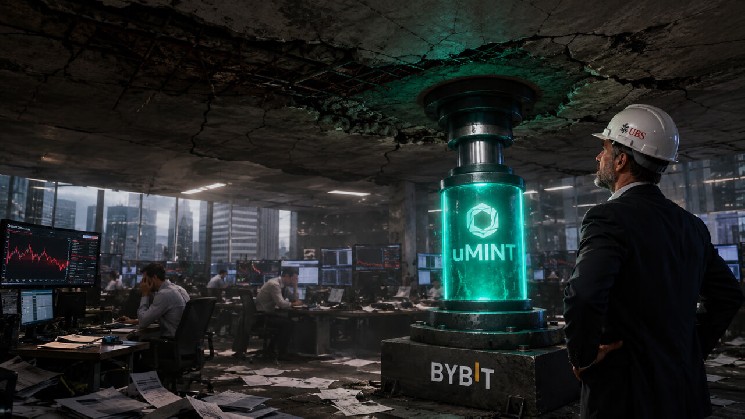
Calais Digital Assets has converted UBS uMINT collateral into a live trading workflow on Bybit, giving tokenized money market funds a concrete margin use case rather than a new issuance milestone.
The setup runs across Bybit, ByCustody and DigiFT, with the uMINT position remaining in escrow while being recognized as stock exchange collateral.
The June 18 bet is important because collateral that would normally sit in the form of idle cash or cash equivalents can still generate money market returns while supporting trading activity.
For tokenized real-world assets, the discussion shifts from issuance volume to market plumbing. The question is whether these instruments can become useful enough to replace unused margins within real trading transactions.
How UBS uMINT collateral works on Bybit
Calais, a quantitative investment fund headquartered in Singapore, uses UBS uMINT as collateral for off-exchange settlement on active trades.
The off-exchange collateral transaction goes through a three-party setup: DigiFT provides regulated access and distribution for uMINT, ByCustody holds the asset, and Bybit accepts the held position as collateral on its exchange infrastructure.
That changes the economics of the margin. Traditional collateral arrangements often require a trader to park cash, stablecoins, or other eligible assets in a form that protects the trading platform while limiting what the fund can earn on those assets.
In DigiFT’s description, Calais can maintain exposure to a money market product while using that same position to support trading.
The distinction is operational rather than cosmetic. A tokenized fund that exists on-chain is only useful as a settlement asset if venues, custodians, distributors and legal structures agree on how it can be held, valued and controlled.
A tokenized fund that can also meet the exchange’s collateral requirements begins to behave more like a working balance sheet instrument.
The equation is the core claim of capital efficiency. The tokenized position can be recognized by an exchange while remaining within a custody agreement designed for institutional use.
That’s where the implementation goes beyond another RWA announcement and becomes a live test of RWA collateral within the foreign exchange margin infrastructure.
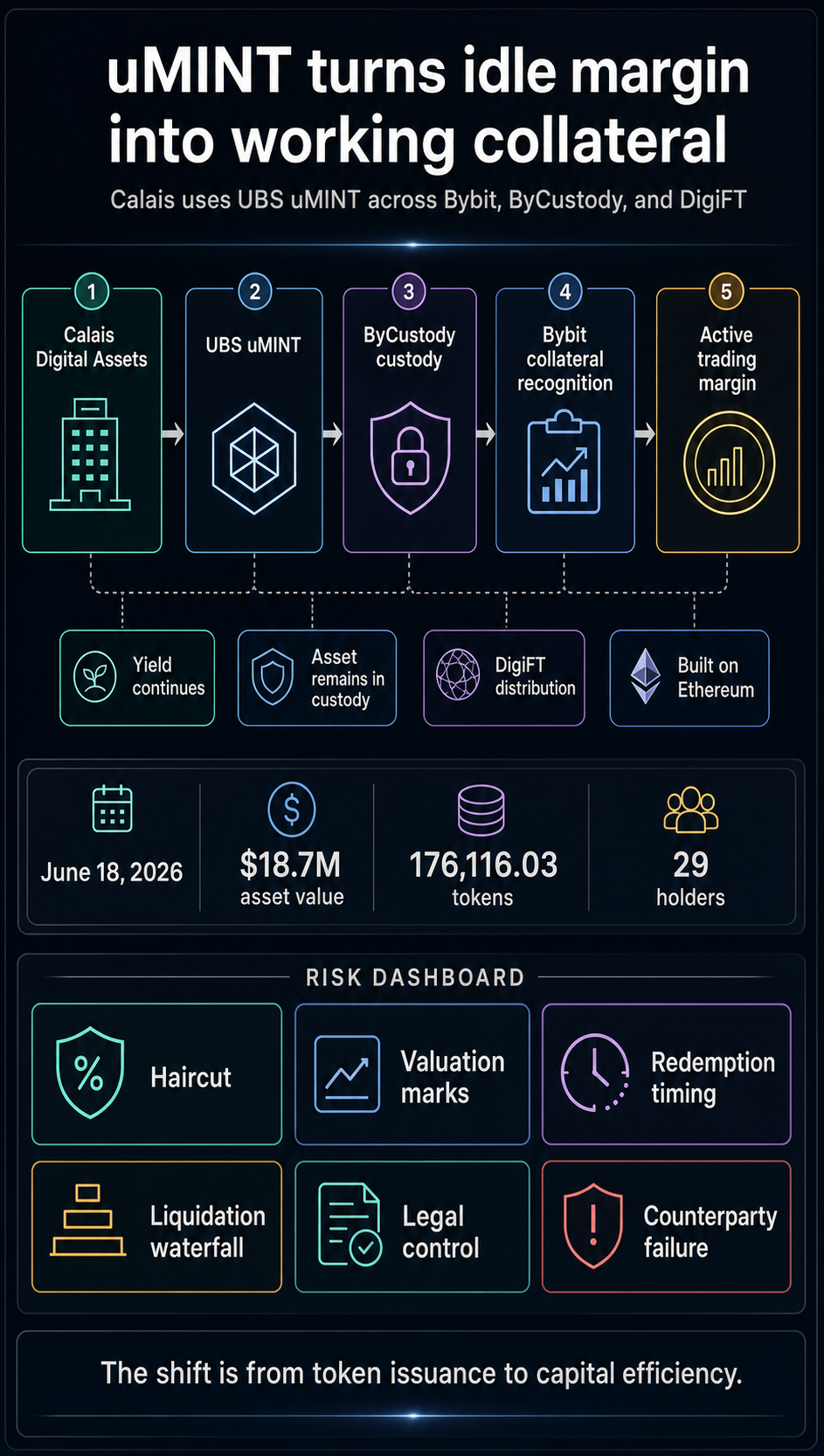
It also shows why just issuing tokens is just the first layer. The trade requires that a distributor, custodian and exchange agree on custody, recognition and operational control before the fund position can effectively function as collateral.
The rails and the shell
The deployment in Calais follows earlier plumbing work. In October 2025, Bybit, DigiFT and UBS uMINT introduced institutional access to collateral for the tokenized fund.
That earlier announcement laid the foundational institutional premise: shares of UBS’s tokenized money market fund, distributed via DigiFT, could be used as collateral on Bybit.
In November 2024, uMINT was launched as UBS’s first tokenized investment fund. UBS described the UBS USD Money Market Investment Fund Token as a money market investment built on Ethereum distributed ledger technology.
The product is designed to give token holders access to institutional-quality cash management, backed by high-quality money market instruments.
These details are key because uMINT is positioned as a conservative cash management exposure rather than a volatile crypto margin exposure.
Calais’ use case is about capital efficiency: a fund wants collateral that remains suitable for trading activities while remaining productive on the balance sheet.
Crypto has already covered the original uMINT launch and the wider version trend towards becoming tokenized income products more than passive ownership.
The new step is the specific workflow for exchange margins. The live connection is that an institutional trading client is now using the fund token as recognized collateral within a Bybit, ByCustody and DigiFT stack.
The current size of uMINT still calls for restraint. The uMINT asset page identifies UBS USD Money Market Investment Fund Token as a US Treasury asset on UBS Tokenize, with UBS Asset Management (Singapore) Ltd. as the administrator and Ethereum as the original ERC-20 network.
As of June 21, the total asset value was approximately $18.7 million, 176,116 tokens and 29 holders.
These figures ensure that the product lives early. They demonstrate a truly tokenized money market product with visible on-chain scale, connected to an institutional collateral workflow, while widespread adoption and standardization across crypto platforms remains to be seen.
The business problem is in the market structure and not the price action. Crypto’s aggregated market pages can provide broad context for the size of the crypto market, but the operational driver is whether tokenized funds can be made useful within repeatable trading processes.
These processes include custody, collateral recognition, settlement, valuation, liquidity and risk management.
If the model spreads, the impact would be practical. Funds would have a stronger path to holding yield-bearing cash management products while posting trade collateral.
Exchanges could compete on the quality of the assets they consider margin, as well as liquidity and fees. Custodians and distributors would become part of the trading stack, rather than just the post-trade infrastructure.
The difficult questions are still in the margins
The same features that make the Calais setup interesting also leave a number of unresolved questions. Public details released for the implementation omit the haircut Bybit applies to tokenized money market fund collateral, the valuation source, the frequency of collateral markings, and the liquidation waterfall if losses exceed the redemption or transfer processes.
The timing of liquidity is another pressure point. Money market funds are designed for cash management stability, but may behave differently than stablecoins in the face of rapid exchange rate stress.
RWA.xyz’s product page lists subscription and redemption fields, while trading firms still need to understand what happens when margin calls, exchange rate risk systems and fund liquidity windows collide.
Legal treatment is just as important. Separate custody can limit the risk of a particular location, while questions of bankruptcy, control, and enforceability remain when multiple parties are involved.
A fund using this structure still needs trust about who can move collateral, under what circumstances, and what happens if the exchange, custodian, distributor or other intermediary fails.
Eligibility will also determine adoption. DigiFT’s materials state that the product and services are only available through authorized and regulated intermediaries to eligible investors.
This indicates a professional and institutional approach before using retail margins. If the model expands, it will likely do so first through qualified customers, approved custodians and location-specific collateral rules.
The Calais implementation is best read as a first-customer implementation with meaningful implications. It shows a concrete path from token issuance to trading utility: a UBS money market token distributed via DigiFT can sit in ByCustody and still count as collateral on Bybit.
The commitment reaches a pain point that institutions understand. Idle margin is expensive. Yield-bearing collateral is attractive.
But the model will only become sustainable if operational controls can survive the moments when collateral matters most: market volatility, forced deleveraging, liquidity stress and counterparty failure.
The next signal is whether more funds, more eligible assets and more locations adopt similar terms with transparent haircut, redemption, custody and liquidation rules.
Until then, the Calais trademark stands as a living proof point for tokenized money market collateral, and a reminder that the real test for RWAs is whether they can do useful work once they come on chain.