
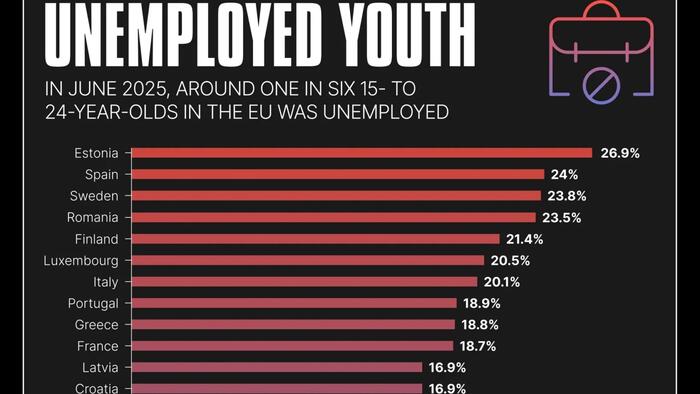
Breaking into the workforce looks very different depending on where you live in Europe. While some countries have relatively smooth transitions from education into employment, others continue to struggle with stubbornly high youth unemployment.
This visualization, created by DataPulse Research via Visual Capitalist, uses Eurostat data alongside additional analysis from DataPulse Research to compare unemployment rates among 15- to 24-year-olds across the EU in June 2025. Under Eurostat’s methodology, unemployed young people are those actively seeking work and available to start within two weeks.
Europe’s Youth Employment Divide
The table below ranks youth unemployment rates across EU member states in June 2025.

The spread is striking. Estonia’s 26.9% rate is more than four times Malta’s 6.2%, highlighting how dramatically employment prospects can differ across the bloc even as the EU-wide average remained steady at 14.8%.
Southern European countries continue to feature many of the highest rates of youth unemployment, with Spain (24.0%), Italy (20.1%), Portugal (18.9%), and Greece (18.8%) all posting elevated numbers. France also remained above the EU average at 18.7%, while Nordic economies presented a mixed picture, with Finland and Sweden ranking among the highest despite generally strong labor markets.
Why Are the Gaps So Large?
Youth unemployment reflects more than the health of an economy. Structural factors such as education-to-work transitions, labor market regulations, skills mismatches, and regional economic differences all influence how easily young people secure their first job. Research has long shown that these structural differences help explain why some European countries consistently experience higher unemployment than others.
Spain illustrates this complexity. Although the country continues to record one of Europe’s fastest-growing economies, youth unemployment remains among the continent’s highest, partly due to skill mismatches and regional labor market frictions.
At the same time, Spain has expanded pathways for international workers through new visa programs aimed at attracting talent in sectors facing labor shortages. Similar initiatives are appearing elsewhere in Europe as governments attempt to address demographic pressures and reduce hiring bottlenecks.
Why Some Countries Perform Better Than Others
Countries such as Germany (6.3%), Malta (6.2%), and the Netherlands (8.7%) have benefited from tighter labor markets, strong vocational training systems, and robust employer demand for apprentices and skilled workers. These economies have generally been more successful at connecting education with employment, reducing the time many young people spend searching for their first job.
The uneven outlook also helps explain broader migration trends across Europe, as workers often relocate in search of stronger employment opportunities, contributing to Europe’s shifting talent landscape.
To explore more global demographic and migration trends, check out Ranked: Countries With the Fastest Immigration Growth (2019–2024) on the Voronoi app.