
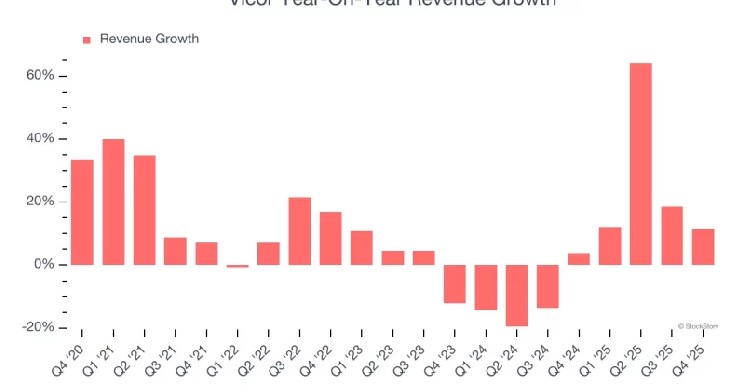
Vicor Corporation just bumped its second-quarter 2026 revenue guidance to $142 million, up from the $126 million it projected barely a month ago. That’s a $16 million upgrade in five weeks, driven by stronger product sales and a fresh stream of royalty income from a new licensee of its patented power conversion technology.
For a company that makes the kinds of power modules most people never think about, the kind buried inside data center racks and defense systems, that’s a meaningful jump. It suggests demand isn’t just holding steady. It’s accelerating.
The numbers behind the revision
The original $126 million guidance was issued on April 21, 2026, alongside Vicor’s first-quarter results. At that time, the company also laid out a full-year revenue target of approximately $570 million. The Q2 bump to $142 million suggests the annual figure could climb higher too, though Vicor hasn’t officially revised its full-year outlook yet.
Here’s the thing about the $142 million number: it’s not just about selling more units. Part of the increase comes from royalty income tied to a new licensee of Vicor’s patented power conversion technologies. In English: someone else is now paying Vicor for the right to use its inventions. That’s the kind of revenue that shows up with essentially zero manufacturing cost, which makes it particularly attractive from a margin perspective.
The company’s backlog tells an equally compelling story. After Q1 2026, Vicor reported a one-year backlog of $300.6 million. Its book-to-bill ratio exceeded 2.0, meaning the company is booking more than twice as many orders as it’s shipping. A ratio above 1.0 is generally considered healthy. Above 2.0 is, well, the kind of problem most companies wish they had.
That backlog number is worth sitting with for a moment. At $300.6 million, it represents more than half of the company’s full-year revenue target. It means Vicor isn’t just hoping demand materializes. A significant chunk of future revenue is already spoken for.
What’s driving the demand
Vicor operates in the power electronics sector, specifically designing and manufacturing modular power components that convert electricity from one form to another. Think of it as the plumbing of the electronics world: unsexy but absolutely essential. Their modules show up in AI data centers, electric vehicles, aerospace applications, and defense systems.
The company has built its competitive moat around proprietary power conversion architectures. These aren’t commodity chips. Vicor’s technology enables higher power density and efficiency in smaller form factors, which matters enormously as computing workloads get more power-hungry. When an AI server rack needs to cram more processing power into less space, the power delivery system becomes a critical bottleneck, and that’s exactly where Vicor plays.
The new royalty income adds another dimension to the business model. Licensing intellectual property allows Vicor to monetize its technology portfolio without taking on additional manufacturing complexity. It’s the semiconductor industry’s version of getting paid while you sleep. And the fact that a new licensee has signed on suggests Vicor’s patents are becoming harder for competitors to design around.
One wrinkle worth noting: CEO Patrizio Vinciarelli sold 4,000 shares on April 24, 2026, just three days after issuing the original $126 million guidance and before the upward revision. Insider sales happen for all sorts of mundane reasons, including tax planning, diversification, and estate management. But the timing will inevitably draw scrutiny from investors who watch these transactions closely.
What this means for investors
Look, a $16 million guidance increase in a single quarter isn’t going to rewrite Vicor’s entire investment thesis overnight. But it does reinforce a trajectory that’s been building for a while. The combination of accelerating product sales, expanding royalty income, and a backlog that keeps growing tells a consistent story about a company gaining share in markets that are themselves expanding.
The book-to-bill ratio above 2.0 is particularly notable because it suggests the demand runway extends well beyond this quarter. Companies don’t typically book orders at twice their shipping rate unless there’s genuine urgency from customers. In the power electronics space, that urgency is largely being driven by the buildout of AI infrastructure, where power delivery is increasingly the constraint that determines how fast new capacity can come online.
The royalty income component deserves extra attention from anyone modeling Vicor’s future margins. Product revenue requires manufacturing, which means cost of goods sold, supply chain management, and capacity constraints. Royalty revenue requires a legal team and a patent portfolio. The gross margin differential between those two revenue streams is enormous, and as licensing income grows as a percentage of total revenue, it could meaningfully improve Vicor’s overall profitability profile.
The risk side of the equation hasn’t fundamentally changed. Vicor operates in a competitive market where larger players like Texas Instruments and Analog Devices have deeper pockets. The company’s premium positioning works as long as customers believe the performance advantages justify the cost. If competitors close the technology gap, or if AI infrastructure spending slows, the demand picture could shift. But for now, a backlog of $300.6 million and guidance revisions that keep moving in one direction suggest those risks are theoretical rather than imminent.