

Despite broad market weakness and waves of forced liquidations in crypto, DeFi’s Total Value Locked (TVL) has proven surprisingly resilient – a signal that traders are still trying to generate returns despite the bearish sentiment sweeping the crypto market.
Over the past week, crypto majors have sold BTC, $ETHXRP and SOL fell to multi-year lows $ETH is now losing 21% of its value in the last seven days alone.
But that decline did not translate into an outflow from DeFi protocols. Total value locked up fell from $120 billion to $105 billion, a decline of 12% as it outperformed the market.
The 12% decline can be attributed to falling asset prices, rather than yield farmers rushing for the exit. The amount of ether staked in the DeFi market has increased from 22.6 million $ETH at the beginning of the year to 25.3 million, with 1.6 million $ETH according to DefiLlama, added this past week alone.
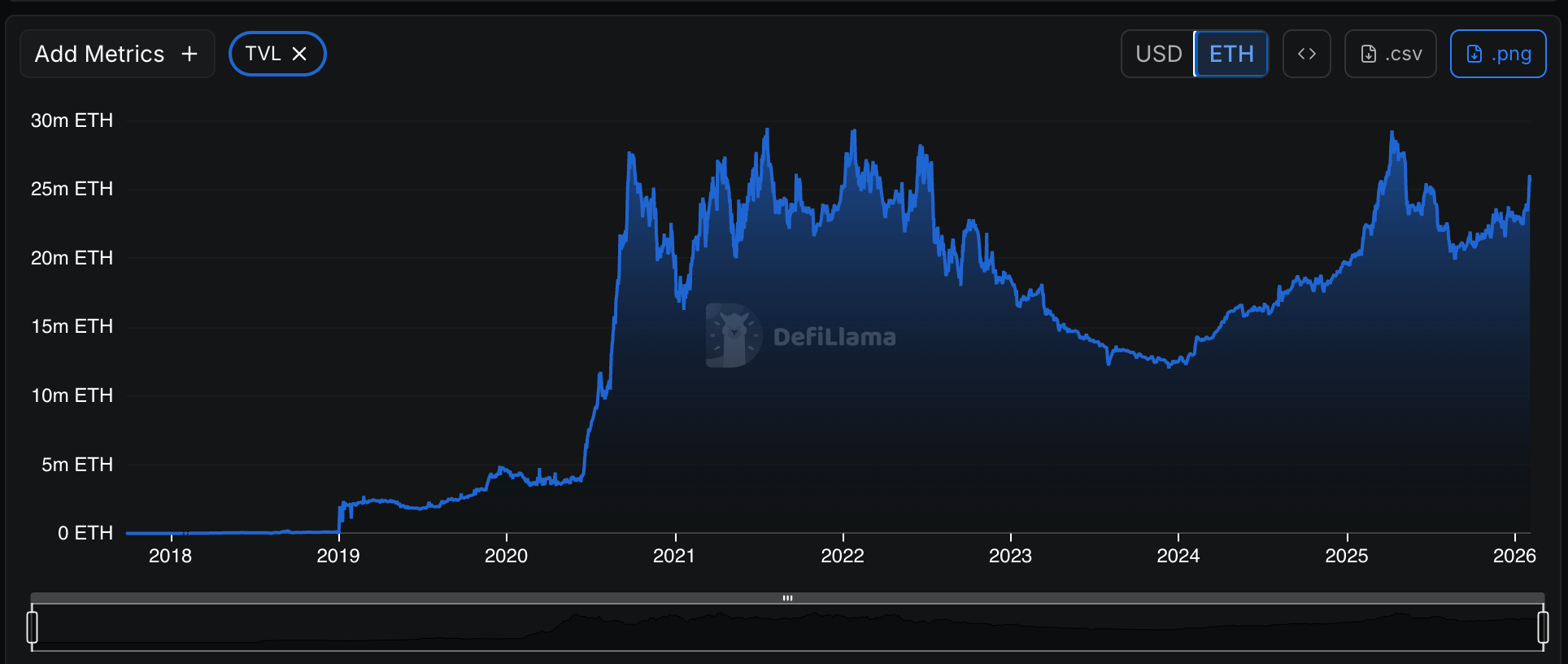
Ether Stakes Chart (DefiLlama)
Onchain liquidations muted
In February last year, the crypto market experienced a similar decline following the rise of Donald Trump to become US president. Back then, the DeFi market was much more vulnerable, with a massive string of $340 million in onchain liquidations about to be triggered.
This time around, the DeFi market is better collateralized, with only $53 million in liquidable positions within 20% of the current price. Positions on the Compound algorithmic interest rate protocol are only at risk if: $ETH falls below $1,800, although the biggest danger zone is between $1,200 and $1,400 – which contains $1 billion in liquidable positions, DefiLlama data shows.
Resilience shows a maturing sector
In previous cycles, the DeFi market was the first to implode. In 2022, investors succumbed to overly tempting returns on the Terra blockchain by deploying the algorithmic UST stablecoin, only for the entire ecosystem to collapse months later amid a market downturn that reduced the value of the crypto assets backing the stablecoin.
This led to contagion across all DeFi markets, with TVL falling from $142 billion to $52 billion between April and June of that year.
This time, downside risk is minimal, returns are stable and inflows are quietly increasing – suggesting the sector has matured against a backdrop of institutional adoption and broader market volatility.