
Key Takeaways
- Gao Tianyun outlined a 3,000-km carrier targeting concept challenging U.S. standoff strategy.
- National University of Defense Technology proposed layered tracking to pressure U.S. defenses.
- Guam’s buffer may shrink as Chinese sensors improve, shaping future Pacific naval planning.
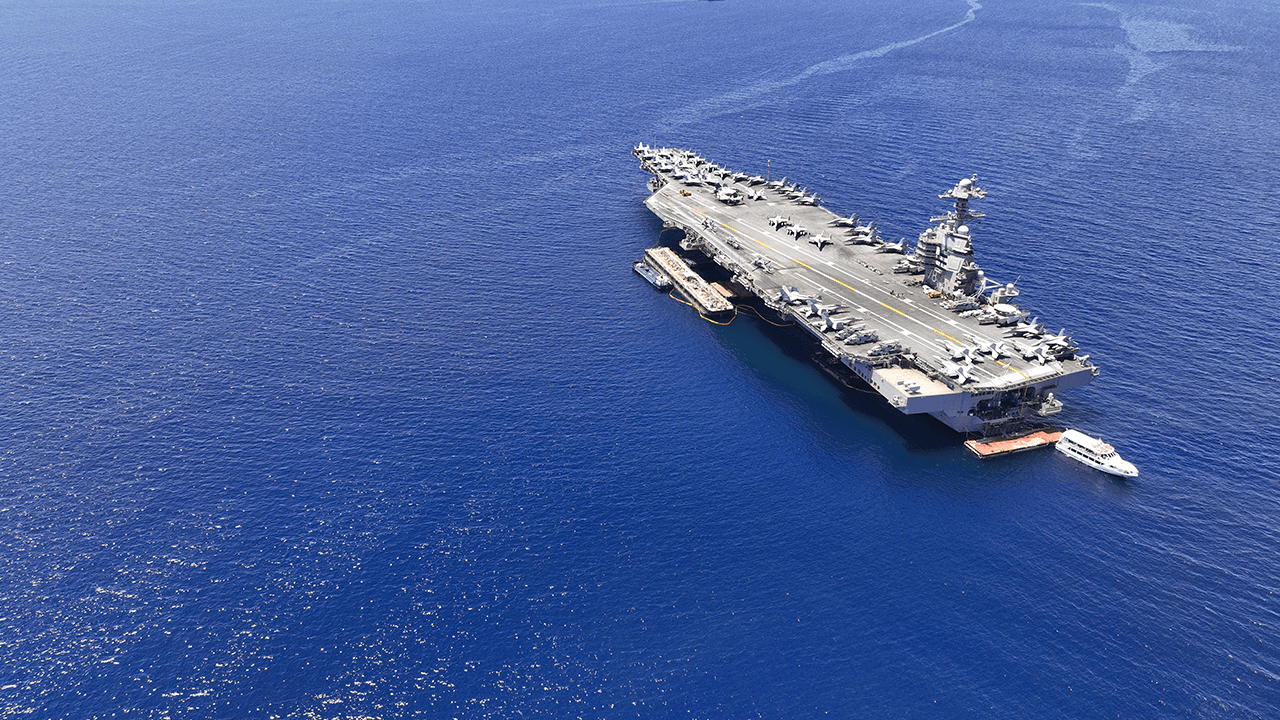
At Midway in 1942, distance was supposed to buy the Japanese time. Eight decades later, the Pacific’s geometry is back at the center of US-China strategy, as Washington leans on dispersion and standoff range to keep carrier strike groups harder to hit. A new Chinese military study from Gao Tianyun at the National University of Defense Technology in Nanjing sketches how a carrier could be tracked and attacked from 3,000 kilometers away, roughly Shanghai to Guam, by fusing satellites, drones, radar aircraft, submarines, ships, and signal intelligence. Read less as a proof of today’s kill chain and more as a warning shot, it argues that pushing big-deck assets farther out may change the problem, not solve it.
A historical lens on distance and naval warfare
There is a comforting logic to pushing high-value assets farther from danger. The U.S. Navy has leaned on that logic before, and so have its rivals. During the Battle of Midway in 1942, Japan counted on distance and dispersion to shape the fight. The U.S. read the plan, closed the gap, and turned that spacing into a trap. Distance helped, until it didn’t.
That old lesson is resurfacing in a thoroughly modern debate: whether an aircraft carrier’s best defense is simply operating farther out in the Pacific, beyond the presumed reach of China’s missiles and sensors. The technology has changed. The question has not.
The U.S. strategy of distance for defense
As China’s missile forces and surveillance networks have expanded, U.S. planners have increasingly treated geography as a layer of protection. The idea is straightforward: if carriers and their escorts operate farther east, China has fewer options, less time, and more uncertainty when trying to track and strike a moving target.
This is also why places like Guam matter so much in American strategy. They anchor logistics, airpower, and command links, while sitting at ranges that historically looked like a buffer. But buffers tend to shrink as sensors improve.
China’s blueprint for targeting 3,000 km away
A recent Chinese military research paper puts that shrinking buffer front and center. The study, led by Gao Tianyun at the National University of Defense Technology, describes a concept for attacking a U.S. carrier strike group from 3,000 kilometers (1,864 miles) away, roughly the span between China’s coast and Guam.
Per the paper’s outline, the focus is not a single “wonder weapon,” but a layered targeting chain: find the carrier, keep it continuously tracked, then fire coordinated salvos meant to arrive from multiple directions. The defensive picture it wants to stress-test is familiar to U.S. sailors, built around escort ships with Aegis and close-in systems like CIWS, plus electronic warfare and decoys.
Challenges on China’s side, and the message to Washington
Pulling this off at extreme range is harder than the headline suggests. Hitting a fast, maneuvering target requires precise, real-time updates and tight coordination across satellites, aircraft, ships, and submarines, all while the U.S. tries to jam, deceive, and shoot back. Can any military guarantee that kind of choreography under fire?
That is why the paper reads as much like signaling as engineering. The implicit point to Washington is crisp: moving carriers farther away changes the problem, but it does not make it disappear.