

The decentralized finance (DeFi) world is starting to reward actual profits. Hyperliquid, Pump.fun, and EdgeX have collectively distributed approximately $96.3 million to token holders over the past 30 days.
The trend showed that investors are starting to look at protocols that generate and share real revenue, and not just promises of growth, high transaction speeds or inflated user activity statistics.
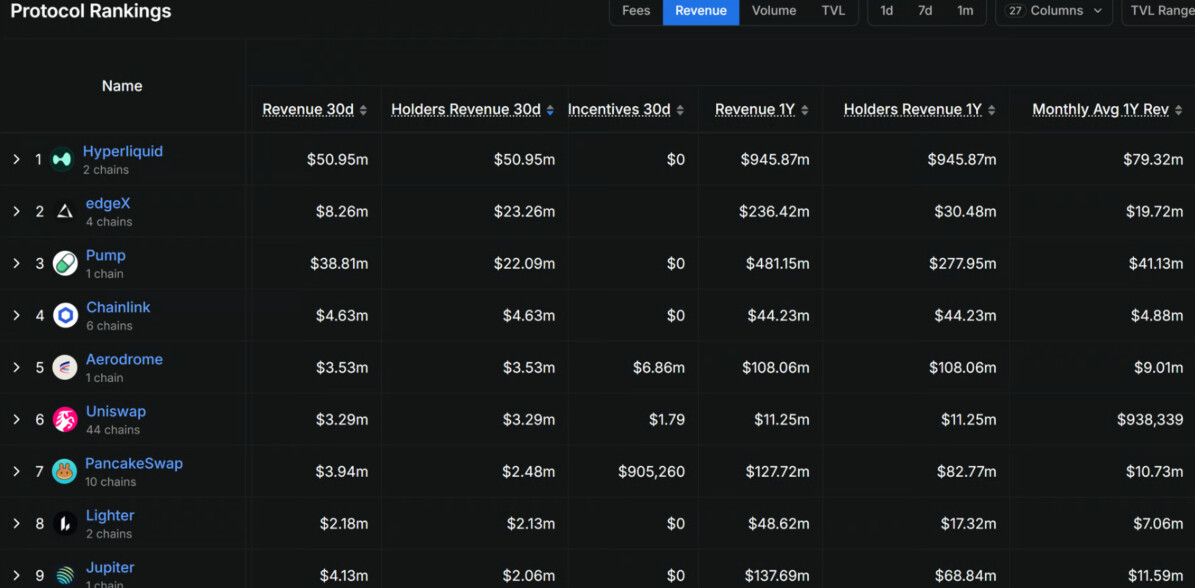
Data from DefiLlama shows that Hyperliquid led the group and distributed $50.95 million in full to its users. Pump.fun followed with $22.09 million in payouts, compared to $38.81 million in revenue.
On the other hand, EdgeX reported $23.26 million in protocol revenue, up from $8.26 million, suggesting a reserve or other funding source to pay the benefits. The numbers mark a growing shift in the crypto sector.
Why are DeFi investors focusing on revenue now?
For years, DeFi products competed with each other on metrics such as TVL, daily users, and transaction throughput. But as traders turn away from long-term commitments to sustainable business models, market sentiment is changing.
Robbie Klages recently summed up the new mood in the market by saying that investors no longer care whether a blockchain handles “10x the TPS” if it can’t earn. His comments are part of a broader vision that DeFi initiatives are now seen more as businesses than experimental crypto networks.
A tougher market has also driven investors to places where they can visibly see income. It also means that, as competition increases and we don’t want to be speculators, protocols without solid revenue models risk being seen as ventures without a clearly defined path to success. The magnitude of the trend is also illustrated in annual figures.
Hyperliquid generated approximately $945.87 million in annual revenue, with holders receiving all of this. Pumping fun earned $481.15 million annually, and EdgeX reached $236.42 million. Token holders are increasingly seeking direct economic value from the protocols they support, making this transition a key one.
Instead of hoping that token prices will rise based purely on speculation, many investors are now looking to platforms that share revenue, such as paying dividends or buybacks, as we do in the traditional financial world.
How do established DeFi platforms compare to each other?
The latest data also shows how emerging DeFi apps are gradually competing with some of the leading names in the industry. Chainlink delivered $4.63 million to token holders during the same period, while Aerodrome returned $3.53 million. Uniswap distributed $3.29 million across 44 blockchain networks.
On the other hand, PancakeSwap generated revenue of $3.94 million but paid out only $2.48 million to holders after spending approximately $905,260 on incentives. It is now critical to distinguish between monetization and actual distribution.
Some protocols spend lavishly on incentives to attract liquidity and users, while others return them directly to token holders. That division could impact how investors evaluate DeFi projects in the future.
A protocol with lighter trading but stronger cash payouts can become even more attractive to investors than a protocol with higher trading volumes but weaker profits.
It is also clear that younger platforms are challenging older DeFi brands, with newer brands offering clearer economic benefits to their communities.
Will DeFi become a real financial infrastructure?
The DeFi revenue conversation follows the sector’s rapid growth due to speculation and memecoin trading. In his latest blog post, Andre Cronje said that by 2026, DeFi will increasingly look more like a functional financial infrastructure than an experimental crypto niche.
He cited a skyrocketing sector market of stablecoins, worth more than $320 billion today, led by companies like Tether and Circle. He also pointed out that decentralized exchanges handle more than $160 billion in spot trading volume monthly and perpetual decentralized exchanges handle approximately $540 billion in monthly activity.
Cronje said several lending platforms, including Aave, Morpho and Maple Finance, now manage about $28 billion in active loans. This is a new type of asset collateral that is more directly linked to real-world assets and is increasingly used as collateral across the chain. The bigger point is that DeFi could be entering a more mature stage.
Some protocols are now beginning to function more as money-generating financial networks with measurable business performance than as speculative networks. However, sustainability will be the next challenge.
Investors will be keeping a close eye on whether these protocols can generate strong revenues without relying on token incentives or aggressive growth campaigns.