
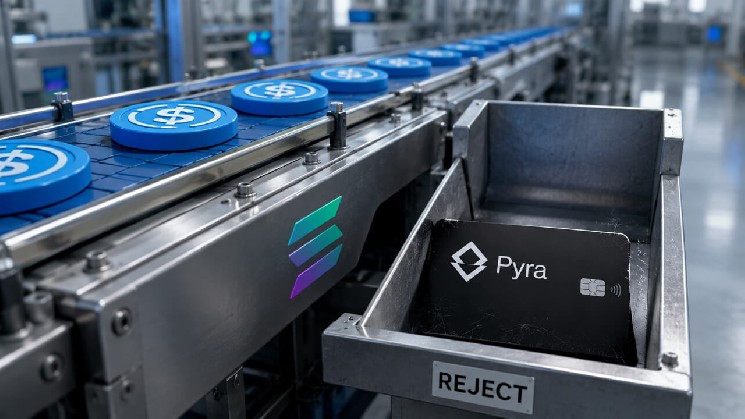
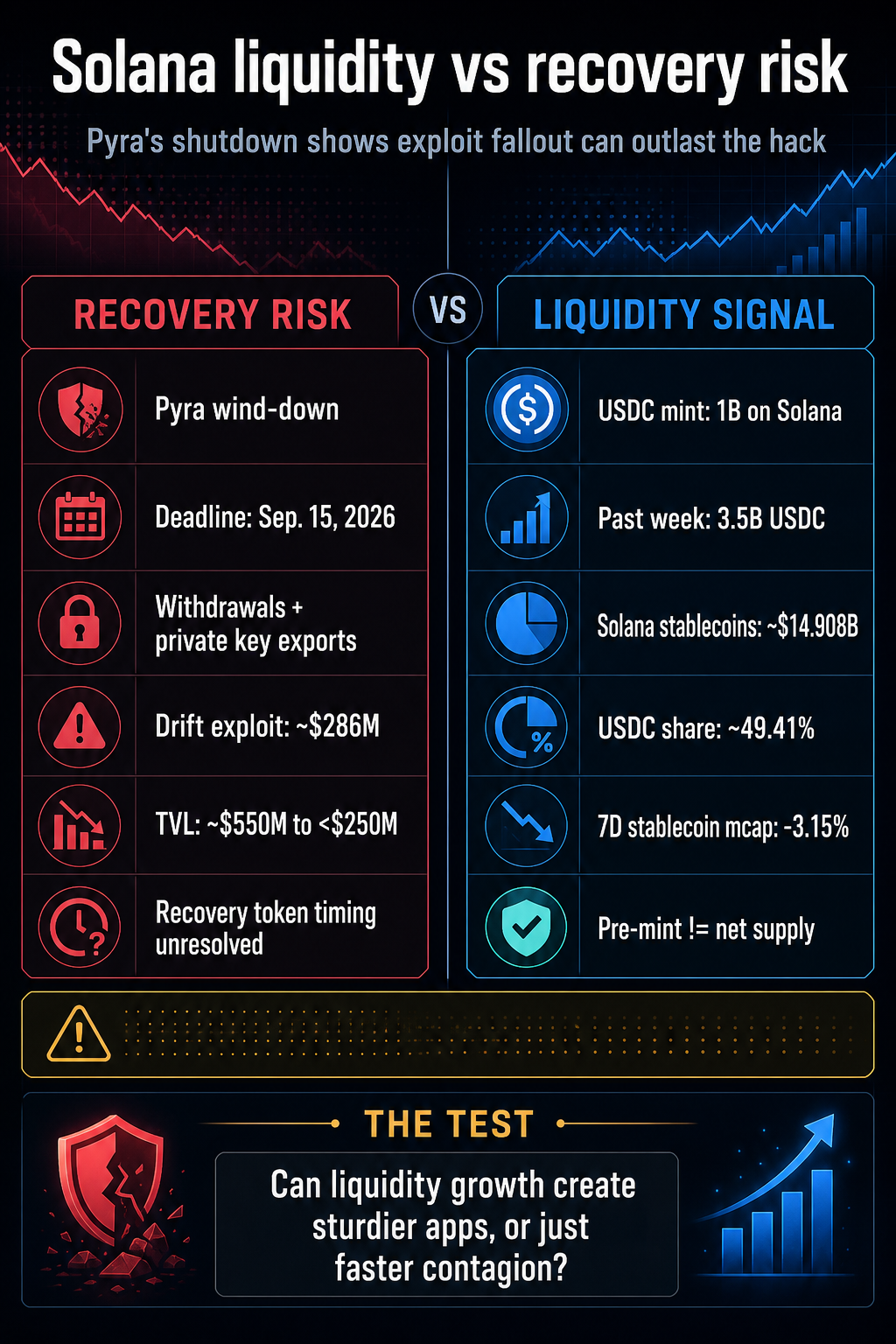
As a result of the Drift exploit, crypto payments platform Pyra has stopped accepting new users, canceled existing payment cards, and says withdrawals and private key exports will remain available through a web portal until September 15, 2026, according to Pyra’s shutdown announcement.
Pyra also plans to use that portal to facilitate future Drift recovery token distribution once those tokens become available.
Pyra’s shutdown shows how exploit damage can persist in a consumer-facing product long after the first loss estimate, postmortem, or recovery proposal.
In contrast, Solana received a very different signal from the stablecoin side of the market: Circle pre-minted another 1 billion $USDC on Solana, bringing reported Solana $USDC issuance over the past week to 3.5 billion, according to Lookonchain and a WEEX relay.
Pyra is still absorbing the operational consequences of the Drift attack, while the network’s dollar rails continue to draw large issuance signals. Reported issuance points to continued demand for liquidity. Recovery remains unresolved.
A shutdown with a user deadline
Pyra’s shutdown adds a consumer layer to the fallout from Drift. The platform’s cards have been canceled, new onboarding is paused, and the remaining user path now focuses on withdrawing assets or exporting private keys before the September deadline.
That kind of wind-down creates a different risk profile than the exploit itself. A protocol hack is immediately and measurably apparent once the stolen assets are traced.
A product shutdown extends the incident into months of offboarding, account access, communication, potential future recovery token logistics, and user support.
For anyone who used Pyra as a payment product rather than a trading venue, the failure raises a practical question: can they regain access and preserve their claims before the portal closes?
The April 1 Drift exploit was a suspected DPRK-linked attack worth roughly $286 million, according to Elliptic.
The blockchain-intelligence firm said Drift’s total value locked fell from about $550 million to under $250 million after the incident, and that the attacker swapped the stolen assets for $USDC on Solana before bridging the funds to Ethereum.
The exploit did not stay confined to a protocol balance sheet. It left Pyra users facing a product shutdown, a portal deadline, and unresolved questions about recovery tokens after months of attempted recovery.
Pyra’s wind-down is one of the clearest examples of that downstream damage.
Drift’s own April recovery update described $295 million in outstanding user losses over time and a framework centered on a recovery pool, a dedicated recovery token separate from DRIFT, and Tether support.
Pyra’s plan to facilitate future recovery-token distribution through its portal fits into that unfinished recovery layer, but it does not answer the harder questions about timing, token economics, transferability, or how much users will ultimately receive.
The user consequence is therefore concrete but incomplete. Pyra has set a date for withdrawals and private key exports. It has not, based on the available record, turned Drift recovery into a settled payout path.
The liquidity signal needs caveats
The $USDC mint report runs counter to Pyra’s closure. Circle’s token is one of crypto’s core settlement instruments, and large Solana mint activity is normally read as a sign that the chain may need more dollar liquidity.
$USDC is backed by highly liquid cash and cash-equivalent assets, is redeemable 1:1 for US dollars by eligible users, and is natively supported on Solana, among other networks, according to Circle. Crypto’s market data places $USDC near a $75 billion market capitalization, while Solana sits near a $43 billion market capitalization.
Crypto’s aggregate market page also places both assets among the largest crypto assets by market capitalization.
Solana’s own ecosystem data also supports the idea that the network’s financial activity remains substantial. Stablecoin supply crossed $16.4 billion during May, and Solana-based perpetuals venues reached $64.6 billion in monthly volume, according to the Solana Foundation.
Those figures are consistent with the network’s role as a high-throughput settlement venue for trading, payments, and DeFi activity.
Circle has explained that Solana uses pre-mint mechanics, in which $USDC can exist at a pre-mint address before being authorized for circulation.
That means a reported gross mint or issuance signal should not be treated automatically as net new circulating supply.
The same caution appears in DeFiLlama’s live Solana stablecoin dashboard. When accessed on June 16, it showed a Solana stablecoin market cap of about $14.9 billion, $USDC dominance of around 49.4%, and a seven-day decline in Solana stablecoin market cap of nearly 3.15%.
In other words, the reported mint can still function as a liquidity signal, while the chain-level supply picture was mixed at that snapshot.
Solana can remain a large venue for dollar settlement while still carrying unresolved app-level recovery risk.
The network can process capital quickly, but speed and liquidity alone do not create better offboarding, clearer recovery tokens, or stronger controls for users left behind after a protocol failure.
Recovery risk now sits beside growth
The Drift fallout has already been tied to stablecoin settlement dynamics. Crypto previously reported that Tether’s proposed support package for Drift could challenge Circle’s grip on Solana payments and move Drift settlement from $USDC toward USDT.
The recovery dispute therefore extends beyond user reimbursement and into the question of which stablecoin infrastructure will be trusted after a large failure.
Pyra’s shutdown is best read beside that market backdrop. The available data shows a large, currently stable, stablecoin supply, recent gross $USDC issuance signals, and mixed short-term Solana stablecoin market-cap movement.
It also shows a consumer-facing payments app closing with a fixed user offboarding deadline.
Liquidity answers whether capital can arrive, move, and settle. Resilience answers the question of whether users can survive a failure without being pushed into months of uncertainty, platform shutdowns, portal deadlines, and unresolved recovery claims.
Solana’s large stablecoin base can improve the first answer while leaving the second one exposed.
The next test is whether Solana’s reported issuance signals and substantial stablecoin supply translate into more durable user-facing financial products. If they do not, faster dollar rails could accelerate both growth and contagion.
For Pyra users, the immediate answer is operational: withdraw assets, export keys, and monitor any Drift recovery token distribution before the portal deadline.
For the broader Solana market, the signal to watch is different: whether large stablecoin issuance is matched by stronger recovery design, clearer user claims, and fewer app shutdowns after the next major exploit.