

Oracle provider RedStone has launched its price feed infrastructure on the Stellar network, introducing a new data layer for decentralized finance (DeFi) applications on a blockchain that has historically focused on payments and stablecoin transfers.
The implementation makes price feeds for major crypto assets and stablecoins available on the Stellar mainnet, including Bitcoin (BTC), Ether (ETH), USD Coin ($USDC) and PayPal USD (PYUSD). The rollout also includes pricing data for the Franklin Templeton BENJI tokenized money market fund.
RedStone said the feeds are designed to support financial applications such as credit markets, decentralized exchanges (DEXs) and tokenized real-world asset (RWA) platforms that build on Stellar.
The launch adds a new infrastructure provider to Stellar’s emerging DeFi stack as developers experiment with lending, tokenized assets and on-chain financial services.
Stellar is expanding its DeFi infrastructure
RedStone said the price feeds rely on an anomaly-based update system and freshness checks intended to ensure data accuracy for financial applications.
“Stellar has long proven its strength as a blockchain for real-world financial activities, especially in the areas of payments and stablecoins,” Marcin Kazmierczak, co-founder of RedStone, said in a statement.
He added that an enterprise-level oracle infrastructure was “what was missing” for the network to unlock more advanced financial applications.
Related: ‘ClickFix’ Hackers Posing as VCs and Hijack QuickLens in Latest Crypto Attacks
RedStone operates in a competitive oracle market dominated by Chainlink. DeFiLlama data shows that Chainlink has about 64% of the market by value, followed by Chronicle with 11%.
Internal protocol oracles account for about 6%, while Pyth and RedStone hold about 5.8% and 5.5% respectively.
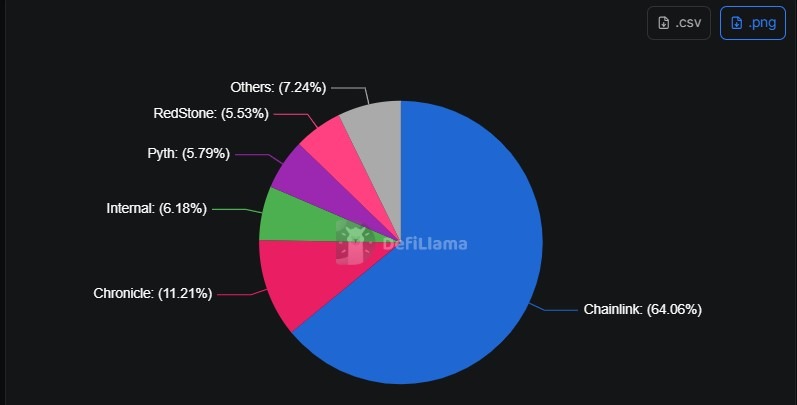
Market share data from Blockchain oracle. Source: DefiLlama
Oracle risks highlighted by recent exploit
The launch comes weeks after a DeFi exploit on Stellar exposed risks related to price feeds and collateral valuation in lending protocols.
On February 21, attackers withdrew approximately $10 million from a YieldBlox DAO-managed lending pool built on the Blend protocol after manipulating the price of the USTRY token used as collateral.
A security analysis by blockchain security firm BlockSec found that the lending protocol relied on a price path associated with the shallow USTRY/$USDC market on the Stellar decentralized exchange. The manipulated price increased the collateral value of the token, allowing the attacker to borrow assets higher than its actual value.
A Redstone spokesperson told Cointelegraph that relying on sparse onchain markets for price discovery could expose credit pools to manipulation risks.
“The February exploit was only possible because an oracle derived a price from a market with less than one dollar of trading volume per hour,” the spokesperson said.
RedStone said its price feeds instead use deviation-based updates, typically around 0.5% to 1% for stablecoins, along with minimal daily refreshes to ensure the data remains fresh.
Magazine: Telegram bypasses Philippines ban, yen carry trade continues: Asia Express