

A New York judge has postponed a decision on Aave’s emergency bid to release $71 million worth of crypto coins tied to victims of the $293 million Kelp DAO hack. He asked for additional information ahead of another hearing in June.
Aave has attempted to use $71 million in ETH that Arbitrum has frozen to help with recovery efforts after the Kelp DAO hack, one of the worst DeFi hacks this year.
However, US law firm Gerstein Harrow LLP filed a restraining order in early May, arguing that its clients are entitled to the funds. Aave then filed an emergency motion to have the funds released, arguing that user liquidations and potential destabilization of the DeFi market could occur if the funds were not unlocked quickly.
According to documents In a filing Wednesday in the Southern District of New York, Judge Margaret M. Garnett said Aave had not adequately outlined in its filing earlier this month how “escalating losses” on user fees “could occur if the restriction declaration remains in effect.”
Judge asks for more information from both sides
Judge Garnett acknowledged that the case is complex and that there are risks to the victims, and called for additional briefings from both sides to further explain their case.
“The court recognizes the risk of potential short-term harm to users of Aave LLC and Aave Protocol. Due to the complexity of the issues raised in the parties’ motions and during oral arguments on May 6, 2026, and the extremely condensed timeline of which they were informed, the court orders the parties to file additional briefs,” Judge Garnett said.
The judge outlined six key points on which the court wants more information, including whether the hacking transactions fall under the New York shelter principle; the legal distinction between fraud and theft and what interest hackers have in stolen assets; which law determines the priority of creditors over frozen assets; whether a constructive trust would be an appropriate solution and whether Aave or Arbitrum can identify individual victims to return the assets on a pro-rata basis.
Aave and Gerstein Harrow now have until May 22 to submit their briefs, while the hearing is scheduled for June 5.
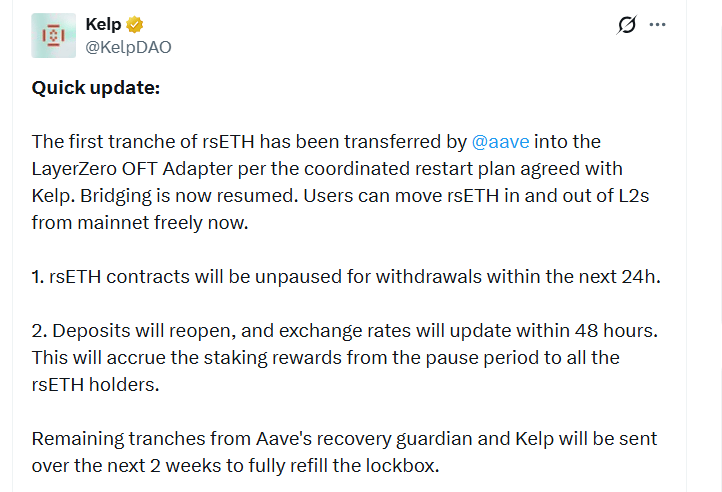
The case comes amid broader recovery efforts for Kelp DAO. Kelp and Aave announced on Tuesday that they had taken significant steps to restore rsETH’s support.
The hacker’s rETH has been burned on Arbitrum, while the lost tokens, worth approximately $278 million, will be recovered over the next two weeks via funds from Aave Recovery Guardian’s multisignature wallet.
Once the associated smart contracts are reactivated, all rETH usage will return to normal.
Source: Kelp DAO