
By Molly Schwartz, cross-asset macro strategist at Rabobank
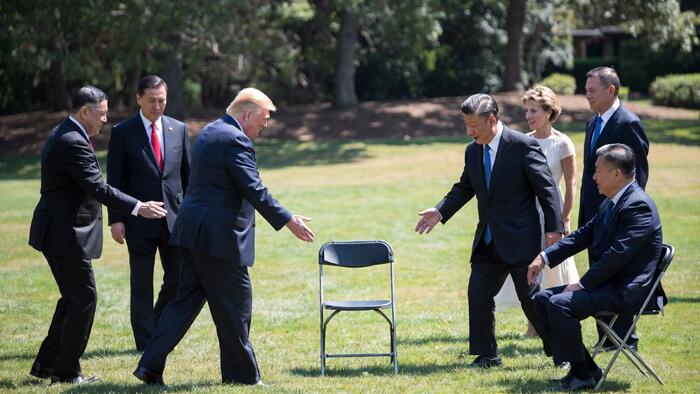
Yesterday, Trump spoke with Xi in Beijing. While markets kept a watchful eye on any headlines about the war in Iran, palates were left dry as only tepid announcements dripped out, such as that China “offered help” on Iran and “pledged not to send weapons.” What they did not manage to evade was a conversation about Taiwan. During the two and a half hour conversation with Trump, Xi underscored that US intervention in Taiwan could trigger a “highly dangerous situation.” While Rubio underscored that the topic of American arms sales to Taiwan wasn’t a major focus of discussion, it likely will be when Congress’ approved USD 14bn arms sale to Taiwan lands on Trump’s desk, and again when Xi visits the White House in September.
While the US and China are stalled in the geopolitical arena, the financial scene seems to be bearing fruit. Treasury secretary Scott Bessent announced that conversations around the creation of a “Board of Investment” were underway, and that tariffs would be reduced or removed for products that the US doesn’t plan on reshoring, like fireworks. China also agreed to buy 200 “big” Boeing planes, according to Trump, which would mark the first significant Chinese purchase of Boeing jets since the last time Trump went to Beijing in 2017. China also hinted that they may intend to buy more US energy to compensate for flows disrupted by the war.
Though Iran didn’t appear to produce much in the way of headlines, the Strait is still closed, and Brent crude oil is still trading above $100/bbl at $106/bbl at the time of writing. According to Reuters, the IRGC announced that some 30 vessels have crossed the Strait since Wednesday (with Tehran’s permission), and transit is being permitted for “some” Chinese vessels.
US Treasury yields closed higher after hotter-than-expected trade price data for April printed, with import prices up 1.9% m/m and export prices up 3.3% m/m. These were the fastest monthly price index increases since early 2022 for both. However, the import price index, excluding petroleum, registered more modest gains of only 0.7% which, while hotter than the expected print of 0.5%, is cooler than levels seen as recently as January and February of this year. USD was the best performing G10 currency yesterday on a one day view. Yesterday afternoon saw a surge in yields across the board, absent a clear driver in sparse news flow, as the 2 year closed 3bp higher, above 4.00%.
Warsh was recently voted in as Fed Chair by the US Senate, but this creates a game of grown up musical chairs for the Board of Governors. There can only be seven Governors on the FOMC, and with Powell not giving his seat up just yet, if no one steps down, we have eight. However, Stephen Miran has announced that he would be stepping down as Governor and has submitted his resignation, effective upon Warsh being sworn in. Miran also assured that while he believes it’s important that the Fed only have one chair, Powell could help Warsh through the transition.
Bloomberg’s Anna Wong hit Powell with an uncomfortable reality check: “if Powell’s Fed had been more active in getting its own house in order following a massive miss on inflation, outsiders would have had less motive and opportunity to attack.” Powell’s Fed was criticized for its slow response to the inflationary pressures which led to “the Great Inflation.” Wong summarizes that “[Powell’s] limited push for accountability, such as a thorough review of Fed’s forecasting framework, opened the door to the nomination of a more aggressive outside like Warsh, who has vowed to ‘break some heads’ at the Fed. The moral of story: Get your own house in order or someone will do it for you.”
Across the pond, UK Health Secretary, Wes Streeting, resigned from his role in an attempt to take over Starmer’s seat. In a statement posted to X, Streeting outlined his accomplishments as Health Secretary, but claimed that he has “lost confidence” in Starmer’s leadership, partially due to the success of the Reform party in elections across the UK last week. Manchester Mayor Andy Burnham has also thrown his hat into the ring after MP Josh Simmons resigned, allowing Burnham to run for Parliament and make a bid for Labour leader as well.
The 30 year gilt yield is down from yesterday’s level of 5.74% to 5.67%, and GBP was the worst performing G10 currency on a one day view, depreciating 0.9% against USD and 0.6% against EUR, and on a month-to-date view, dropped from the fourth worst performing G10 currency to the worst. See Jane Foley’s commentary on GBP here.