
By Benjamin Picton, Senior Macro Strategist at Rabobank
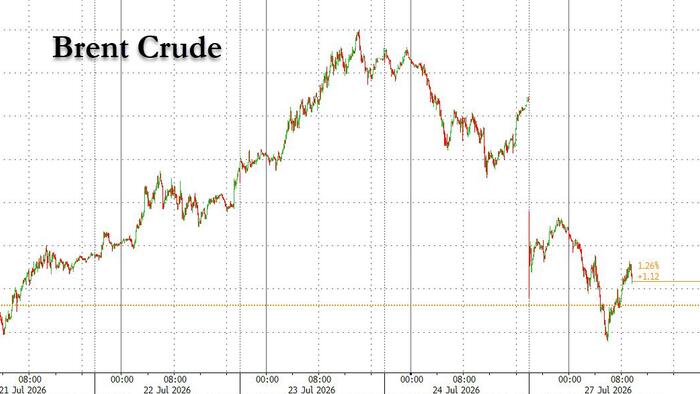
Oil futures are being offered this morning after President Trump on Friday declined to continue strikes on Iran. The ‘pause’ was extended over the weekend and reciprocated by the Iranians, marking the first ‘cease’ of the ceasefire in almost a fortnight.
According to Axios, Donald Trump’s advisors had provided the President with attack plans for the day but CENTCOM commander Admiral Brad Cooper reportedly advised against further strikes, arguing that Iran’s ability to disrupt shipping in the Strait of Hormuz had already been substantially degraded and that the aerial campaign had reached the limits of its effectiveness.
In a similar vein, the New York Times published a report over the weekend revealing that General Dan Caine, Chairman of the Joint Chiefs of Staff, had cautioned the President that further escalation was possible but that it would dangerously deplete CENTCOM’s stock of interceptor missiles. This would expose the nineteen-odd US bases across the Middle East to even greater damage than they have already sustained, to say nothing of the infrastructure of GCC allies and the strain on the US’s defence priorities in the Pacific and elsewhere. President Trump denied the reports, telling the Wall Street Journal “we have far more [interceptors] than we need.”
In a further hopeful sign, an Omani team of negotiators has reportedly met with counterparts in Tehran to discuss arrangements to re-open the Strait of Hormuz. Iranian foreign ministry spokesman Baqaei said that the talks had been “useful” and that progress had been made, but that there was no change in the status of the strait at this point. It also remains to be seen whether any agreement reached between Iran and Oman would be accepted by the United States.
Nevertheless, President Trump’s threats of ‘massive attack’ late last week that saw Brent crude surge above $100/bbl, higher bond yields, and equities under pressure has now given way to a massive relax, with Brent below $92/bbl, equity futures pointing higher and sovereign yields lower across the board.
Though it hardly bears noting, at this point it would behove us to caution that the war is not over and that we certainly are not out of the woods from either an energy security or financial markets perspective.
To illustrate this point, the Wall Street Journal carried a story over the weekend regarding the escalating tit-for-tat between the Saudis and the Houthis that threatens to conflagrate into all-out war. Houthi attacks on Saudi Aramco infrastructure at the critical port of Yanbu (the Red Sea release valve for Saudi oil exports) over the weekend followed a declaration last week that Saudi Arabia’s Red Sea ports would be subject to a blockade that further threatens to starve energy-poor Asia of vital crude oil flows. For now, China is continuing to play the constructive role of balancing item by holding its crude imports well below the usual levels.
Similarly, Israel was reportedly bracing for escalation over the weekend with the Jerusalem Post noting that public bomb shelters had been re-opened in major cities. Israeli Prime Minister Netanyahu said that the war would continue until the Iranian regime fell or gave up its nuclear ambitions, again highlighting the likelihood that hostilities will remain ongoing until one is forced to concede on the nuclear issue – and likely concede its regional influence in the process.
A further coalescing of an anti-Iranian bloc is also becoming more evident. Al Jazeera reports that Syrian President Al-Sharaa is seeking a security agreement with Israel that will apparently include several other countries and likely include provisions to stem to flow of weapons to Hezbollah in Lebanon. This as Israeli government sources indicate that Israel has dramatically stepped-up its engagement with the GCC since the outbreak of the war, which has perhaps already yielded fruit through the UAE’s decision to leave OPEC and OPEC+. Détente between Gulf states and Israel holds out the prospect of less fragile supply chains in the future, where oil flows West rather than East and Iran loses its leverage over the global economy, but that potential future is riddled with ‘ifs’, and solves none of our near-term problems.
Elsewhere, Iranian Foreign Minister Araghchi accused Ukraine of doing Israel’s bidding after the former struck an Iranian vessel in the Caspian Sea, killing at least one crew member. Ukrainian President Zelensky defended the action by stating that Kyiv was targeting vessels involved in military cargo shipments alongside Russian warships, again raising the prospect of two conflicts merging into one.
While geopolitical considerations will doubtless continue to set the tone this week, the Fed, Bank of England and Bank of Japan will all be meeting to set their respective policy rates. None are expected to raise their rate targets this time around but the inflationary impacts of war, and considerations over how persistent those shocks may prove to be, will surely loom large in their deliberations.
This week will also bring Q2 GDP readings for the United States and the Eurozone, along with Q2 PCE for the former and July CPI for the latter.