
The Lightning Network, a second-layer (L2) solution built on top of the Bitcoin blockchain, has dramatically changed the way the crypto market perceives transaction speeds and fees.
Designed to address Bitcoin’s scalability issues, it facilitates instant, low-cost transactions by creating off-chain payment channels. This solution eliminates the need to record every transaction on the main blockchain, significantly reducing congestion and costs.
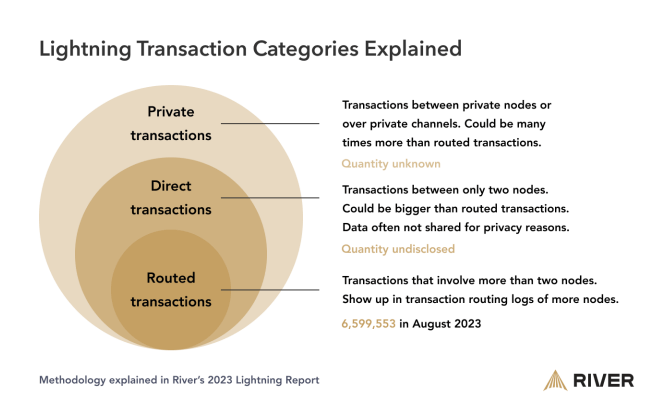
However, estimating the exact number and volume of transactions on the Lightning Network is a complex undertaking. The network architecture inherently makes it challenging for outside observers to determine the precise number of transactions. This is mainly because a significant portion of direct (between two nodes) and private transactions remain unpublicized for privacy reasons. Without comprehensive data from a large majority of nodes, it is virtually impossible to provide an accurate upper bound of transactions on the network.
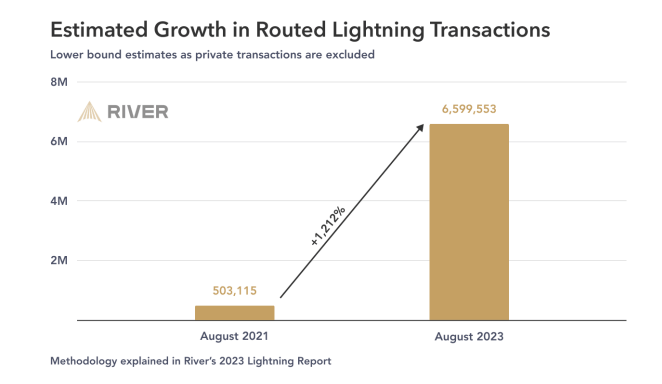
To measure transaction metrics, River analyzed data from nodes representing 52% of public capacity on the Lightning Network. Based on this data, it is estimated that approximately 6.6 million routed transactions occurred on the Lightning Network in August 2023. This represents a staggering 1,212% increase from the estimated 503,000 transactions in August 2021.
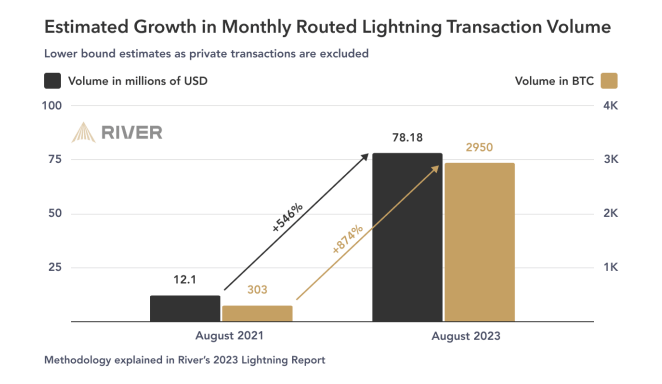
In terms of volume, approximately $78.2 million (equivalent to 2,950 BTC) was publicly routed through the network in August 2023, marking a 546% increase from the August 2021 estimate of $12.1 million.
These numbers are significant for several reasons. First, they underscore the growing acceptance and confidence in the capabilities of the Lightning Network. The exponential growth in transactions and volume, even amid a 44% Bitcoin price drop, indicates that users are increasingly leveraging the network for its efficiency and cost-effectiveness. Second, when combined with Bitcoin’s on-chain transactions, the Lightning Network already exhibits faster speed, suggesting it will enable faster exchange of value in the ecosystem.
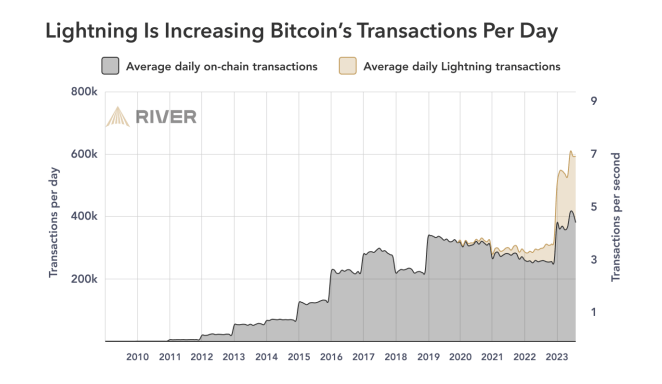
To the market, these numbers indicate a mature and robust second-tier solution that successfully addresses Bitcoin’s scalability issues. The increase in transaction numbers and volumes underlines the network’s potential to handle a substantial portion of global microtransactions, further strengthening Bitcoin’s position as a store of value and medium of exchange.
The post Lightning Network Transactions Increased 1,212% in Two Years appeared first on CryptoSlate.