
In finance, “smart money” typically refers to institutional or professional investors who are perceived to have greater market knowledge and resources. However, an intriguing pattern emerges when examining the top holders on the major DeFi platforms.
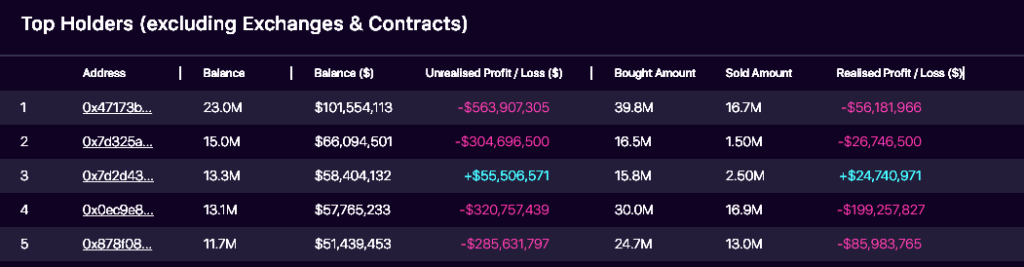
Crypto analyzed the top 5 portfolios (excluding funds and exchanges) and the top 5 fund portfolios of major DeFi platforms listed on on-chain data site Cherry Pick. Platforms included Uniswap, Aave, Curve, Balancer and 1inch.
Risk tolerance and diversification.
The data shows that individual wallets linked to institutions tend to have lower balances than individual wallets. This could indicate several things.
First, institutional investors can diversify their portfolios to reduce risk. Traditional financial wisdom advocates diversification as a hedge against volatility, and it appears that this principle will be adopted in the developing world of DeFi. This is supported by funds with multiple tagged wallets. Second, the lower balances could indicate that institutions are still cautiously exploring DeFi, possibly skeptical about its long-term prospects or operational risks.
Here, “smart money” appears to be being careful not to put all their eggs in one basket or limit their exposure to the DeFi space altogether.
For example, the average balance in Aave for wallets is approximately $11.46 million, while funds hold an average of only $528,635. This stark contrast could imply that institutional investors are diversifying their risks or perhaps still testing the waters in the DeFi arena.
Increased losses from funds.
Despite these lower balances, funds exhibit higher realized and unrealized losses. Uniswap’s average realized loss for funds is approximately $470,000, compared to the whopping average loss of $68.6 million for individual wallets.
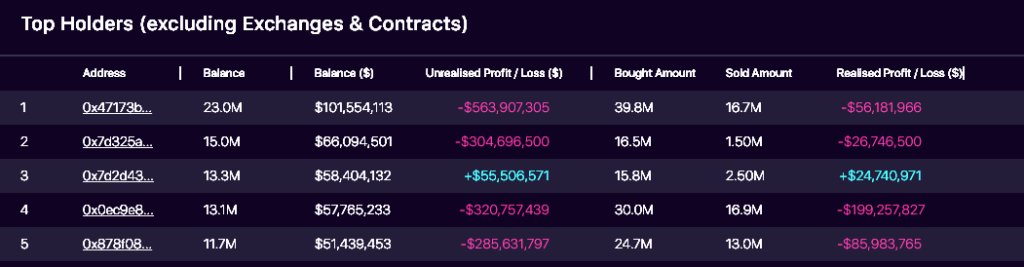
Staggeringly, the top UNI wallet has over $500 million in unrealized losses, with all but one of the top five seeing nine-figure unrealized losses. If we analyze the top wallet, it appears to be a wallet linked to the protocol itself, as it received 39.7 million UNI in March 2021, worth approximately $1.1 billion.
At Uniswap’s peak just two months later, it was worth about $1.68 billion.
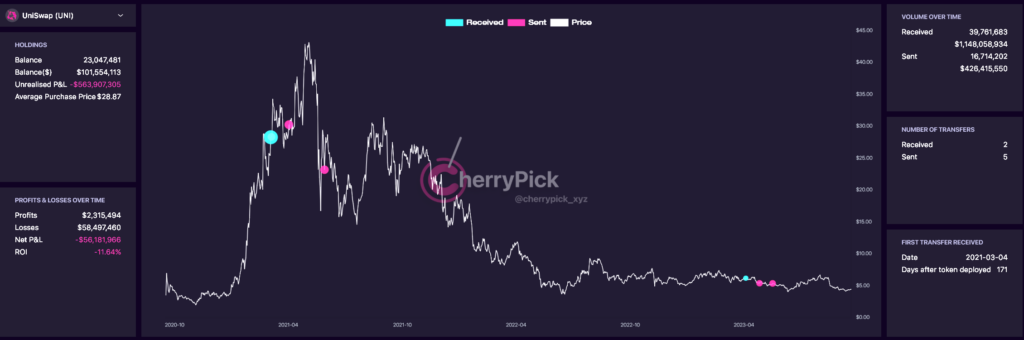
Today, the wallet is valued at $101 million after sending approximately 16 million UNI out of the wallet in the last 36 months, with only one sale at a profit.
The difference could indicate that while institutional investors are more cautious with their capital, they accept more short-term losses, possibly as part of a long-term investment strategy.
A changing of the guard.
Both individual wallets and institutional funds show a strong bias towards Uniswap. With an average balance of $66.9 million for wallets and $104,821 for funds, it is clear that Uniswap remains a cornerstone in retail and institutional DeFi portfolios.
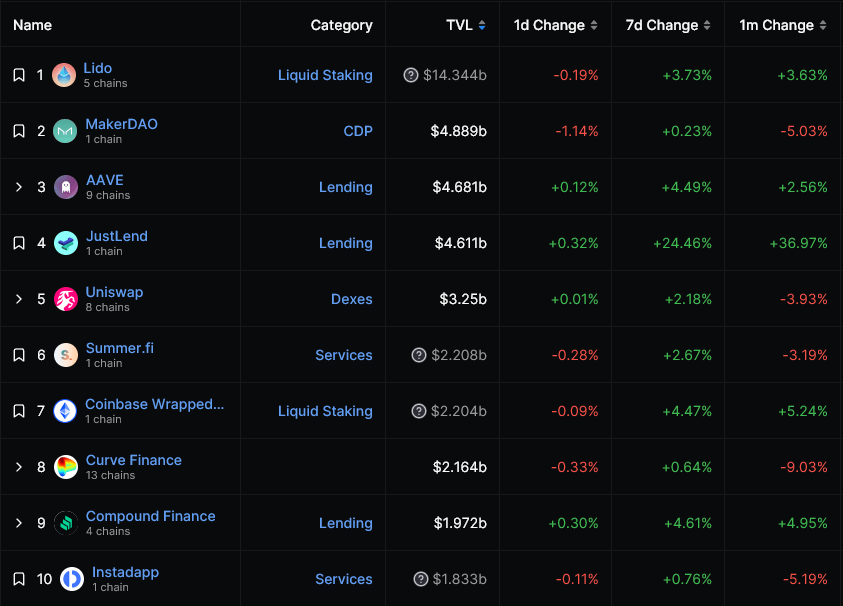
While platforms like JustLend are making progress with a TVL of $4.611 billion, data shows that smart money is still primarily invested in older platforms, with Lido, Maker, Aave and Uniswap all still in the top 5 DeFi platforms of TVL stand.
Still, the top 10, as tracked by DefiLlama, now misses several older DeFi players, such as Balancer, PancakeSwap, SushiSwap, and Yearn Finance. Instead, newer protocols such as JustLend, Summer.fi and Instadapp have taken their place.
Profitability and efficiency
You would expect “smart money” to flow to platforms with higher revenues and fees. However, this is not necessarily the case. For example, while Uniswap has cumulative fees of $3.254 billion, it has not prevented smart money from incurring average realized losses of more than $470,000.
Looking ahead, data from DeFiLlama shows exciting trends in TVL changes over time. Platforms like JustLend have seen a 24.46% increase in TVL in just seven days.
While our data set doesn’t provide a direct correlation, it begs the question: is “smart money” nimble enough to take advantage of these rapid shifts?