

Centralized exchanges, once the primary hubs for trading and storing crypto tokens, have fallen out of favor among many investors in recent years. The collapse of high-profile exchanges like BlockFi and FTX played a big role in this shift, as crypto enthusiasts realized that centralized platforms could leave them exposed to significant risk—if a centralized exchange goes down, it’s possible that investors could lose all of their tokens housed there, particularly in cases in which the tokens have been staked.
Indeed, centralized exchanges that require investors to lock up their tokens, thereby inadvertently preventing people from accessing their funds in times of turmoil, may seem increasingly like traditional financial institutions operating within the crypto space. With fluctuating markets and rampant liquidity issues in recent months, and as regulators move to exert further control on centralized exchanges, investors have even more reason to seek out alternatives with a greater degree of decentralization.
This is where YieldFlow comes in. Launched in 2023, YieldFlow provides customers the opportunity to earn rewards from yield farming and staking—practices which can be lucrative but which typically require users to hand over and lock up their tokens with a platform for a specified period of time—without those tokens leaving their possession. YieldFlow is able to accomplish this as a DeFi protocol through the use of smart contracts, which allow anonymized transactions and full customer custody of their tokens throughout. Additionally, Yieldflow’s security platform is audited by CertiK, the leading smart contract auditor, thereby adding an extra layer of solidity for the Yieldflow infrastructure.
Providing the Benefits of Centralized Exchanges in a DeFi Environment
Despite the drawbacks named above, there are many benefits to centralized exchanges. Perhaps above all, these platforms provide a straightforward, easy-to-use interface for users. In most cases, with just a few clicks and by inputting some basic information, customers can quickly begin to access the services of a centralized exchange. Much of the complicated how-to work is taken care of behind the scenes. Centralized exchanges also aim to provide security, although there is a limit to this when exchanges are increasingly susceptible to total collapse.
YieldFlow is able to provide security, trust, and anonymity without the drawbacks of a centralized service. It does this through its use of smart contracts. The company’s whitepaper says it goes beyond simply “hodling” crypto tokens and that it aims to “grow your portfolio in a secure, anonymous, and decentralized way” by removing technical complexity for customers, by being responsive to customer risk and reward profiles, by automating liquidity mining, and more. Customer assets are automatically routed to different protocols by smart contracts, thereby eliminating the complexity for customers who would otherwise have to manage this system on their own.
YieldFlow’s developers say that it can dock into any Ethereum Virtual Machine (EVM)-compatible yield- or revenue-generating protocol to easily connect customers with different platforms. At launch, YieldFlow provided native staking of Layer 1 blockchains, with additional support added over time. $YFlow, the token of the YieldFlow protocol, is used to generate staking rewards, lower withdrawal fees, and boost commissions, while also allowing users to create proposals and participate in governance of the protocol.
Step By Step: How to Use YieldFlow

The first step to launching your investments and passively growing your portfolio with YieldFlow is to create a Web3 login. Visit the website, yieldflow.com, and click on the buttons labeled “Start Now” in the center or top right of the screen. You may also wish to read more about the latest news for the platform, or peruse the whitepaper or tokenomics materials for a more in-depth technical understanding of how YieldFlow works and what it can accomplish.
Creating a YieldFlow login involves interactions with only smart contracts that are verified and audited by third parties. YieldFlow is excluded from any contracts regarding customer assets. A key aspect of the YieldFlow account creation process is that it does not specify a know-your-customer (KYC) requirement. The reason for this is that it only uses cryptocurrencies and does not have gateways for fiat assets.
Clicking “Start Now” will bring you to YieldFlow’s main portfolio interface:
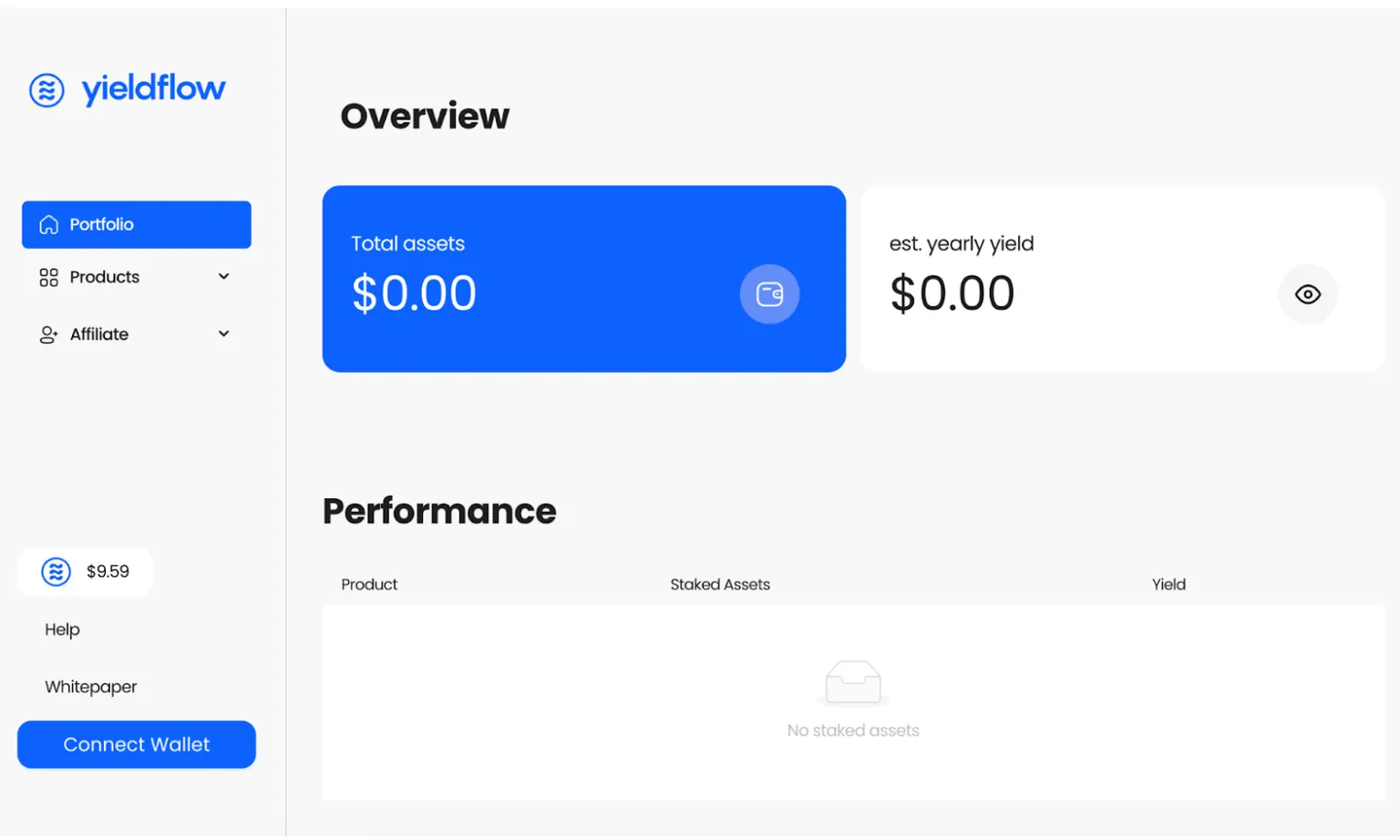
Before you can take advantage of any of the services listed on the left side of the screen, you’ll need to connect a wallet. Use the button in the bottom left corner of the page to begin the process of connecting. Any wallet that is compatible with ethereum will work; YieldFlow automatically provides the option of connecting a Coinbase or WalletConnect wallet.
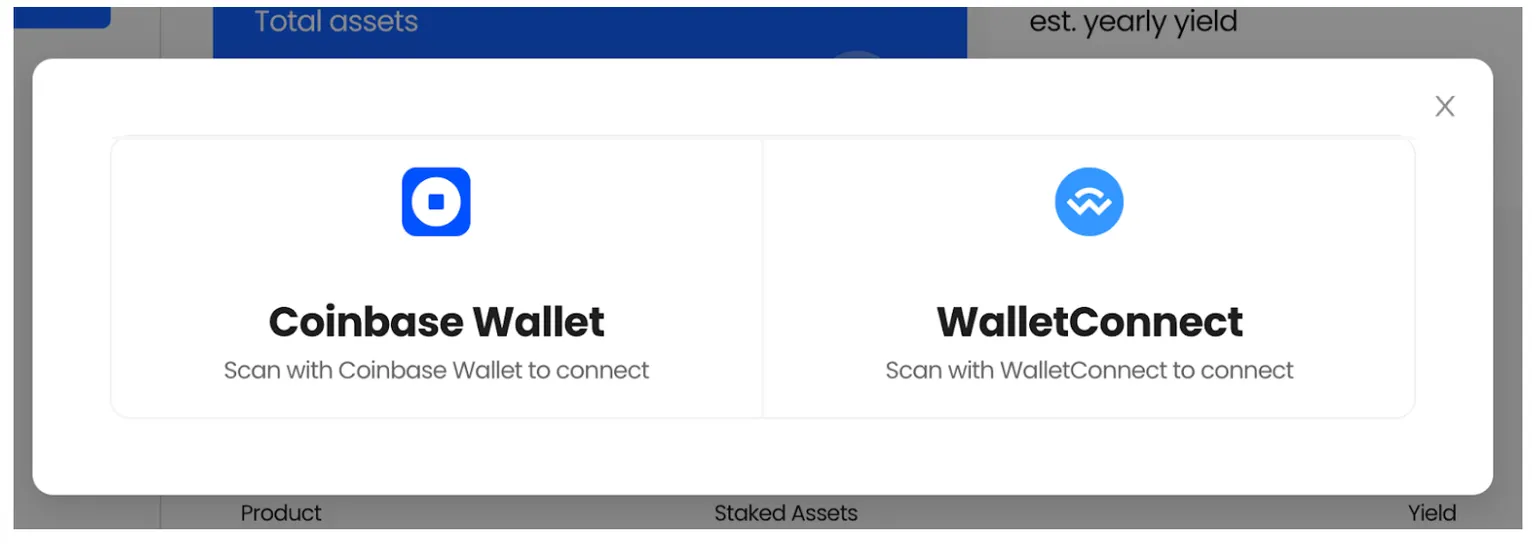
Clicking on either Coinbase or WalletConnect will bring up additional prompts to help you connect either using apps or desktop platforms:
You’ll next need to follow instructions provided by Coinbase or WalletConnect in order to complete the process of linking your wallet. This may require logging in to separate accounts and confirming certain details through an app.
Once your wallet is connected, the bottom left corner of the YieldFlow page will automatically be updated to include both your wallet information and your balance.
At this point, you are able to begin using YieldFlow’s products, as listed on the left side of the screen. Click on YFlow to open up a menu allowing you to buy $YFlow or to stake it with no lock or lock periods of up to 3 years.
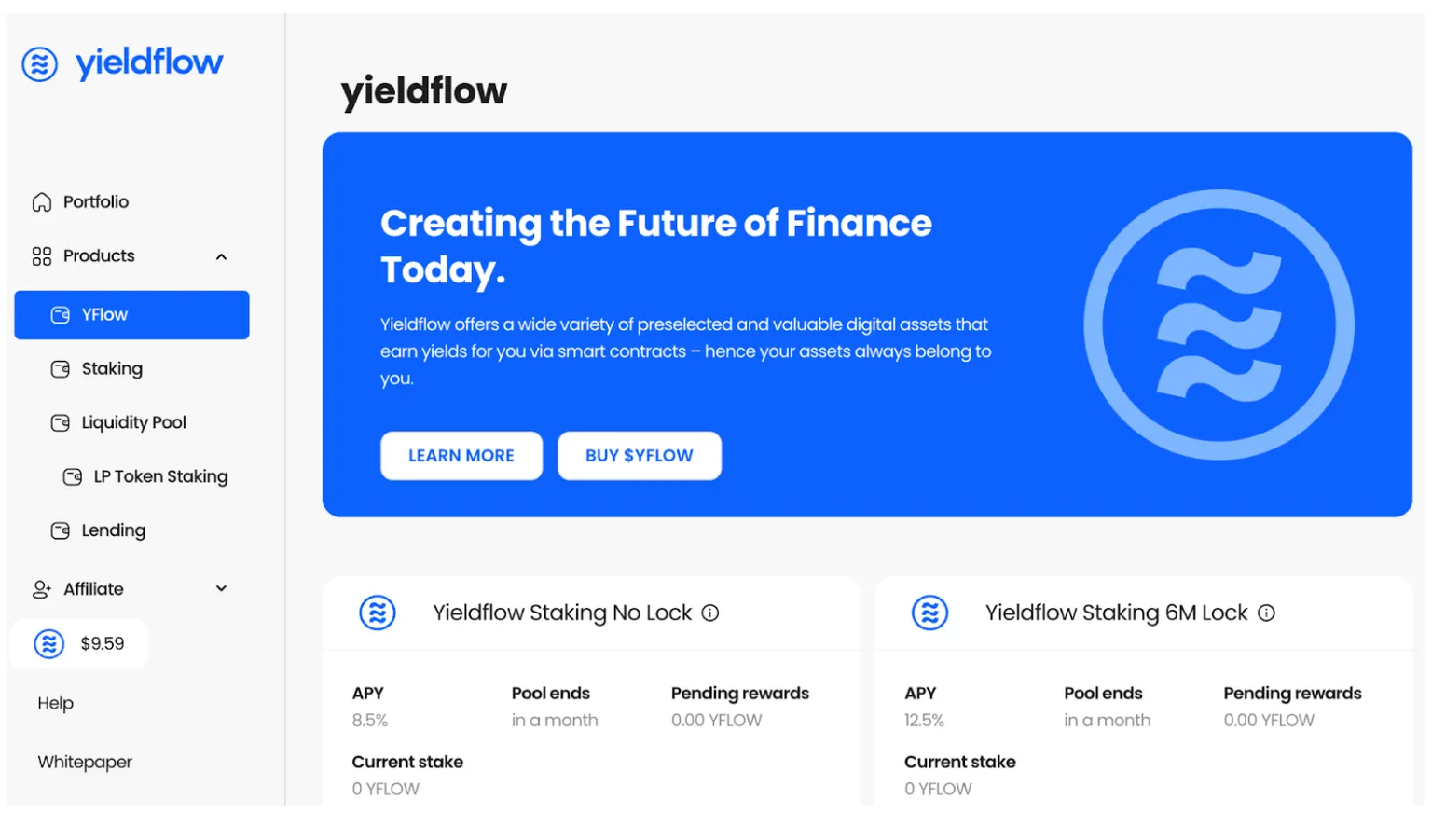
Follow instructions on this page to approve, stake, unstake, restake, or claim rewards for each of the staking categories.
By clicking on the “Staking” button on the left side tab, you can pull up a list of non-YieldFlow products for staking. As of this writing these include Polygon, Fantom, Aave, and The Sandbox. Each is listed along with its current APY. The process for activating is similar to that of $YFlow tokens.
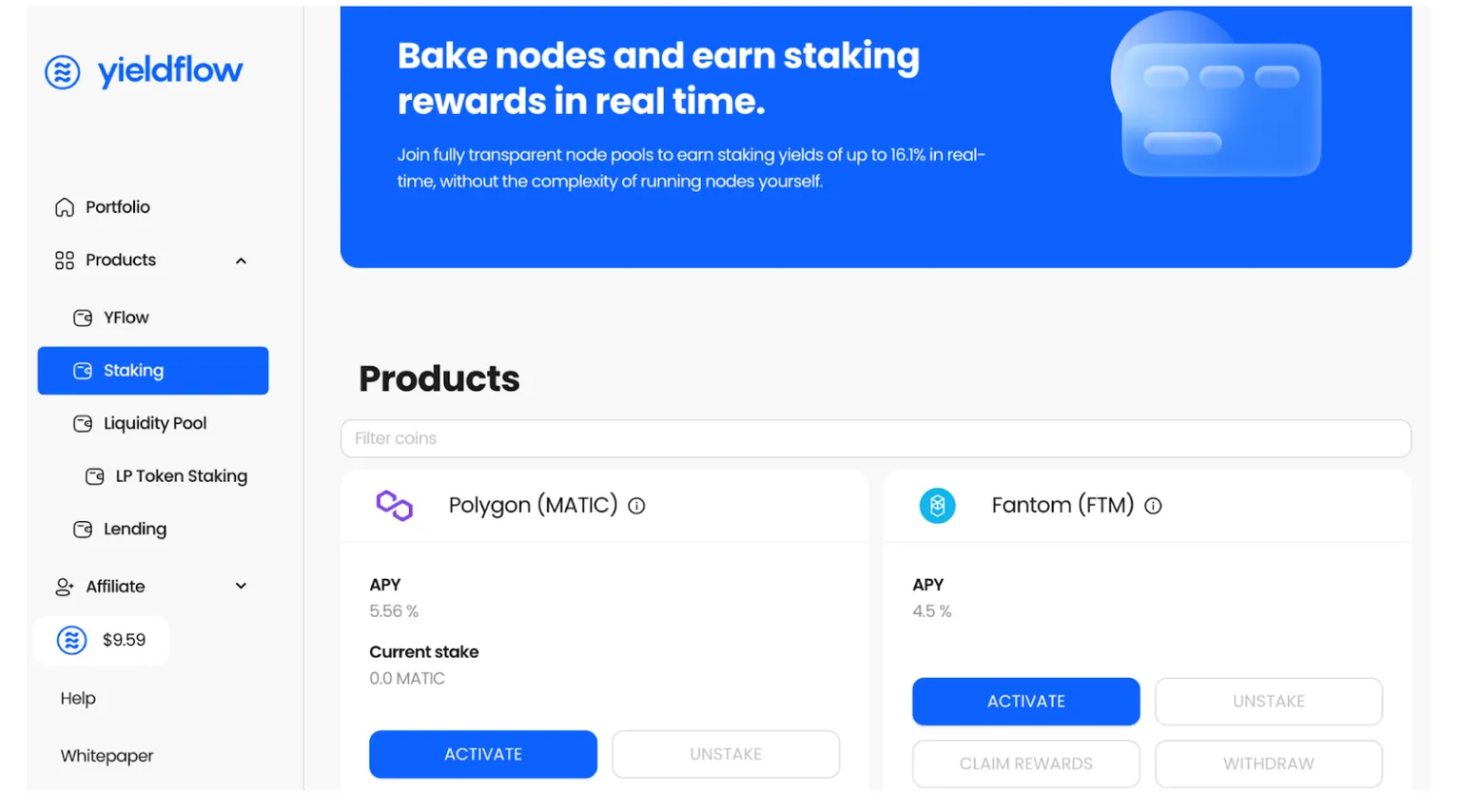
Clicking on “Liquidity Pool” in the left-side menu opens up a list of crypto token pairs for you to investigate. Again, APY is listed for each pair. These pairs include LINK/ETH, MATIC/ETH, USDT/ETH, MANA/ETH, SAND/ETH, and others as of this writing.
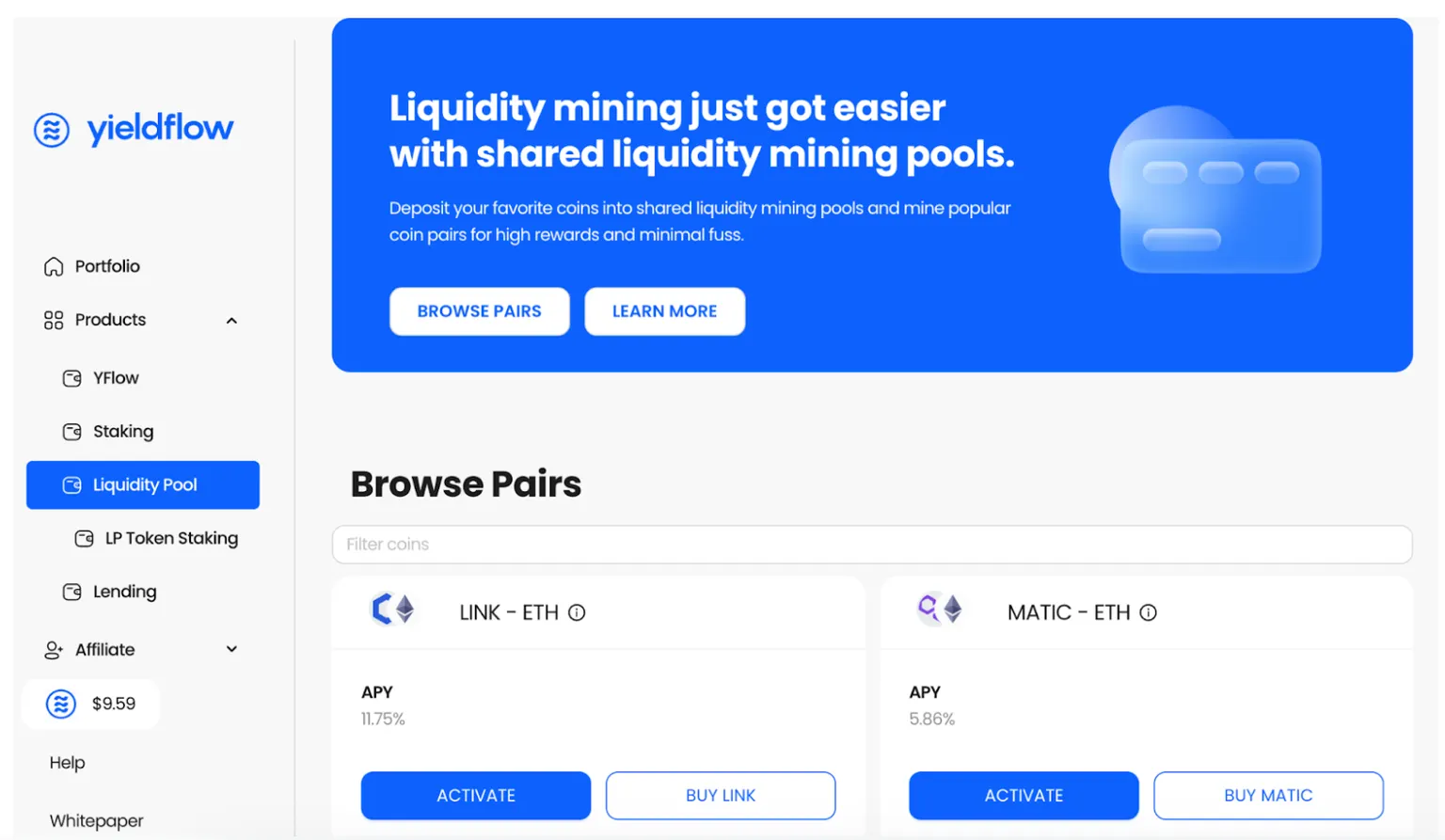
Helpfully, YieldFlow provides links for you to purchase tokens included in each pair on this page directly.
The “LP Token Staking” button pulls up a list of liquidity pool staked assets. They are sorted by name, APY, staked status, staked liquidity, reward, and pool end data.
Finally, the “Lending” button pulls up a list of lending batches that provide guaranteed returns with a base APY for each included on the page.
YieldFlow also offers an affiliate program. Clicking on the tabs for “My Affiliate” and “Leadership” under the “Affiliate” menu on the left side of the screen pulls up information relevant to this program.
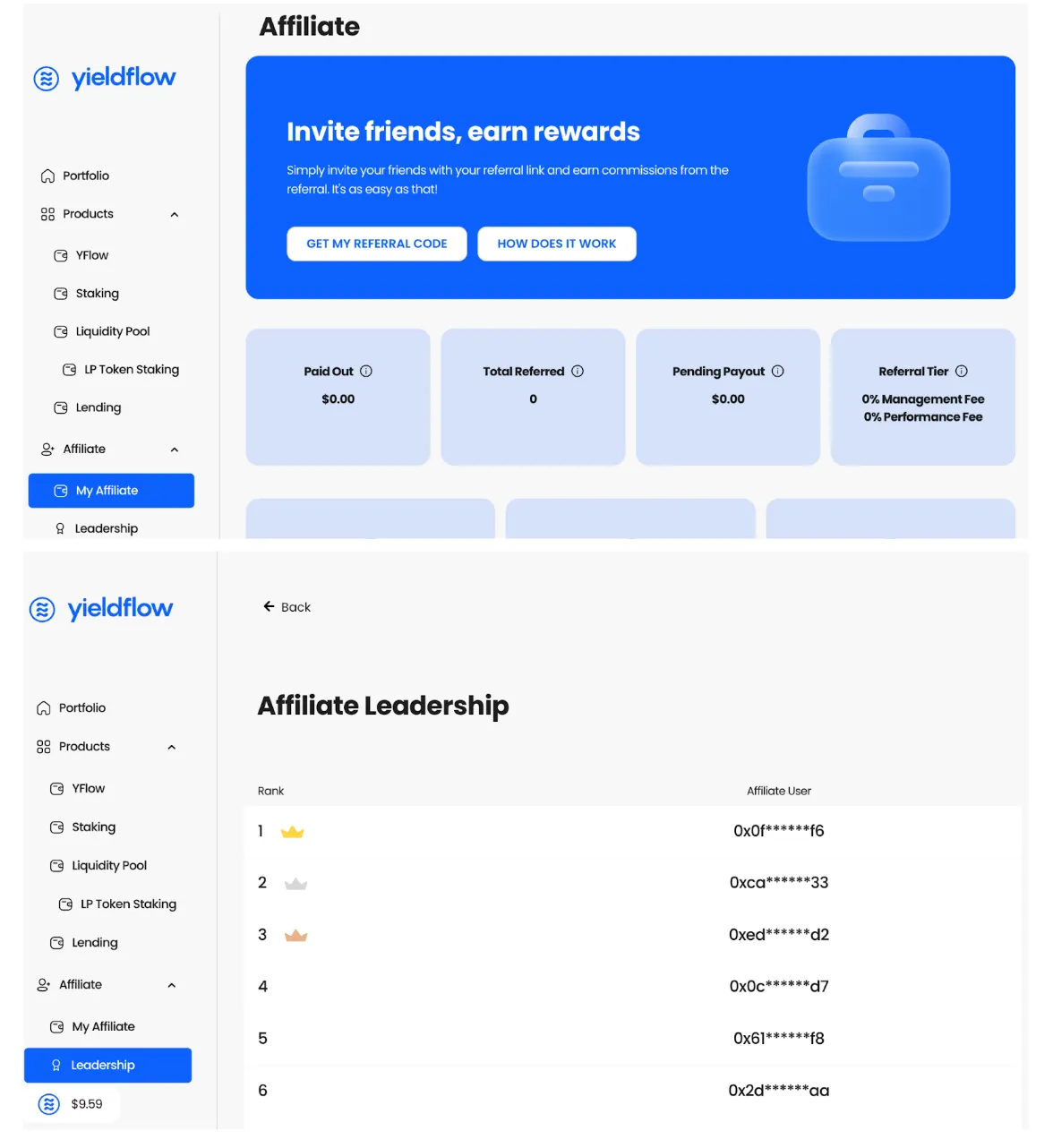
The “My Affiliate” page provides users with a referral code to give to friends in order to earn commissions when others join YieldFlow. The page shows a total amount of money paid out, the total pending payout, how many users have been referred from this account, the referral tier, and additional information. The “Leadership” page is an updated ranking of YieldFlow users by referrals.
Heading back to the main portfolio page provides a quick glimpse of total assets, estimated yearly yield, and a list of staked assets by performance for ease of monitoring. There is also a way to search for help, a way to view the whitepaper, a way to disconnect the wallet you’ve connected, and a way to change chains between Ethereum, Fantom, Polygon, and Arbitrum One.
Cheat Sheet
- YieldFlow launched in 2023 as a DeFi platform and an alternative to centralized exchanges.
- While centralized exchanges expose customers to security risk in the event that they collapse, and to unpredictable liquidity, inflexible staking rules, and more, YieldFlow aims for a smooth user experience governed by trust, security, and decentralization.
- Using YieldFlow is straightforward, particularly compared with complicated DeFi protocol competitors.
- To begin using YieldFlow, users simply visit the platform’s website and create an account. They will need to link a crypto wallet from Coinbase or WalletConnect. At that point, they are able to begin to use YieldFlow’s staking, lending, and other products.
- YieldFlow is crypto-only and does not have a fiat gateway, so it does not require KYC protocols, thereby speeding up the account onboarding process.