
Mustafa Al-Bassam was a Ph.D. student in computer science in 2019 at University College London when he published a paper titled “LazyLedger.”
Not meant for a lazy reader, the paper went on to describe, in excruciatingly complex terms and Greek mathematical characters, what was then a radical rethinking of how blockchains could work: separating out the various functions of a distributed ledger – especially the way users query the network for data – into distinct “application layers.” A key benefit would be to minimize the total resources needed to run the main blockchain.
Al-Bassam now serves as CEO of Celestia Labs, the primary developer behind the Celestia project, which launched this week as a new “data availability” network, and in various pronouncements heralded the accomplishment as the start of a new “modular era” in blockchain architecture.
It’s presumed that a primary use case for Celestia will be to relieve the Ethereum blockchain of the burden of storing and transmitting reams of data produced by the fast-growing ecosystem of “layer-2” networks known as “rollups,” where users can make cheaper and faster transactions.
“The theory is that Celestia can become the backbone for a highly scalable and interoperable network of rollups and, most importantly, achieve this modular vision without sacrificing decentralization or security,” Christine Kim, a vice president of research at the crypto firm Galaxy, wrote in an Oct. 19 report.
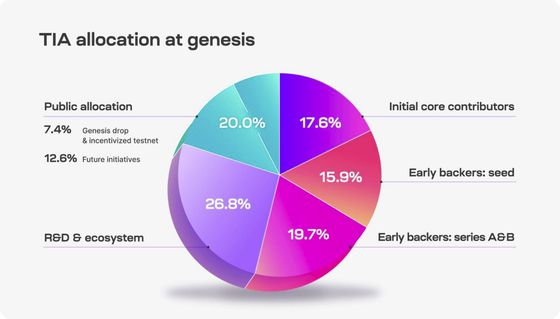
Of course, this being crypto, the primary focus of most news coverage (and social-media posts) was on the project’s buzzy airdrop Tuesday of some 60 million of its native TIA tokens, or roughly 6% of the supply, with a final tally of some 191,391 claims. Another 140 million tokens will be allocated to future initiatives.
Read More: Celestia Airdrops TIA Token as Network Goes Live, Claims Start of ‘Modular Era’
The airdrop was so highly anticipated that, in the lead-up to the giveaway, traders were speculating on the price using pre-launch futures contracts. According to the website CoinMarketCap, the TIA token has already been listed on a host of crypto exchanges, including Binance, KuCoin, Kraken, Bybit and MEXC.
As of late Tuesday, CoinMarketCap listed the project’s circulating supply of TIA tokens around 141 million, and price of $2.44 each, for a market capitalization of $344 million.
The airdropped tokens represent a portion of a total of 1 billion tokens minted, and this being crypto, just over half of those are getting allocated to early investors and initial contributors. Many of those are locked up for now: Seed investors will receive their tokens evenly between October 2024 and October 2025, with initial core contributors receiving their tokens until October 2026.
The TIA airdrop is one of the biggest in the crypto industry over the past year, and of course a big airdrop is no guarantee of a project’s ultimate success.
Two mammoth projects, Sui and Aptos, both layer 1 blockchains staffed by former Meta employees, have similarities with Celestia in that they airdropped tokens to developers and test network users, but they have struggled to wrangle market share from the likes of Ethereum.
Aptos rose to a market cap of $2.9 billion on the release of its main network while Sui debuted at $750 million. Yet in spite of inflated token values, the total amount of capital locked on either blockchain has failed to surpass $100 million.
What does Celestia do?
On Tuesday, X (formerly Twitter) was filled with go-go posts – “$10 soon,” wrote one user in reference to TIA’s price. Another poster asked where they could dump the airdropped tokens. Jesse Pollak, who oversees Coinbase’s new Base layer-2 blockchain atop Ethereum, offered congratulations.
Such euphoria may have served to gloss over the reality of just how hard the project is to understand.
“Data availability” is such an arcane term that even Dankrad Feist, an Ethereum Foundation researcher who’s the namesake for the equally arcane blockchain concept of “danksharding,” said recently that he found it too confusing.
Sean Farrell, a crypto analyst at FundStat, simplified it for investors in a note on Tuesday: Data availability “allows network nodes to download, store, and make transaction information accessible for verification.”
The big idea is that Celestia aims to help solve scalability and stability issues that have plagued monolithic blockchains like Ethereum and Solana – partly by creating a new venue for hosting and accessing the reams of data created by the rapidly proliferating ecosystems of “layer 2” networks working atop primary “layer 1” blockchains.
Data availability is considered so crucial to alleviating the load on Ethereum that two rival projects, Avail and EigenDA, are working on it in addition to Celestia. Avail is headed by a former Polygon co-founder, Anurag Arjun, while EigenDA is a project of EigenLayer, headed by Sreeram Kannan, an associate professor at the University of Washington.
The push to erect these new networks reflects this year’s push by developers toward a “modular blockchain” architecture that separates the core functions of a blockchain – consensus, settlement, data availability, and execution – and then segment them into layers that ensure efficiency.
“It’s the start of a new era,” the Celestia Foundation, which supports development on the network, wrote in a blog post on Tuesday. “The modular era.”
Read More: What Is Ethereum’s ‘Data Availability’ Problem, and Why Does It Matter?
How does Celestia work?
According to the Celestia’s project documentation, the TIA tokens represent “an essential part of how developers build on the first modular blockchain network.”
To use Celestia for data availability, rollup developers submit a type of transaction known as “PayForBlobs” on the network for a fee, denominated in TIA.
Modular blockchains are designed with a focus on using specific channels for speed and execution, unlike monolithic blockchains that can only scale at the expense of decentralization or security.
“Instead of one blockchain doing everything, modular blockchains specialize and optimize to perform a given function,” Celestia spokesperson Ekram Ahmed told CoinDesk.
Al-Bassam, the former Ph.D. student who went on to found Celestia, co-authored three academic books with the Ethereum’s famous founder. Vitalik Buterin. In a talk earlier this year, Buterin touted Celestia as a scaling solution for Ethereum rollups.
On Tuesday, the official Celestia account on X posted: “What was once considered a wild moonshot is now a reality four years after the LazyLedger white paper was published.”
What sets Celestia apart from other blockchains?
“Data availability answers the question,” Ahmed replied before highlighting the importance of verifying data on a blockchain. “Users of a monolithic blockchain usually download all the data to check that it is available.”
Currently, this problem isn’t necessarily in the forefront of the mind of Ethereum or Solana users, but that may be because neither blockchain has scaled to the masses. Ethereum averages around 1 million transactions per day, according to ycharts, with Solana racking up a fraction of that.
Last week, fund manager VanEck modeled a scenario that would see Solana reach 100 million users. If blockchains manage to scale to this level, projects like Celestia aim to ensure that the data for every blockchain node is verified and validated.
“Modular chains solve this problem by making it possible for users to verify very large blocks using a technology called data availability sampling,” Ahmed said.
The flagship feature of Celestia is data availability sampling (DAS) – a way of verifying all data that is available on a blockchain.
Intended users include those running so-called light nodes – able to be run on small computers that don’t need massive amounts of computational power or data-storage capacity – who could then verify data availability without having to download all data for a block. These light nodes conduct several rounds of random sampling of block data, as more rounds are completed it increases its confidence that the data is available.
“Once the light node successfully reaches a predetermined confidence level, for example 99%, it will consider the block data as available,” Ahmed concluded.
Eventually, if Al-Bassam’s vision takes hold, day-to-day crypto users might interact with Celestia without knowing it. And understanding it all? Seems a lot less likely.