

The French banking and insurance regulator, the Autorité de contrôle prudentiel et de résolution (ACPR), has published a summary of the findings of a public consultation on regulating decentralized finance (DeFi.)
The consultation received significant engagement from global DeFi stakeholders, providing valuable insights to inform potential regulatory approaches in Europe.
According to the ACPR, the two-month consultation enabled a deeper understanding of the risks and opportunities of DeFi. While DeFi is often described as “decentralized,” the regulator states that “disintermediated” may be more accurate given the concentration of infrastructure among major cloud providers, which represents a potential operational vulnerability.
The consultation also found broad support for certifying smart contracts, the core of DeFi protocols, with suggestions around proportionality and incident reporting. Regulating intermediaries and user interfaces also received broad consensus.
Most participants advocated continuing the commitment to public blockchains while strengthening resilience. The feedback will help shape the ACPR’s contributions to European regulatory discussions following the Markets in Crypto-Assets (MiCA) legislation, focusing on issues such as:
- Blockchain reliability rules that are crucial for DeFi.
- Certification frameworks for smart contracts.
- Governance and conduct standards for DeFi platforms.
According to the ACPR, regulating infrastructure, smart contracts, and businesses would allow DeFi to develop while protecting consumers. Crypto-native and established financial institutions submitted feedback along with auditors and consultants, providing different perspectives.
While MiCA provides a foundation, the regulator believes that further regulations are necessary due to the unique nature of DeFi and tokenized finance. The consultation allowed specific recommendations to be drawn up to expand the regulatory perimeter.
The DeFi centralization problem persists.
The ACPR’s sentiment that DeFi has a hardware centralization problem is shared by some within the crypto community itself, as the data shows. In July 2022, CryptoSlate reported that Amazon AWS powered approximately 32% of Ethereum nodes at the time, with 47% of the total number of nodes running through major US internet and cloud providers. Analysts argued at the time that the network’s reliance on companies like AWS could still enable coordinated attacks between providers to disrupt operations.
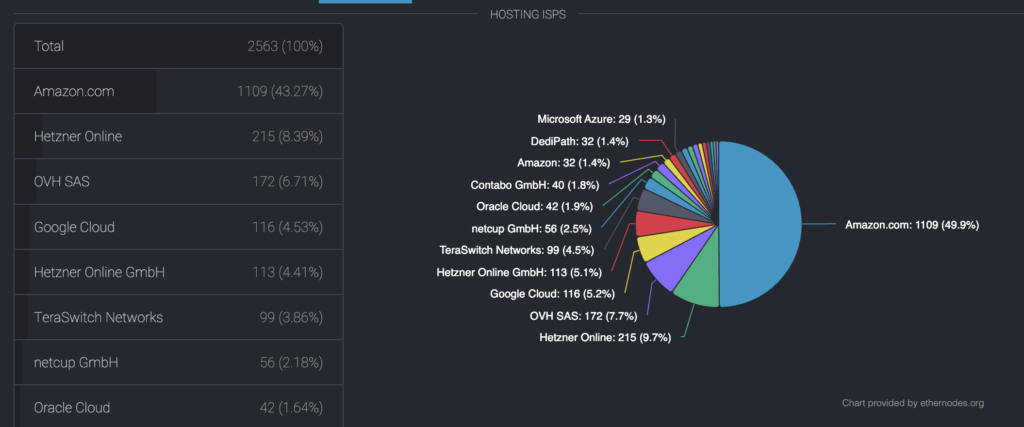
The charts below show the distribution of Ethereum nodes by provider in July 2022 and as of October 12, 2023. Currently, 52.3% of nodes are running on hosting services, an increase from 5.3%.
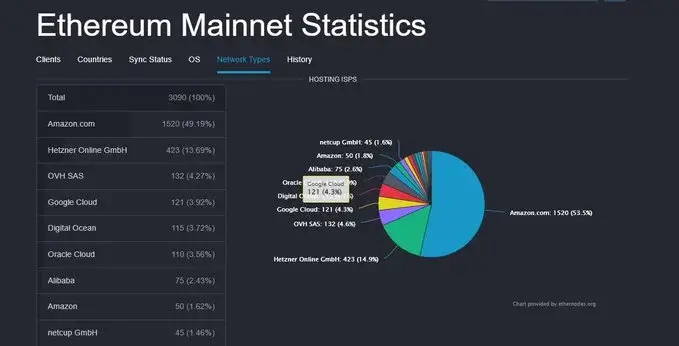
According to most recent data, Amazon now holds the majority of hosting hosts, having increased its market share by around 6% over the past 15 months to 49.19%, up from 43.27% in July 2022.
UPDATE: The numbers on the ethernodes graphs don’t seem to match those in the tables. The analyzed data follows the table.