
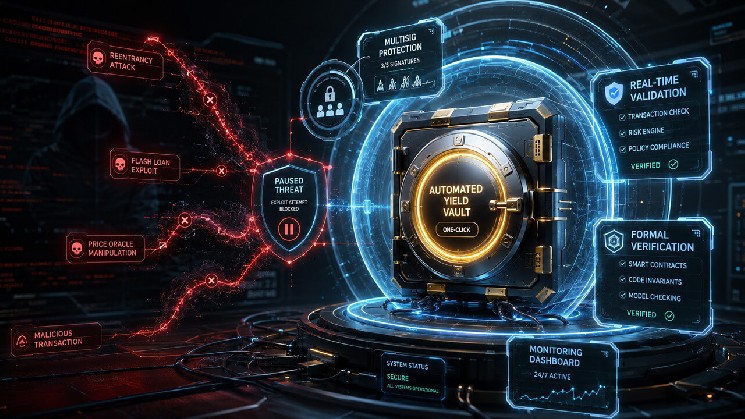
Automated return protocols provided DeFi’s most compelling sales pitch that depositing into a vault was all a user needed to do, while the protocol handled everything else.
For users who want to benefit from Curve’s increased returns without manual management $CRV locks, voting power, wrappers, meters and incentives, Stake DAO offered a product that packaged the entire stack behind a simple interface while also packaging what could break.
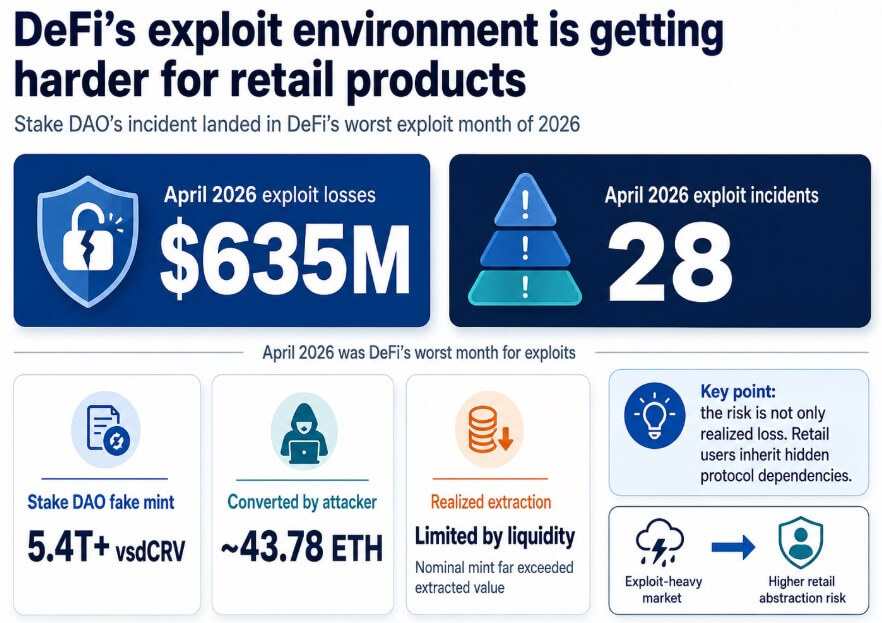
According to Blockaid, an attacker minted more than 5.4 trillion vsdCRV on Arbitrum via a suspected deployment key compromise and began exchanging tokens for $ETH.
The attacker modified the LayerZero-related peer configuration to spoof a cross-chain message before creating 5,446,744,073,709 vsdCRV, converting a portion to approximately 43.78 $ETHwhere liquidity limits the realized extraction to well below the nominal currency.
Stake DAO told users not to interact with vsdCRV while the situation was active. The incident spread to Curve, which alerted users in an affected Arbitrum LlamaLend market, and Beefy Finance paused a connected vault with exposure to Curve and Convex.
Stake DAO’s Liquid Lockers allow users to deposit governance tokens $CRVreceive liquid sdTokens and access increased yield and governance exposure without directly managing the Curve-locking stack.
The vault interface hides all that, while also hiding the deployment keys, cross-chain messaging trust, wrapper token accounting, and oracle dependencies the exploit traveled through.
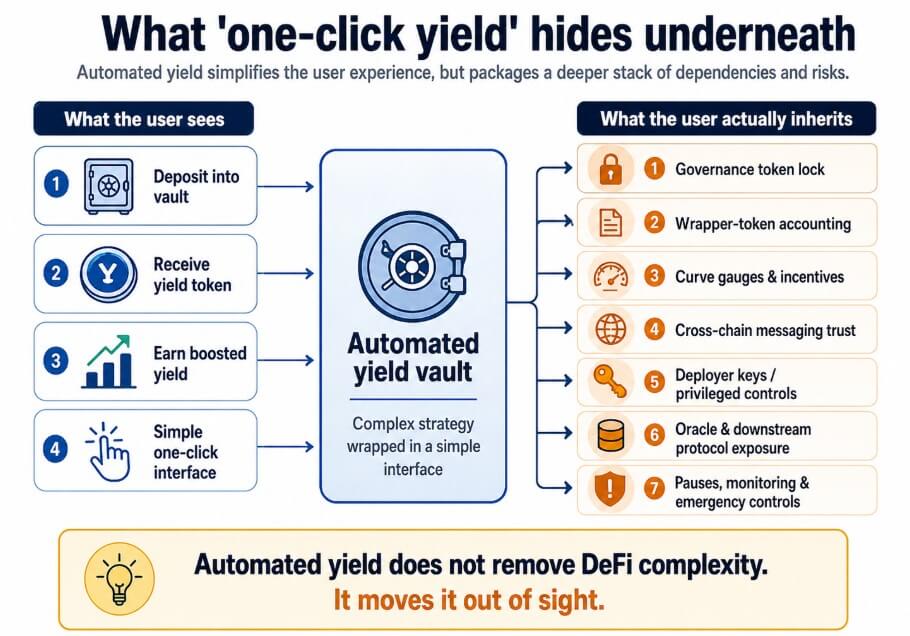
Automated yield takes the complexity of DeFi out of sight, a move that only becomes visible when something breaks in the hidden layer.
Ido Ben-Natan, co-founder and CEO of Blockaid, summarized the security disconnect in a note:
“Wherever there is value on the chain, there will be attackers trying to exploit it, and that is true no matter how simple or complex a protocol’s strategy is. Two things matter here. First, whether protocols have the right governance infrastructure in place to ensure there is no easy mistake to exploit. Second, having a real-time on-chain security tool that validates every transaction before it is executed.”
The broader reckoning
April 2026 was DeFi’s worst month for exploits, with roughly $635 million recovered from 28 incidents, driven by social engineering, bridge spoofing, and AI-assisted exploration.
Manuel Aráoz, co-founder of OpenZeppelin and CTO until 2019, wrote that he now considers “all” of DeFi unsafe because AI coding agents have become “superhuman” at finding vulnerabilities, while defenders need to fix every bug and attackers only need one.
OpenZeppelin has publicly rejected that claim, stating that Aráoz’s posts do not reflect the company’s position. However, the asymmetry he describes has also attracted serious attention outside the attribution conflict.
Ben-Natan puts the defensive advantage in real-time tooling and adaptive threat detection:
“Hackers are increasingly using AI to act faster and find new attack vectors. However, on-chain cybersecurity providers like Blockaid have deep experience using AI to stay ahead. We continuously analyze and adapt to new threat patterns in real time, using AI agents for investigations, simulations and malicious pattern matching.”
That real-time capability makes transaction validation a viable countermeasure to the speed edge attackers are gaining, and for automated yield protocols, governance controls and monitoring have become the de facto layer of security on which the vault interface depends.
The next vault
In the bear scenario, more major compromises, bridge incidents, oracle contagions, and vault breaks lead to an abstraction discount in automated return products.
Users demand higher returns to compensate for hidden stack risk, making it harder to sustain one-click returns without explicit risk disclosure, and smaller vaults lose TVL as integrations become risk-sensitive.
The incident pattern that defined April extends through the rest of the year, and each new incident reinforces the perception that revenue automation bundles risks that users cannot independently assess.
In the bull case, the protocols adopt the architecture that Ben-Natan describes, consisting of governance controls that eliminate simple points of failure, real-time transaction validation and continuous monitoring of threat patterns, and automated returns survive in a more standardized form.
Formal authentication, multisig controls, and runtime monitoring become the standard infrastructure, and the products that maintain retail trust are the products that expose and manage the dependency stack.
Security vendors and risk dashboards are embedded in the vault interface itself, and the competitive advantage shifts from hiding complexity to proving which parts of it are under control.
The retail promise of automated yield has always been about shifting complexity, and for years the protocol invisibly absorbed that burden. The Stake DAO exploit shows what happens when the invisible layer breaks, and April’s record shows that it is breaking more and more often.
The next automated yield product that wins retail trust will earn it by showing users which parts of the stack are monitored, controlled, and isolated, and what the protocol does if one part fails.