
DeFi’s Total Value Locked (TVL) has fallen from nearly $178 billion to around $72.5 billion, continuing a decline that has been ongoing since its late 2025 peak.
This weakness extends across lending, liquid staking and bridging protocols, suggesting that participation within the broader ecosystem is shrinking rather than within a single sector.
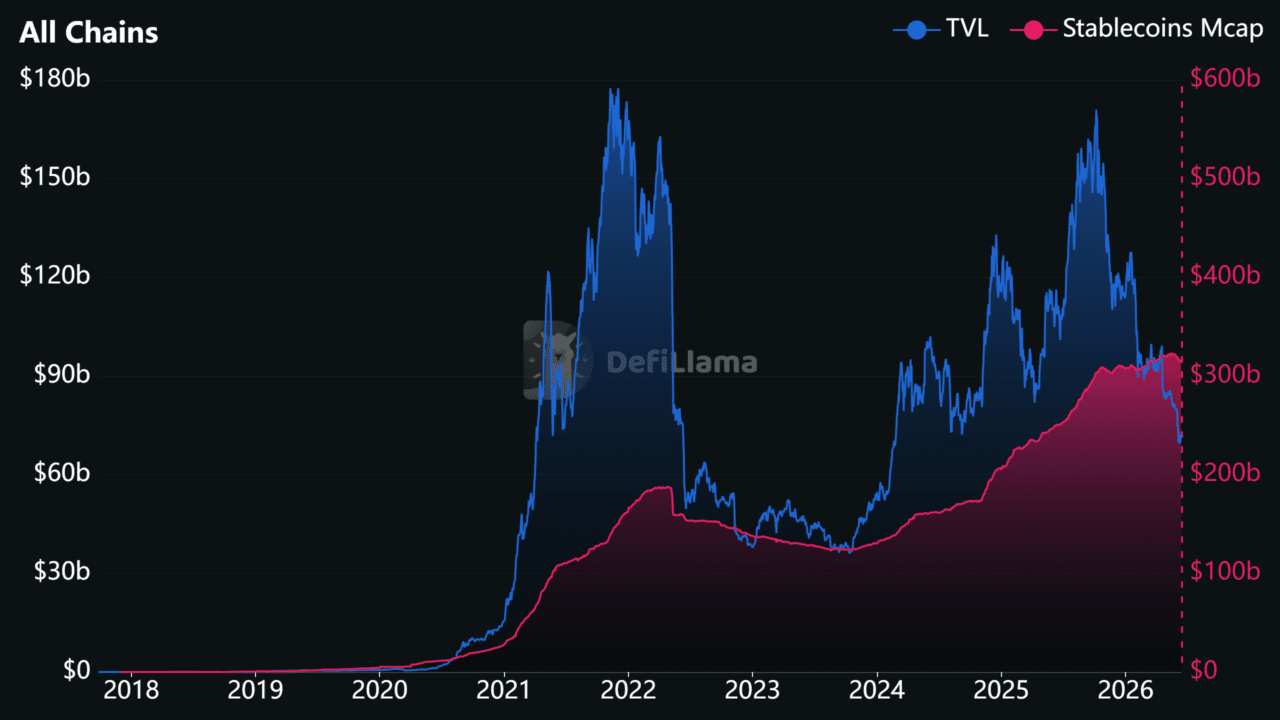
Meanwhile, stablecoin supply remains close to $315 billion, indicating that liquidity still exists even as DeFi activity declines. The gap between available capital and declining TVL indicates that investors are becoming increasingly selective about risks.
Taken together, these trends point toward reduced capital deployment rather than a collapse of the DeFi infrastructure itself.
Why is capital leaving DeFi?
DeFi’s latest slowdown reflects a growing risk-reward mismatch across the ecosystem.
Stable interest rates on major platforms now range between 3.5% and 9%, reflecting weaker loan demand and offering investors less reward for taking DeFi-related risks.
As returns shrink, investors receive less compensation for smart contract, liquidity, and liquidation risks. This shift reduced the appeal of deploying capital in the credit and staking protocols.
The pressure increased in the second quarter of 2026, when nearly seventy protocols were abused and approximately $746 million was lost. While most incidents remained smaller than previous megahacks, their frequency heightened security concerns.
As a result, investors increasingly prioritized capital preservation over generating returns. This combination leaves DeFi with weaker incentives and higher perceived risk.
Ethereum and Solana hold steady as DeFi falls
The shrinkage of DeFi exposes a growing gap between network belief and protocol participation. While Total Value Locked continues to trend downward, Ethereum remains [$ETH] and Solana [$SOL] holders show little sign of reducing exposure.
About a third of Ethereum’s supply remains staked, while Solana’s staking participation is nearly 68%. These numbers suggest that investors still have confidence in the underlying networks, even as activity within the DeFi protocols weakens.
The difference indicates that capital is becoming more selective. Rather than seeking additional returns through borrowing, liquid staking or other strategies, investors appear increasingly comfortable holding and deploying the underlying assets.
Instead, the decline appears to reflect changing risk preferences within crypto.
Final summary
- Ethereum [$ETH] and Solana [$SOL] continue to raise capital through staking and accumulation, even as DeFi participation weakens.
- DeFi’s TVL decline reflects lower risk appetite and weaker incentives, rather than a collapse in the underlying infrastructure.