
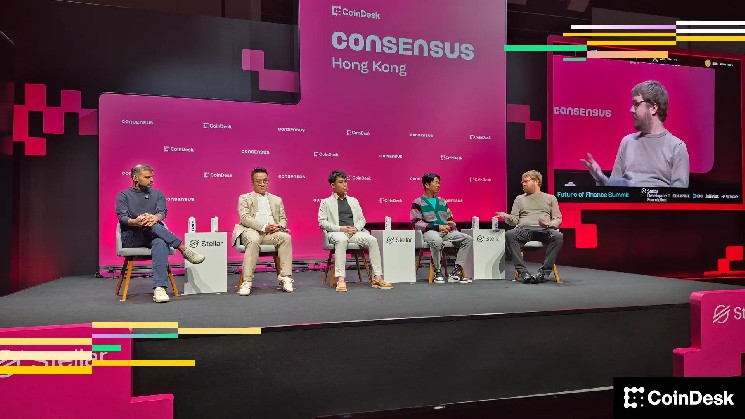
HONG KONG – At the Consensus Hong Kong 2026 conference, the conversation about decentralized finance (DeFi) took a sharp turn toward the pragmatic.
The panel: “How Decentralized Is DeFi Anyway?” saw industry leaders dismantling the myth of ‘pure decentralization’ in favor of a reality where temporary centralization is a survival mechanism.
The “decentralization illusion” highlights the friction between the permissionless ideals of DeFi and its operational reality. While the goal is to replace intermediaries with smart contracts, most protocols exist on a spectrum rather than in a binary state.
Anand Gomes, head of Paradigm and Paradex, rejected the idea of binary decentralization and instead described the current state of most protocols as a necessary “incubation phase.”
Gomes famously compared the role of a protocol founder to that of a parent. “You want your children to be strong and independent when they grow up,” he explained, “but that doesn’t mean you leave them alone in their infancy.” For Gomes, using admin keys and centralized guardrails in the first 18 months is a fiduciary duty; a protocol that is exploited in the first six months simply has no future to decentralize.
This creates a clear contrast with Vitalik Buterin’s role as architect of Ethereum’s base layer. Gomes positioned Buterin as the head of a ‘government’ (layer 1) whose role is to guarantee stability through neutral, constitutional rules.
Conversely, Tier 2 founders act as “companies” focused on growth. While Buterin pushes for “phase 1” decentralization to ensure the L1 remains a “freedom machine,” Gomes argued that founders must be “stubborn” in protecting their protocols during early vulnerability.
Glenn Woo, representative of infrastructure giant Blockdaemon, noted that as DeFi scales to meet institutional demand, hardware and security requirements naturally create layers of centralization.
Woo said he believes that if DeFi is to survive the scrutiny of global clearinghouses like the DTCC, it will need a professional, robust infrastructure that often trades absolute decentralization for institutional-grade reliability.
Treehouse’s Benji Loh echoed this sentiment, noting that temporary centralization is the “price of admission” to the Wall Street tailwind needed to fund a robust ecosystem. He noted that even the most successful protocols only push for the decentralized ideal after finding good product-market fit and a stable trading infrastructure.
Arion Ho, CEO of ENI, added that the path to true decentralization must be paved with “transparent rules” rather than immediate, chaotic supervision. “Decentralization is not really a form of the kind of governance we have been doing,”
Ho said: “This is how to avoid too much human intervention.” He also said that by starting with a rules-based, verifiable structure hard-coded into the system’s DNA, the founders ensure that when the keys are eventually handed over to the community, the transition is both safe and sustainable.
As institutional heavyweights like Goldman Sachs move multibillion-dollar operations up the chain, the panel’s consensus was clear: the goal is no longer just to remove middlemen, but to ensure that when the “parental” guardrails are finally removed, the protocols are mature enough to withstand the scrutiny of global markets.