
Despite the recent bloom of the decentralized social media app Friend.tech, executives from the industry argue there’s still much more work to be done — with many still experiencing massive challenges getting users to sign up and stay on their platforms.
Two executives in the decentralized social (DeSo) media space told Cointelegraph that as much as 99% of users moving into DeSo for the first time will end up quitting, either due to clunky onboarding or simply not knowing anyone.
Ed Moss, the head of growth for layer-1 blockchain firm DeSo, said the process of cryptocurrencies from an exchange, transferring it to a wallet with an installed Chrome extension, and then paying high gas fees to transact on-chain or across chains is tedious and expensive for first-time users.
“We’ve found that 99% of mainstream users will drop off at that first step, so simplifying this flow is mission critical.”
Therefore, the single most important factor is to make sure the onboarding process is as frictionless as possible, Moss said.
Imagine you had to mint everything we post on social media and had to pay gas fees. How would you spend your time, money and energy? This is what you should be focusing on.
— Ruben Cress #HIVE (@RubenCress) October 21, 2022
But the problems can start even before this point, according to Suhail Kakar, the creator of DeSo app Onboard.
Because users need to familiarize themselves with blockchain, smart contracts, and wallets before they sign up, they often shy away from taking the first step, Kakar explained.
“A party where you don’t know anyone.”
Catching up to the massive network effects that web2 social platforms such as Facebook, Instagram and X (formerly Twitter) won’t be an easy task either.
Kakar said DeSo apps need to spend more time building their communities because making a presence in these applications is “a bit like going to a party where you don’t know anyone.”
He believes that as more top-tier creators and influencers move on-chain it could be a tipping point, as users will ultimately follow where the high-quality content goes.
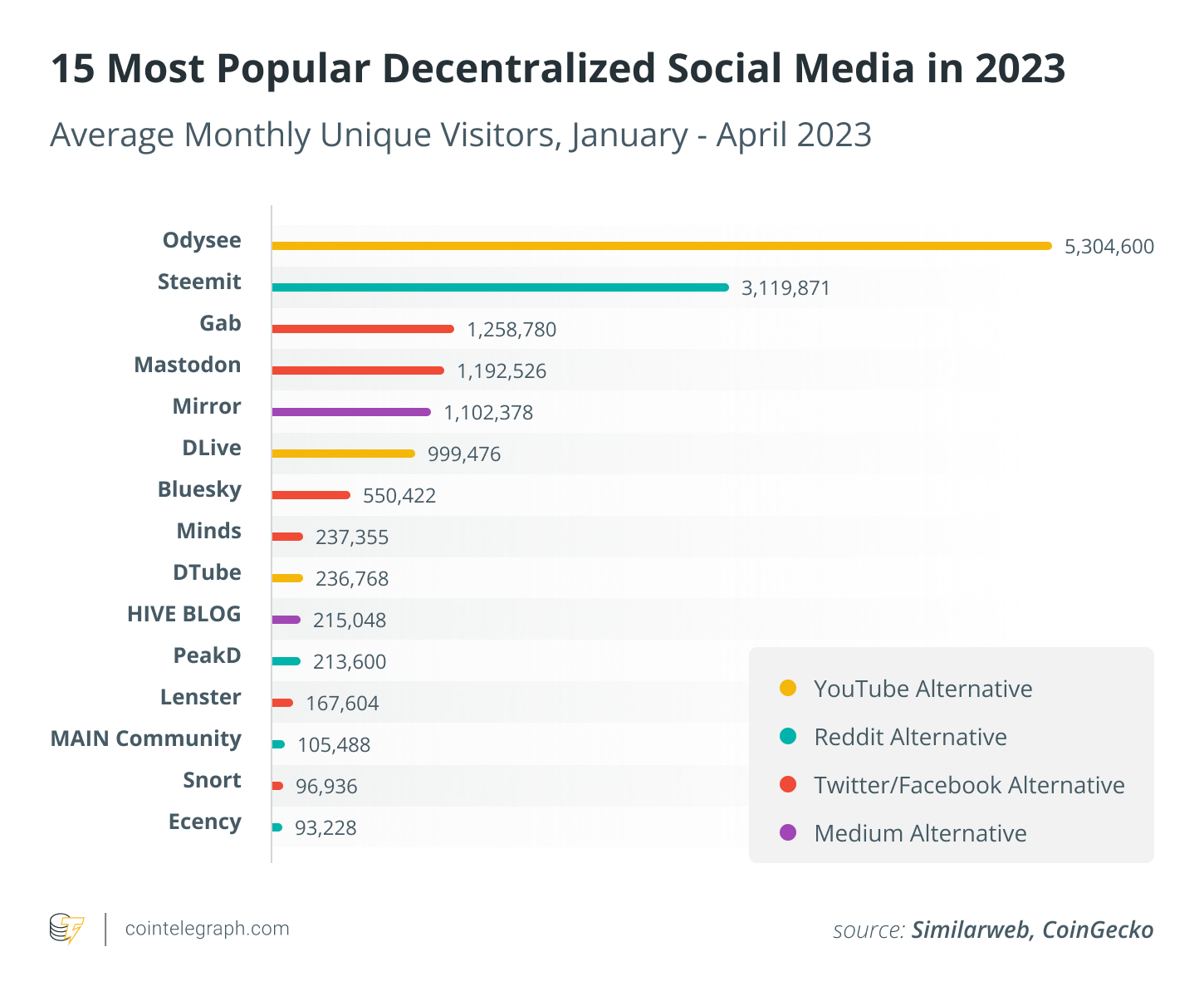
Data from April shows that Facebook, Instagram and Twitter hosted about 2.98 billion, 2 billion, and 372.9 million monthly active users, respectively. By comparison, one of the most visited decentralized social media networks Odysee averaged only 5.3 million average monthly unique users between January and April, according to CoinGecko.

Moss argues another reason why decentralized social media hasn’t hit the masses is because Ethereum and other smart contract platforms aren’t purpose-built to provide social media applications at scale.
Thus, we believe the future of crypto does not consist of a single general-purpose blockchain that rules them all, but rather a series of dominant, specialized blockchain, each tailored to a particular category of applications. This is the way crypto will see mass adoption.
— DeSo (@desoprotocol) December 29, 2021
The ideal solution would be to architect a “storage-heavy” or “infinite-state” blockchain, that is capable of storing and indexing massive amounts of data at the lowest cost possible, he explained:
“This is what a social application would require in order to store actions like ‘posts,’ ‘likes,’ ‘follows,’ ‘comments,’ and ‘social graphs’ directly on-chain to enable full decentralization from any corporate entity or centralized government.”
Without it, Moss believes end-users may never truly own their content, identity and social graph.
Will Friend.tech buck trend?
Base-powered social platform Friend.tech has seen strong uptake over the past few weeks.
The platform allows creators to connect to their audience through tokenized attention, where a creator’s influence is represented by shares, or keys that can be traded for access to exclusive private chat rooms.
Friend.tech has reeled in over 85,000 users from over 127,000 wallets, which have collectively sent over 630,000 requests to the network since it launched earlier this month, according to CoinGecko.
However, other industry pundits believe the model may turn out to be a six-to-eight-week fad, while some have even suggested the platform is already starting to lose steam.
Related: Decentralized social media a game changer for creator monetization — Web3 exec
Sales revenue from decentralized social media networks is projected to reach $12.1 billion in 2023 and is estimated to surpass $101 billion by 2033, a compounded annual growth rate of 23.6%, according to Future Markets Insights.
Other decentralized social media networks include Jack Dorsey’s Bluesky — a decentralized Twitter alternative, Mastodon and Lens Protocol.
Collect this article as an NFT to preserve this moment in history and show your support for independent journalism in the crypto space.
Magazine: Decentralized social media: The next big thing in crypto?