

Decentralized finance (DeFi) can no longer rely on inflationary token incentives to support growth, according to Michael Egorov, founder of Curve Finance.
In an interview with Cointelegraph, Egorov said protocols should generate real revenue instead of relying on issuance to attract liquidity.
“Your return should come from revenue, not from tokens,” Egorov told Cointelegraph. “You need real income.” He added that if a token “doesn’t do something, it might be better for you not to do a token at all.”
Egorov contrasted the current environment with the “DeFi summer” of 2020, when triple-digit and even annual rates of 1,000% attracted capital into new protocols. He said speculative premiums at the time drove up token prices and boosted the total value locked (TVL) for protocols.
“At this point, news no longer changes token prices,” he told Cointelegraph, arguing that users have “reevaluated the risks.”
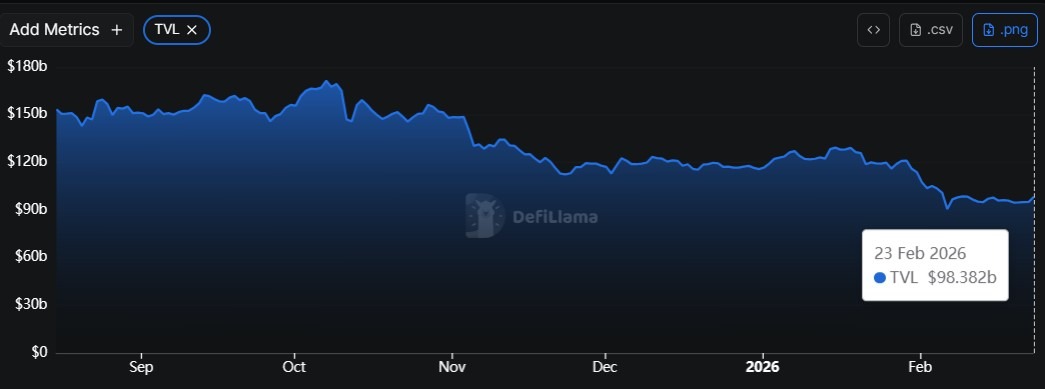
DeFi TVL in the last six months. Source: DefiLlama
His comments come as DeFi’s TVL has fallen by around 38% over the past six months, according to DefiLlama. Data from the analytics platform shows that TVL fell from $158 billion on August 23, 2025 to around $98 billion on Monday.
Curve’s founder says revenue integration is better than emissions-driven returns
Egorov said protocols “cannot live without real income flowing,” arguing that sustainable returns must be linked to actual economic activity.
While token issuance once helped projects quickly accumulate liquidity, he argued that sustainable returns must be linked to actual economic activity.
“In 2020, people didn’t care much about risks,” Egorov said. High symbolic rewards can compensate for losses if projects fail later.
“At the moment that is absolutely impossible. If you deposit something somewhere, you have to be sure that the protocol will be technically safe for at least years.”
He also linked tokens to decentralization rather than speculation. Without decentralized governance, he said, a project risks being treated like a regulated financial service.
“Tokens are needed for decentralization, not a get-rich-quick scheme,” he said.
Previous commentary has raised similar concerns. In an op-ed for Cointelegraph, Marc Boiron, CEO of Polygon Labs, wrote that inflationary emissions only create “temporary illusions of success.”
Discussions about DeFi and centralized returns products have also recently resurfaced on social media.
On February 9, Ethereum co-founder Vitalik Buterin argued that the real value of DeFi lies in redistributing risk, rather than simply generating returns on fiat-backed assets.
Related: Hyperliquid launches DeFi lobby amid ‘critical time’ for US policy
From speculation to sustainability
Egorov also said that speculative focus has shifted. “All speculative premiums have been stolen by meme coins,” he said, suggesting that DeFi tokens are now traded more on fundamentals than hype.
He told Cointelegraph that this dynamic makes it harder to attract “mercenary capital” that moves quickly between protocols in search of the highest returns.
He also pointed to a changing market structure. Retail traders have gravitated toward perpetual futures markets, while institutional participants are accumulating more and more spot assets.
Defillama data shows that perpetual futures volume reached $1.37 trillion in October 2025.
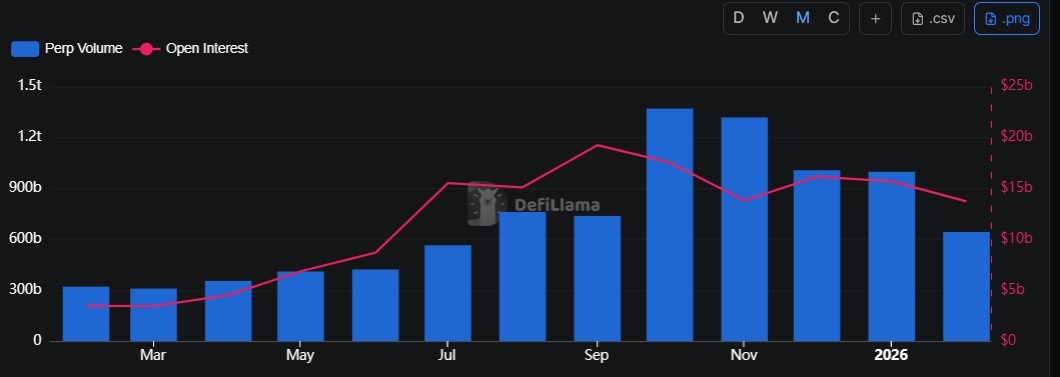
Perpetual futures monthly trading volume. Source: DefiLlama
According to Egorov, sustainable oncha companies will have to compete on revenue generation and capital efficiency, rather than on annual returns.
Magazine: The 6 Strangest Devices People Have Used to Mine Bitcoin and Crypto