
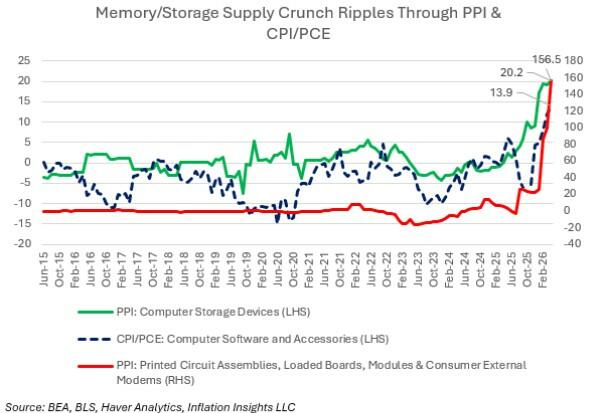
Last September, when the memory bubble was just getting started, we said that inevitably “the cure for high commodity prices is, well, high commodity prices.” While many financial market maxims have quietly ceased working in recent years thanks to rigged markets due to central bank interventions and market manipulation by both money printers and HFTs, this is one that will never fail, the only question is timing. Furthermore, there is one other thing that can be added as an ironclad footnote here, and that is that once China starts producing the commodity in question, what was formerly price euphoria quickly turns to collapse (as history so vividly demonstrates when looking at any of China’s export markets, where price dumping always unleashes hell for domestic producers). Well, for memory chips, that time has finally come.
You mean commodity DRAM prices won’t go to infinity? https://t.co/islKPtFQY2
— zerohedge (@zerohedge) May 22, 2026
According to Tom’s Hardware, Wccftech and techspot, Chinese semiconductor firms have begun flooding the market with domestically produced DRAM and NAND chips in a move that analysts say will drive down memory and storage prices, offering consumers some much-needed relief. Reports suggest that several leading global PC component manufacturers have already started using the chips in upcoming products.
According to screenshots posted on X by tipster @wxnod, Corsair has integrated memory chips manufactured by Chinese DRAM maker ChangXin Memory Technologies (CXMT) into its next-generation memory modules. While Corsair typically sources memory chips from Micron Technology, elevated market prices have reportedly pushed the company to explore more cost-effective alternatives.
CXMT DDR5 DRAM Die Appears in Corsair Memory pic.twitter.com/GRLeAUHtEN
— Алексей (@wxnod) May 22, 2026
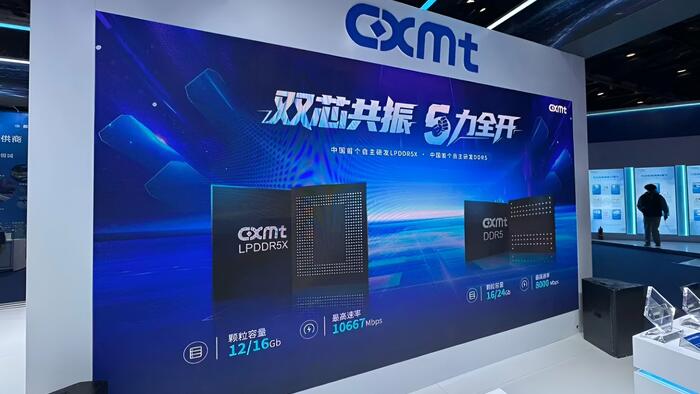
As Tom’s Hardware lays out, in late 2024, China-based ChangXing Memory Technologies (CXMT) began producing DDR5 modules aimed at the consumer market. Since then, the company has even laid out a roadmap that currently puts its max DDR5 capabilities at 8,000 MT/s across 16 Gb and 24 Gb densities. Fast forward to today, and we’re finally seeing Chinese DRAM in a mainstream product, more specifically, a Corsair Vengeance DDR5 16GB stick, running at 6,000 MT/s with CL36 speeds.
In the “CMK5X16G3E60C36A2-CN” part number, the “CN” denotes it’s a China-exclusive kit. It’s still certified for both Intel XMP and AMD EXPO (since it runs beyond JEDEC speeds), and we also see the rest of the specs printed on the label, such as the timings and operating voltage. There are also “UKCA” and “CE” signs that indicate this kit meets European and British standards for sale in those regions.
The most important thing to note is that the DRAM manufacturer is listed at ChangXin Technologies or CXMT. Now there are plenty of reasons why Corsair has chosen CXMT over its usual Samsung and SK Hynix partners. The shortages that everyone now knows about are the primary reason, and then there’s the cost factor.

The post above shows CPU-Z screenshots clearly revealing that the DRAM powering this kit is from CXMT and not one of the big three memory makers: Micron, Samsung, or SK Hynix. All of those companies are busy selling out their entire production lines to data centers instead, so it makes sense that Corsair is shifting around its suppliers. CXMT might seem like an unusual choice, but the company is well-positioned for this transition. It confirms that consumers are now buying RAM made outside the Micron, Samsung, SK Hynix memory cartel that has controlled the market for 20 years, and has single handedly sent us PPI soaring.
While unlike major DRAM manufacturers, CXMT isn’t widely seen as possessing the latest cutting-edge tools to produce memory for hyperscalers, it is rapidly catching up: HP placed major LPDDR5 orders with CXMT in January, Qualcomm began custom DRAM work with the company in April, and Dell, Asus, and Acer have all approached the manufacturer. Furthermore, the company isn’t tied to any data center contracts (for now), so it has largely empty production lines just waiting for customers. The clientele CXMT seems to be targeting is regular consumers left in the dust by the rest of the RAM industry.
Until now, CXMT has only really sold to local businesses and lesser-known brands, but being featured in a Corsair kit marks a major shift in the landscape. Even if this kit is exclusive to Chinese markets, it’s still made by one of the biggest names in consumer memory — a name that people trust. Besides, most customers won’t actually check what factory their DRAM chips are coming from as long as the specs seem up to par.
As shown below, the kit in question is a DDR5-6000 CL36, which is not the fastest, but is more than sufficient for gaming and daily tasks. There’s generally less than 5% difference between a CL30 and CL36 kit at 6,000 MT/s, so for those saving a lot of money going for the slower latency, it might be worth it in some cases, like – you know – a global RAM shortage. That brings us to the main question: Is this RAM actually cheaper?
CXMT DDR5 DRAM 6000 C36-40-40-96 V1.35 pic.twitter.com/rk22qsWYkJ
— Алексей (@wxnod) May 22, 2026
There was no explicit mention of a price, so for all we know, Corsair is sourcing cheaper memory from CXMT but still selling it at the same inflated rates. If supply from Samsung, SK Hynix, and Micron is tight, it makes sense that DRAM bought from those companies would be expensive, but CXMT-made DDR5 should be significantly more affordable for it to matter and make an actual dent in the market.
Given how massively Chinese firms are increasing their memory production capacity this year, they can not only facilitate their own domestic needs but also provide a cheaper yet similar spec’d alternative to offshore PC manufacturers. Both CXMT and YMTC are going to double their wafer output capacity through an “Epic Expansion” initiative, which is already underway.
As the memory crisis intensifies and more pressure is exerted on Samsung, SK Hynix, and Micron, Chinese vendors will start to fill in the gaps, and are already seeing major revenue boosts. Expect to see lots of Chinese DRAM solutions powering memory modules from well-known brands at Computex this year.
And while Hefei-based CXMT, or ChangXin Memory Technologies, is China’s largest memory chipmaker, it only unveiled its DDR5 portfolio last year. Furthermore, the company only controls about 7.7% of the global DRAM market and counts several major Chinese tech firms, including Alibaba, Tencent, and ByteDance, among its customers. And now that it can easily undercut most of its international competition on price to gain market share, it will do just that. As a reminder, Chinese chips broke DDR3 and DDR4 pricing on the way in, and DDR5 is now next in line for the same treatment.
The company’s strategy ties directly to what Seagate’s CEO told JPMorgan last Monday (sending the company’s stock price tumbling): that building new factories would “take too long,” and the stock fell 6% because investors heard “we cannot meet demand.” When, not if, CXMT meets that demand from outside the cartel, the supply tightness that has justified the memory ETF rally will collapse. To be sure, political risk remains since CXMT could still get added to any future US blacklist, but European markets are already open and the trade routes for memory chips do not respect Commerce Department guidance.
Why is CXMT going all out now
CXMT, has been ramping up capacity to compete with global leaders Samsung, SK Hynix, and Micron. The company offers DRAM dies in 64Gb and 16Gb configurations with speeds of up to 8,000 MT/s. Other Chinese memory manufacturers, such as YMTC and Jiahe Jinwei, are also expanding capacity to produce DDR5 RDIMMs for data centers and server deployments.
With memory pricing reaching record highs, CXMT’s Q1 revenue rose to 50.8 billion yuan ($7.4 billion), up 719% year over year. The company also reported net profit of 33.0 billion yuan ($4.41 billion), compared with a loss of 2.83 billion yuan ($384 million) in the same period last year. The chipmaker is now reportedly preparing for a listing on the Shanghai Stock Exchange, with a multi-billion-dollar IPO planned later this year. Indeed, last week Goldman noted that “CXMT’s updated IPO prospectus, filed last Sunday, indicates that the company is scaling faster and has become materially more profitable than the market had appreciated.”
Here comes Chinese memory: “CXMT’s updated IPO prospectus, filed on Sunday, indicates that the company is scaling faster and has become materially more profitable than the market had appreciated”- Goldman
— zerohedge (@zerohedge) May 20, 2026
Some more details: according to China’s Hongxing News on the 18th of May, ahead of its upcoming IPO, CXMT said in a prospectus released the previous day that first-quarter sales came to 50.8 billion yuan (about 11.1 trillion won), up 719.13% from a year earlier. First-quarter net profit (net profit attributable to the parent company) was 24.762 billion yuan (about 5.4 trillion won), up 1,688.3% from a year earlier.
Net profit attributable to the parent company refers to the portion of consolidated net income that ultimately belongs to the parent company’s shareholders. CXMT’s first-quarter sales and net profit surpassed all listings on the STAR Market, including SMIC (Semiconductor Manufacturing International Corp.), China’s largest foundry (contract chipmaker).
CXMT has higher revenue than Kioxia and SanDisk. China finally has a memory player. pic.twitter.com/hkA052ud36
— Omer Cheema (@OmerCheeema) May 24, 2026
As an aside, the CXMT prospectus indicates that the company’s yields for DDR5 and LPDDR5X on its 1a (16nm-class) node have reached 80%+.For semicap space the cleaner beneficiaries are likely to be the domestic Chinese equipment vendors (given that China policy is to push for domestic tools where feasible) such as Naura, AMEC and SMEE, while the case for ASML is more nuanced given ongoing lithography constraints in China.
But wait, it’s not just DRAM and CXMT: last week Reuters reported that China’s top flash memory chipmaker YMTC has begun the so-called “tutoring” process for a potential initial public offering, where a company receives formal pre-IPO guidance from an investment bank, a regulatory filing showed on Tuesday. NAND maker Yangtze Memory Technologies Co (YMTC) has hired CITIC Securities, a Chinese state-owned investment bank, to guide its IPO preparation ahead of a potential stock market listing.
Despite being added to a U.S. trade blacklist in late 2022, which curtailed its access to foreign chipmaking tools, the Wuhan-based company has expanded its use of domestic equipment suppliers such as Naura and is aggressively adding capacity
If CXMT is going after the Samsungs and Microns of the world with its DRAM portfolio, YMTC is going right after Sandisk: China’s largest maker of NAND flash memory chips has two factories with a combined monthly output of 200,000 wafers. YMTC’s third factory in Wuhan will start operations late this year, and has capacity to produce 50,000 wafers per month by 2027, Reuters has reported previously.
YMTC and CXMT are China’s best hopes for establishing a foothold in a global memory chip market long dominated by South Korean and US players, and one can be sure that in a world where even hyperscalers are giving up a huge chunk of margins to memory producers (see “Nvidia’s Vera Rubin Rack Will Cost $7.8MM: Here’s What’s In It”), Beijing will do everything it can – and must – to win over as many margin-conscious companies as it can.

And it will do so using the oldest trick in the Chinese book: by massively undercutting all of its established competition on price.