
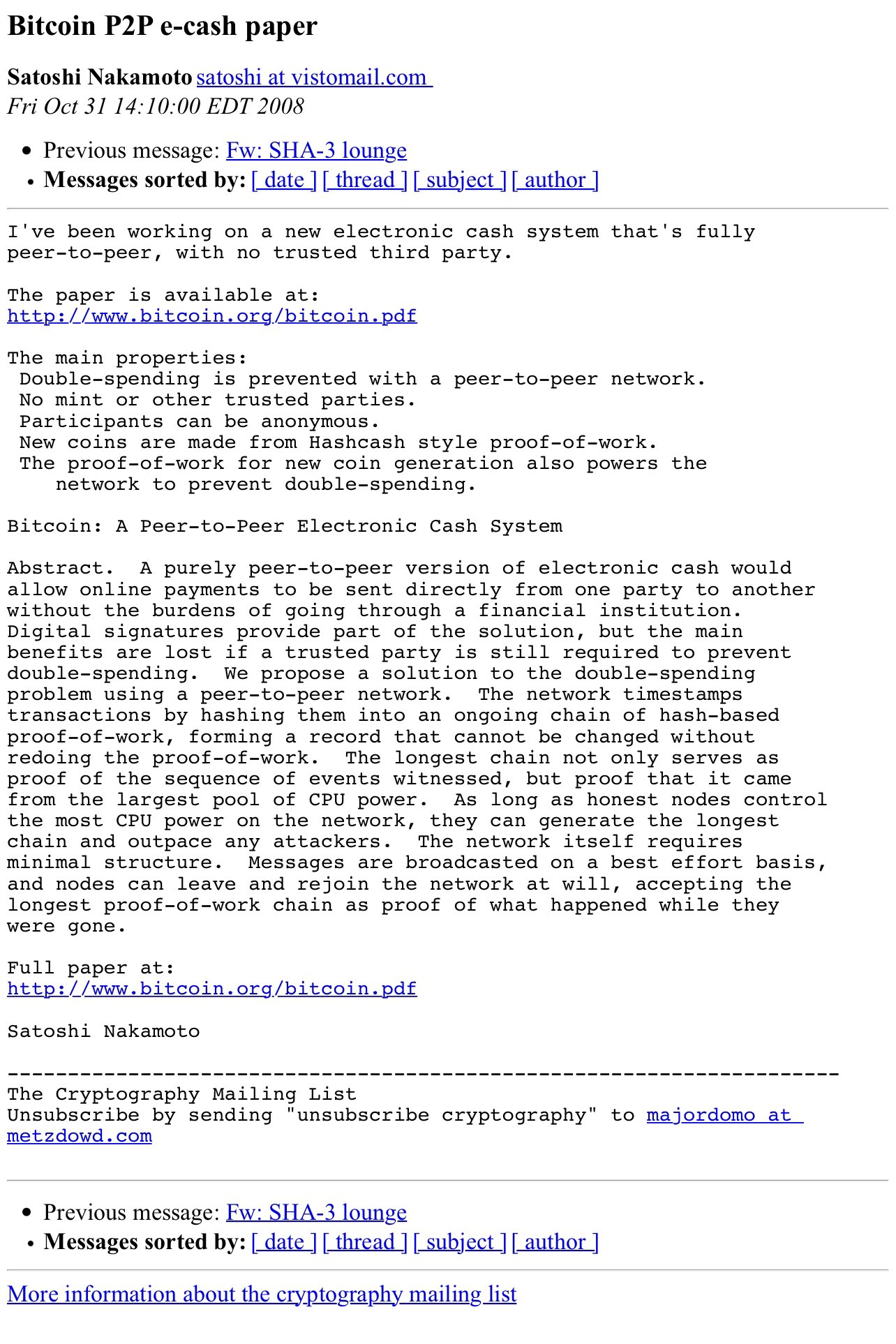
Today marks 15 years since the pseudonymous creator of Bitcoin, Satoshi Nakamoto, shared the Bitcoin white paper to a mailing list of cryptographers on Oct. 31, 2008 — a date also annually celebrated as Halloween.
“I’ve been working on a new electronic cash system that’s fully peer-to-peer, with no trusted third party,” Satoshi famously said in the opening sentence before linking the document titled “Bitcoin: A Peer-to-Peer Electronic Cash System.”

The white paper proposed a decentralized system that could facilitate peer-to-peer transactions, which could solve the “double spending” problem often associated with digital currency.
It proposed to achieve this via a network of nodes to validate and record transactions through a proof-of-work consensus mechanism, launching just two months later on Jan. 3, 2009.
How Bitcoin was brought to life
Satoshi’s computer science breakthrough came on the back of other impressive developments in the cryptography and e-money spaces.
The first reference cited in the Bitcoin white paper is Wei Dai’s invention of B-money, an electronic peer-to-peer cash system that never launched but nonetheless played a key role in Satoshi’s plans for Bitcoin.
Like Bitcoin, B-money proposed that participants in the system maintain a database of account balances, which keep track of the ownership of money. Transactions would be initiated and completed by a broadcast message to all participants, which would update the account balances of those involved in a specific transaction.
In many ways, it could be seen as a precursor to the nodes of Bitcoin’s protocol, which keep a record of the constantly growing blockchain.
This process requires proof-of-work, a form of cryptographic proof in which one party proves to others that a certain amount of a specific computational effort has been expended.
Satoshi implemented this into Bitcoin, citing Adam Back’s invention of Hashcash in 1997, which incorporated proof-of-work to limit email spam and denial-of-service attacks.
The Cypherpunks and Fathers of #Bitcoin:
• Hal Finney: Reusable PoW
• Adam Back: Hashcash
• Wei Dai: B-money
• David Chaum: DigiCash
• Nick Szabo: BitGold
• Phil Zimmermann: PGP
• Bram Cohen: BitTorrent
• Tim May: Crypto Anarchist ManifestoAnd Satoshi Nakamoto: Bitcoin
— Crypto Leroy (@TheBitLeroy) June 27, 2020
Timestamps are another core property of Bitcoin, which was successfully implemented by Satoshi.
Bitcoin’s timestamp server works by taking a hash — akin to a unique serial number — of a block of transactions and timestamping it when the block is added to Bitcoin’s blockchain.
The hashes cryptographically link one block to the next, ensuring the integrity of Bitcoin data. Timestamps also prevent double spending on Bitcoin, making the network tamper-proof and immutable.
Satoshi cited work from Henri Massias, Scott Stornetta, Stuart Haber and Dave Bayer in implementing timestamping into Bitcoin’s protocol.
Meanwhile, Merkle trees were implemented into Bitcoin to verify transaction data through digital signatures. Satoshi cited Ralph Merkle’s work on developing public-key cryptosystems.
David Chaum – “DigiCash” 1995
R.C Merkle – “Protocols for public key cryptosystems” 1980
Adam Back – Hashcash – “A Deniel of Service Counter-Measure” 2002
Nick Szabo – “Bit Gold” 2005
Wei Dai – “b-money” 1998
Satoshi Nakamoto – “Bitcoin: A Peer-to-Peer Electronic Cash System 2008 pic.twitter.com/EjfVsE4pDc— Crypto Shaman (@CryptoShaman256) September 10, 2022
Bitcoin advocate and cyperphunk Jameson Lopp previously told Cointelegraph that credit should be given to the preliminary projects that paved the way for Bitcoin.
However, the genius in Satoshi was the puzzling of all these pieces into a fully functional system, said Lopp:
“There’s no single piece of the puzzle that I think is more important than the others. Nakamoto’s genius was not any of the individual components of Bitcoin, but rather the intricate way in which they fit together to breathe life into the system.”
What Bitcoin did
Bitcoin was, at the time, one of the first inventions to use cryptography to successfully separate money from the state. Satoshi’s invention enabled users to effectively bypass banks and financial institutions to transact with others — all around the world.
The first real-world transaction paid for in Bitcoin (BTC) came from Laszlo Hanyecz in May 2010, who bought two pizzas for 10,000 BTC.
Mainstream media highlighted Bitcoin’s increased use by criminals to launder funds, among other things, in the early days, but that narrative has continued to change.
It has become increasingly adopted around the globe. It was made legal tender in El Salvador in September 2021.
President Bukele just announced that a new #Bitcoin City will be built in El Salvador.
Bitcoin will be legal tender. There will be 0% income, capital gains and property tax.
A 10% VAT will serve as a key source of city revenue.
The city will be financed by a “bitcoin bond”. pic.twitter.com/CvCPvXvPIq
— Peter Young (@petermiyoung) November 21, 2021
Financial institutions have also recently applied to offer spot Bitcoin exchange-traded funds (ETFs) in the United States, while others have launched their own Bitcoin ETFs in Europe.
Several developments have been implemented to help Bitcoin scale and bring more use cases to the network.
The Lightning network was launched in 2018 to increase Bitcoin’s transaction speed by taking computation off-chain.
Related: BlackRock’s Bitcoin ETF: How it works, its benefits and opportunities
Nonfungible token-like Ordinals were launched on Bitcoin in January, which was made possible by the Taproot soft fork in November 2021.
Bitcoin’s price has also been on a wild ride.
Starting out as cheap as a penny in 2009, BTC has endured several bull and bust cycles, with its price volatility swinging as large as 88% in some instances.

BTC is currently priced at $34,350, down 50% from its all-time high price of $69,000 on Nov. 10, 2021.
Magazine: Gary Gensler’s job at risk, BlackRock’s first spot Bitcoin ETF and other news: Hodler’s Digest, June 11–17