
Aave has struggled to bring back borrowers and lenders since the Kelp DAO hack. The DeFi protocol started a campaign to rebuild rsETH collateral, but other vaults also remain inactive.
New lending on Aave has stalled, with only a blip of $32 million borrowed on April 28. Activity has dropped to almost negligible levels as the protocol and DeFi as a whole try to rebuild trust.
Aave’s total locked value dropped to about $14 billion, down from more than $25 billion before the hack. Reimbursements remained at their base level of $2.8 million daily. As Cryptopolitan reported, on its busiest days after the hack, Aave saw an outflow of more than $15 billion.
The interest on Aave loans remains high
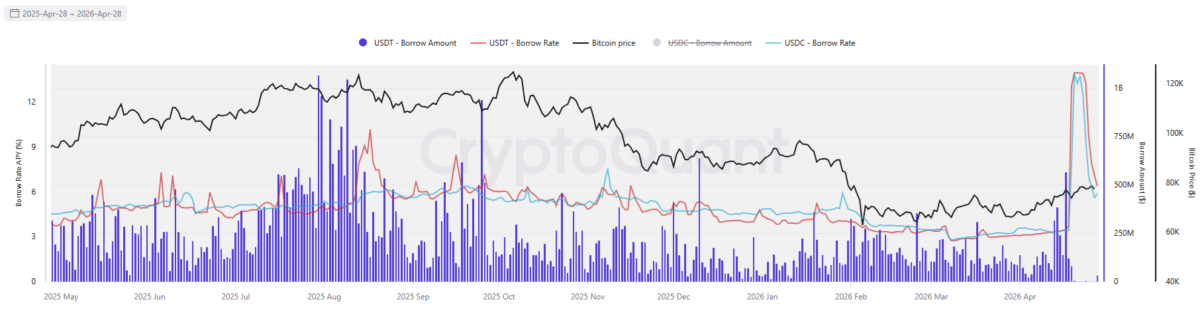
The interest on Aave loans remains high, up to 6.38% $USDC to borrow. During rsETH’s last freeze, the protocol offered over 13% in interest rates but failed to allay investor fears.
$USDC the vaults remained at 100% utilization, discouraging other lenders from risking their money in the aftermath of the KelpDAO hack.
As a result, Aave now offers better rates than DeFi’s baseline, but lenders and borrowers are still reluctant to return.
The latest data from Aave V3 shows that stablecoins and WETH saw the largest lending breakdown, with leverage outflows. Borrowing was still active for liquid assets, for example $USDT, $USDCand WETH, but loan events slowed to near zero, based on CryptoQuant data.
Based on data from Dune Analytics, WETH is the most borrowed asset $6.5 billion in loans. $3.7 billion was borrowed $USDTand $2.9 billion in revenue $USDC.
The recent higher interest rates suggest that Aave was not seeing increased demand for capital, but rather liquidity stress. Interest rates rose sharply, increasing their APY to over 14%. Later, interest rates corrected but remained high at 7.12%. Lenders have become more defensive, leading to more expensive capital for DeFi.
Is another DeFi winter coming?
The recent credit crisis shows that DeFi has experienced one of the biggest credit crises. This time Aave survived, but raised questions about the resilience of DeFi. The previous DeFi winter followed the crash of FTX and Terra (LUNA), which caused a two-year decline in DeFi activity.
Some whales immediately moved their funds and switched to Spark Protocol as one of the more secure DeFi venues.
Aave’s founder Stani Kulechov still expressed his confidence in the protocol, despite the credit crisis. He noted that Aave had survived multiple bear cycles and would be capable of oneattract liquidity again.
“For me personally, the rsETH bridge incident was unfortunate because our team and community put so much effort into securing the protocol and seeing the exploit happen outside of the protocol’s smart contracts, and impacting the markets is hard to see even if the markets had (and still have) full support, like Mainnet Core,” Kulechov noted in a recent after.
The past few days crypto influencers expressed their support for Aave and expressed a willingness to return to lending and generating returns. The Aave Protocol is also voting on a buyback freeze until DeFi conditions improve. The to vote will most likely decide ‘yes’ within two days.
Slower lending continues to put pressure on the AAVE token, which fell to $93.21 over the past week.