

Welcome to our institutional newsletter, Crypto Long & Short. This week:
- Jennifer Rosenthal on the need to protect the people who are actually building the DeFi infrastructure.
- Alexis Sirkia on how Ethereum’s L2 strategy is failing due to a fundamental design flaw.
- Top news that institutions should pay attention to by Francisco Rodrigues.
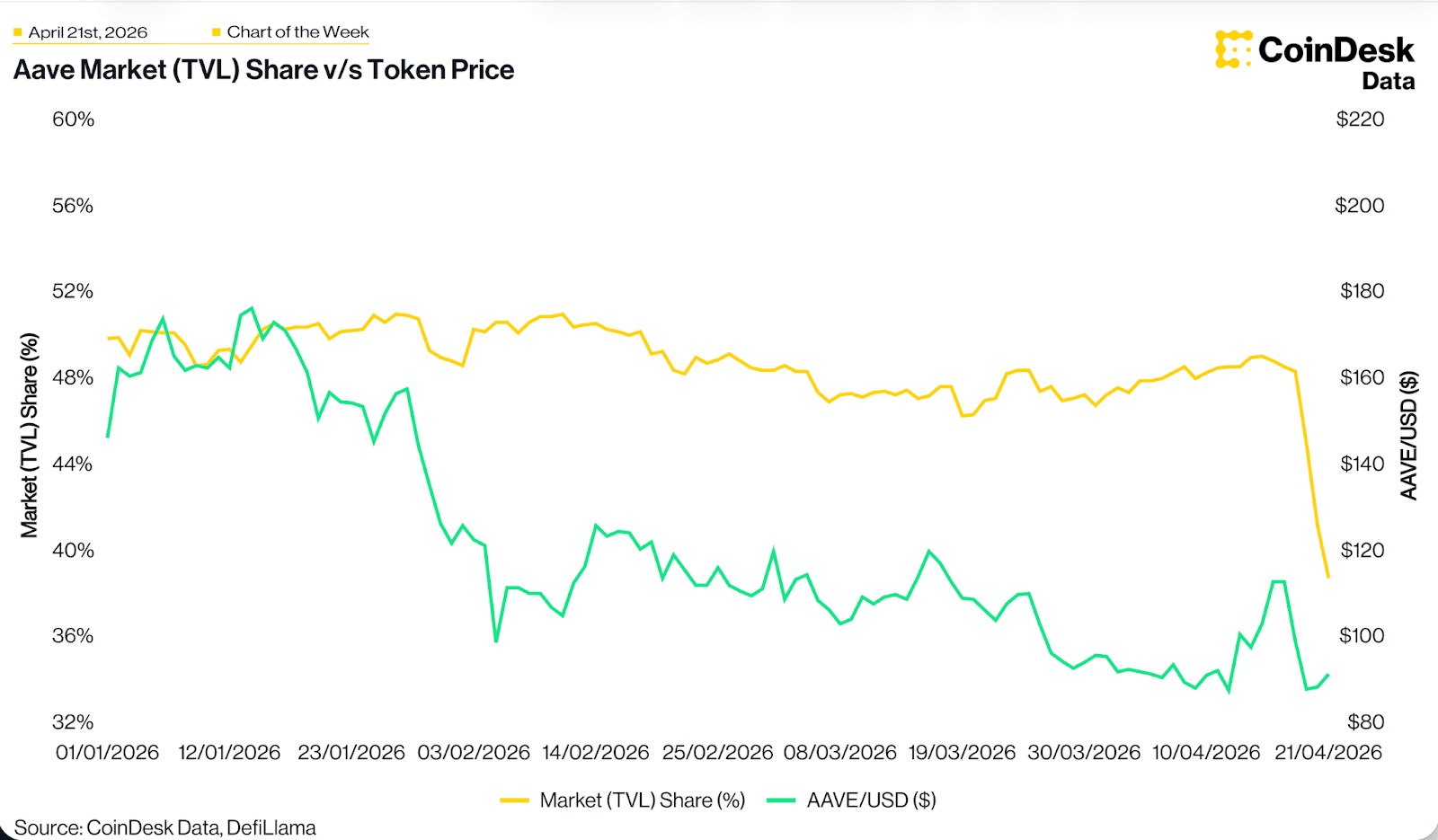
- Aave’s market share drops after rsETH exploit in the week’s chart.
-Alexandra Levis
Expert insights
Protecting the people building the DeFi infrastructure
By Jennifer Rosenthal, Head of Communications at the DeFi Education Fund
There has been a consistent upward trend among traditional financial companies announcing DeFi-related initiatives, and it’s exciting that these companies are embracing technological innovations that will serve as the infrastructure for 21st century finance. There also appears to be a growing realization that open-source, permissionless, programmable, non-custodial, globally accessible and interoperable technology offers important upgrades to certain parts of the financial system.
If you are new to decentralized finance (DeFi), plan to rely on DeFi, or want to connect your customers to DeFi, we at the DeFi Education Fund, a nonpartisan nonprofit organization, invite you to join us to help protect the technology and infrastructure that makes it valuable. There are some high-level policy objectives that we think are worth defending:
- Protect software developers and infrastructure
- Maintaining self-control
- Advocating for open access and interoperability
- Championing permissionless blockchain infrastructure and DeFi markets
- Support clear laws and policies
For months, my team has participated in productive bipartisan, bicameral discussions with members of Congress. We are impressed by how many congressional leaders have worked productively and in good faith to enact legislation that reflects a fundamental understanding of neutral, decentralized technology. Protection of software developers has been a topic of conversation in recent market structure and broader crypto policy discussions. Why? A majority of industry participants agree that if we are going to adopt DeFi, we need to protect the people building it.
For example, on February 26, 2026, Representatives Scott Fitzgerald (R-WI), Ben Cline (R-VA), and Zoe Lofgren (D-CA) introduced the bipartisan Promoting Innovation in Blockchain Development Act of 2026 (PIBDA) to protect software developers – who write code but do not control other people’s money – from improper misclassification under Criminal Code Section 1960. PIBDA clarifies which section 1960 applies only to those who manage customers’ assets and transfer funds on behalf of customers, bringing the statute into line with Congress’s intentions and the Treasury Department’s longstanding interpretation of the regulations.
In discussing the bill, Representative Scott Fitzgerald (WI-05) said, “For years, innovators and software developers have been caught in the crosshairs of an aggressive regulatory approach that treats them like criminals. The Promoting Innovation in Blockchain Development Act draws a clear line between those who develop and deploy blockchain software and those who actually move or manage money. It provides long-overdue legal clarity, protects innovation here at home, and allows law enforcement to focus on real criminal activity rather than chilling America’s technology activities.” leadership.”
Like the early internet in the 1990s, blockchain technology is a new innovation that is evolving faster than existing regulations. Engineers developing open, disintermediated systems do not fit neatly into the financial regulations designed for a system that assumes the existence of intermediaries.
As more individuals and companies interact with decentralized infrastructure, our shared voice can play a constructive role in shaping thoughtful and sustainable policy outcomes. We must jointly support regulatory initiatives that promote clarity, reduce uncertainty and enable responsible participation in both centralized and decentralized markets.
Thank you for taking DeFi tools and technology seriously, and I hope you’ll join us in championing the policy principles that make building and using DeFi possible.
Principled perspectives
Ethereum’s scaling problem was never about throughput
By Alexis Sirkia, President and Co-Founder of Yellow Network
Vitalik Buterin recently admitted that most Layer 2 networks fragment Ethereum instead of scaling. He is right, but the diagnosis does not go deep enough. The aggregation model was never going to deliver uniform scale because it was designed around the wrong assumption: that Ethereum’s limitation was throughput, when the actual limitation was always how value moves between participants.
Rollups addressed congestion by creating parallel execution environments, where each transaction is processed independently and compressed proofs are pushed back to the base layer. On paper, this increases capacity. In practice, it produced dozens of isolated liquidity pools that cannot communicate with each other without routing assets through bridge infrastructure. The concentration is stark: Base and Arbitrum now take 77% of all L2 decentralized finance (DeFi) total value locked (TVL), while usage on smaller rollups has declined by 61% since June 2025. The long tail is collapsing, and what capital remains is fragmenting further. Bridge infrastructure has lost $2.5 billion since 2021 for a simple reason: every time value moves between rollups, it passes a bottleneck. Attackers don’t have to break the chains on either side, they just have to compromise with what’s in between.
The industry responded to each bridge exploit by building better bridges. That instinct, while logical at the time, was wrong. The vulnerability is not in the bridge implementation. The premise is that value must pass through an intermediary in the first place. State channels eliminate this premise entirely by allowing participants to conduct peer-to-peer off-chain transactions, with the base layer serving as an enforcement mechanism rather than a transaction processor. The settlement only affects the blockchain once the transaction is completed through the state channel, and either party can invoke on-chain enforcement at any time if the counterparty misbehaves.
This is not an incremental improvement over the aggregation model, but rather a rejection of the assumption that caused the fragmentation in the first place. Where rollups multiply execution environments and then attempt to reconnect them, state channels keep participants connected from the start and only enable the base layer when finality is needed.
The CFTC is preparing to adopt the first U.S. perpetual futures framework, which will attract a significant portion of $14 trillion in offshore derivatives volume to regulated platforms. To put the magnitude of that shift into context, US-regulated platforms currently handle just 1.6% of global crypto derivatives volume. The infrastructure that absorbs even a fraction of the remaining 98.4% must be handled cross-chain in real time, without passing through bottlenecks. By definition, rollups are not candidates for the position.
21Shares’ prediction that most L2s won’t survive 2026 feels pessimistic, but the reason is more important than the timeline. Rollups failed to deliver uniform scale because they treated Ethereum’s limitation as a throughput problem. The market is starting to price in that the real constraint has always been reliance on the intermediate layer, and that the infrastructure that eliminates that layer entirely is where capital and builders will migrate.
Main points of the week
By means of Francisco Rodrigues
This week’s headlines highlight that as the bridges between the traditional financial sector and the crypto sector continue to grow, the devastation caused by smart contract exploits is hitting the market.
- Deutsche Börse takes a 1.5% stake in Kraken for $200 million: Germany’s largest exchange operator has invested $200 million in Kraken’s parent company at a valuation of $13.3 billion, deepening their commercial partnership, just as the crypto exchange confidentially files for a US IPO.
- British asset manager puts $68 billion of liquidity funds on-chain via Calastone token network: Legal & General Asset Management has moved its £50 billion ($68 billion) liquidity funds onto blockchain rails using Calastone’s tokenized distribution network.
- Kelp DAO Scored $292 Million With Wrapped Ether Stranded Across 20 Chains: Liquid Restaking Protocol Kelp DAO suffered the biggest hack of the year when an attacker drained $292 million, leaving massive amounts of wrapped ether inaccessible across 20 different blockchain networks.
- Drift gets $148 million in funding from Tether and partners as it replaces Circle stablecoin $USDT after a massive exploit: In the aftermath of a devastating $270 million hack, Solana-based protocol Drift has secured $148 million in fresh capital from Tether and partners, simultaneously announcing a strategic move to replace Circle’s USDC with Tether’s $USDT as its primary stablecoin.
- Bitcoin developers are trying to build quantum defenses, but your coins may pay the price: While core Bitcoin developers work to implement quantum-resistant cryptography to secure the network against future computer threats, the necessary network upgrades could result in significantly larger transaction sizes, forcing users to pay much higher fees and potentially leaving unmigrated dormant wallets stranded.
Chart of the week
Aave’s market share drops after rsETH exploit
Aave’s TVL market share has fallen sharply from ~51.5% in February to ~39% today, following the April 18 KelpDAO rsETH exploit, which froze the rsETH markets and led to deposit withdrawals. The share of active loans remained more stable, only declining by ~2% (54% to ~52%), as existing borrowers were unable to settle easily. The AAVE token is down about 50% from its January peak, pricing in both bad debt risk and reputational costs to be the largest platform for DeFi lending when a collateral fails.
Listen. Read. Watch. Involve.
- Listen: From the floor of the NYSE, CoinDesk’s Jennifer Sanasie is joined by Patrick Witt, Executive Director of the White House President’s Council of Advisors on Digital Assets, for the latest on the Clarity Act.
- Read: In Crypto for Advisors, RedStone’s Marcin Kaźmierczak takes us through the evolution of tokenization as it moves from ‘concept to allocation’.
- Watch: David LaValle, president of CoinDesk Data & Indices, joins Remy Blaire to discuss the current state of the cryptocurrency market.
- Involve: Are you going to Consensus Miami? Get a 20% discount on your ticket!
Note: The views expressed in this column are those of the author and do not necessarily reflect those of CoinDesk, Inc., CoinDesk Indices or its owners and affiliates.