

A governance dispute within the Aave ecosystem intensified after two detailed reports offered contrasting interpretations of the protocol’s previous funding and contributions ahead of a vote on a proposed $50 million package for Aave Labs.
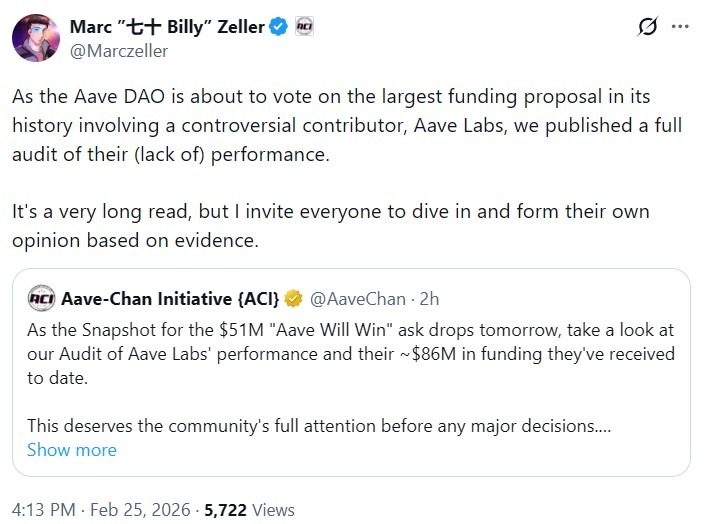
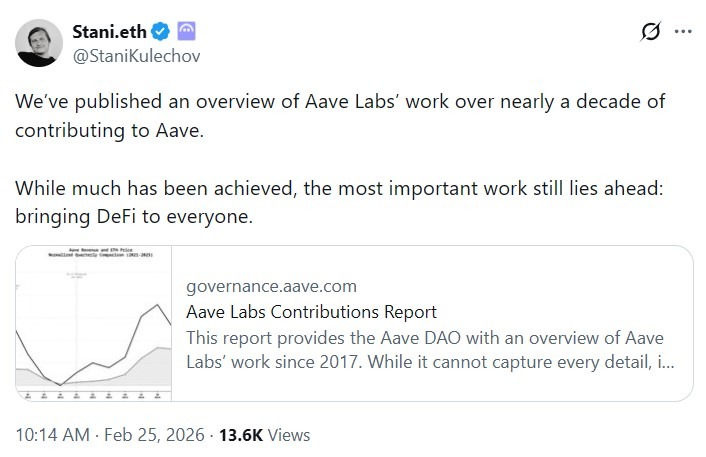
Aave Chan Initiative (ACI) founder Marc Zeller on Wednesday published what he called a transparency report that reviewed Aave Labs’ historical funding and applied a return on investment framework to past DAO grants. Hours earlier, Aave Labs released its own contribution report, outlining its role in building the protocol since 2017.
The dispute centers on the “Aave Will Win” framework, a proposal that asks token holders to approve funding worth up to $42.5 million in stablecoins and $75,000. $AAVE ($AAVE) tokens. In return, Aave Labs would send 100% of revenue from Aave-branded products to Aave DAO’s coffers under a DAO-funded business model, according to the proposal and related forum posts.
The debate has expanded beyond the size of the funding request to include questions about accountability standards, revenue allocation, and who maintains the protocol’s core infrastructure.
It follows the recent announcement that BGD Labs, a major technical contributor, will end its involvement with the DAO on April 1.
Competing views on financing and value
According to Zeller’s report, Aave Labs has received approximately $86 million in lifetime capitalization, including proceeds from the 2017 Initial Coin Offering (ICO), venture funding, and DAO payments.
He argued that future DAO grants should be evaluated against measurable revenue impact and clearer disclosure standards.
ACI, a service provider to the Aave DAO and not a neutral party in the debate, questioned whether board votes should be unbundled to separate funding, revenue reconciliation and V4 ratification.
Zeller wrote that funding decisions should be tied to performance benchmarks and transparent reporting.
Source: Marc Zeller
Aave Labs, in its contribution report, highlighted its role in designing and shipping Aave V1, V2 and V3, highlighting the features it believes underlie the protocol’s current revenue model, including flash lending, the security module and the efficiency mode.
Aave Labs argued that counting governance proposals or forum posts does not reflect the full scope of research, development, security and infrastructure work required to maintain a protocol used by millions of users.
Source: Stani Kulekhov
What token holders vote on
Under the “Aave Will Win” framework, Aave Labs would transition to a DAO-funded business model, while product-level revenues, including from aave.com and planned consumer-facing products, would be sent to the DAO.
Related: The founder of Curve Finance says disagreement within a DAO is a healthy sign
The proposal also seeks the ratification of Aave V4 as the long-term technical basis of the protocol and outlines plans for a new basis to manage the Aave brand.
Some community members have previously raised concerns about the size of the funding package and the inclusion of 75,000 $AAVE tokens, which carry voting rights.
On February 13, critics called for clearer definitions of income and greater transparency around board interests.
The Snapshot vote, scheduled for Thursday, is an initial offchain vote that gauges community sentiment before submitting a binding onchain proposal.
Magazine: Hong Kong stablecoins in Q1, BitConnect kidnapping arrests: Asia Express