
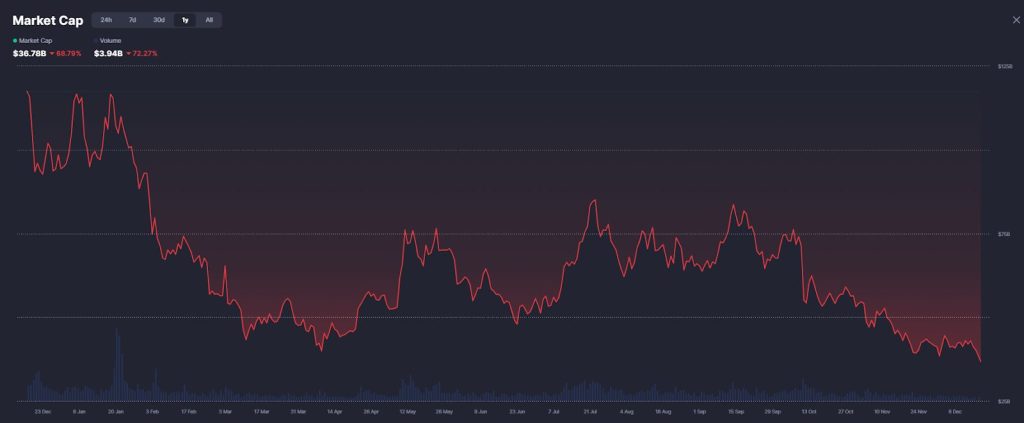
Prediction markets are emerging as one of the fastest-growing corners of crypto just as meme coins are retreating from their recent highs, sparking a broader industry debate about where speculative capital is headed in 2026.
The comparison gained momentum after Kalshi’s head of crypto, John Wang, described prediction markets as “the meme coins of 2023,” arguing that both attract attention during periods when traders are looking for asymmetric opportunities.
The comment came as meme coin activity cooled sharply after a volatile run that defined much of the past two years.
Meme coins had their moment – is this the collapse phase?
Meme coins have soared in 2023, driven by the launch of new tokens and heavy social media attention.
The sector’s total market capitalization reached almost $22 billion by the end of that year, as trading activity grew dramatically.
Data from the period shows that average trading volume increased more than ninefold in the first eleven months.
Two intense rallies defined the year, most notably an April-May blowout fueled by highly speculative launches.
That speculative energy continued into 2024, when meme coins climbed to an estimated peak market cap of about $150 billion in December, helped by Dogecoin, Shiba Inu, Pepe and a wave of politically themed tokens.
The turnaround was just as sharp. By the end of 2025, the total value of the sector had fallen below $42 billion, with daily volumes declining and individual tokens losing most of their previous gains.
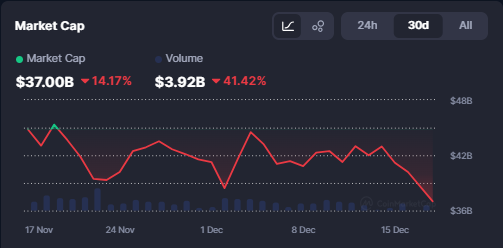
Market data now shows that memecoin trading volumes are down about 85% from their all-time highs, reflecting a broad pullback in risk appetite.
Are traders done with meme coins? Prediction markets are quietly taking over
As meme coins faded, the prediction markets moved in the opposite direction.
Platforms such as Kalshi, Polymarket and Limitless included a combined trading volume of $44 billion this year, with Kalshi alone reaching a weekly volume of $1 billion, largely driven by sports and political contracts.
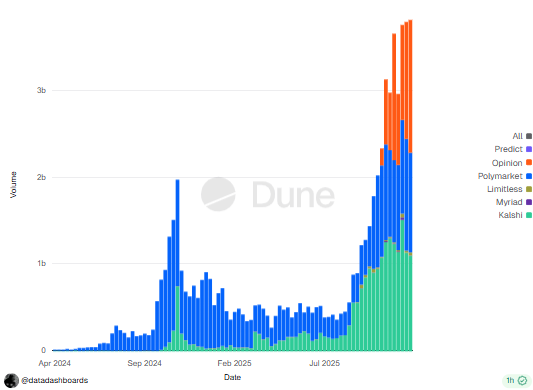
Source: dune/data dashboards
On-chain prediction markets have grown even faster. Monthly volume has increased from less than $100 million in early 2024 to over $13 billion today, a 130-fold increase. according to to joint research by Keyrock and Dune Analytics.
Non-sports markets, including economics, politics and technology-related events, accounted for most of the growth in 2025.
The structure of prediction markets is very different from memecoins, a point repeatedly made by industry participants.
Prediction markets versus memecoins
Watch in 2x speed
– “Memecoins will die like NFTs. Prediction markets will take over” (start @ 0:16)
– Errors in prediction markets (start @ 2:25)
– Flaws in memecoins (start @ 5:24)
– Prime @Pumpfun > fine @Polymarkt (starts @ 5:59) https://t.co/ARppIQ8cTO pic.twitter.com/cesTAQNYEH
– shamans
(@shaams) December 16, 2025
Prediction contracts allow traders to buy ‘yes’ or ‘no’ stocks tied to a specific outcome, with prices reflecting implied probabilities and settled via oracles once events have concluded.
Proponents argue that this allows for clearer pricing and limits some of the manipulation risks that have plagued token markets with low liquidity.
Critics believe returns are limited by design, making it harder for smaller traders to make outsized profits compared to early-stage memecoin trades.
Can prediction markets kill meme coins?
Framing the trend as “prediction markets killing memecoins” misses the point.
Memecoins are not dead. Liquidity has simply shrunk, and that contraction is impacting many other crypto sectors as well.
History shows that meme-driven markets tend to hibernate and not go away. When volatility returns and risk appetite increases, memecoins could quickly reemerge.
At the same time, prediction markets clearly deserve a sustainable user base. Their growth is not merely cyclical hype; it is driven by real world events, regulatory clarity in some jurisdictions and the demand for structured speculation. That gives them a resilience that memecoins often lack during recessions.
The most likely outcome is coexistence, not substitution.
Memecoins will continue to dominate during speculative peaks and attention-driven cycles. Prediction markets will attract traders looking for clarity, probability-based pricing and event-based exposure. They serve different psychological and financial needs.
If anything, the current shift shows a maturing crypto market, one where capital rotates rather than evaporates and where speculation takes multiple forms rather than clustering around a single story.
The post Prediction Markets vs. Meme Coins: Is This Where Crypto’s Next Alpha Lives? appeared first on Cryptonieuws.