
US spot crypto ETFs have attracted net inflows of more than $70 billion since January 2024, making traditional financial investment vehicles the main entry point for new money into the emerging industry.
This surge, driven by products linked to Bitcoin, Ethereum and more recently Solana and XRP, has confirmed the industry view that many investors will only buy crypto through regulated structures they already use for stocks and bonds.
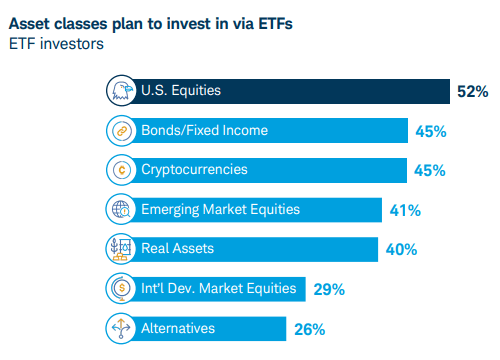
Schwab Asset Management in particular recently found that 45% of ETF investors plan to buy crypto ETFs, a figure now correlated with interest in bond ETFs.

However, with the SEC expected to release more than 100 additional crypto ETFs next year, asset managers are faced with a new problem. As a result of this wave of products, their decision will shift from a simple “own Bitcoin or not” question to choosing which of the dozens of single-asset products could lead the next cycle.
In a recent interview, Matt Hougan, Chief Investment Officer of Bitwise, pointed out this problem, noting that many traditional investors do not have a strong view on decentralization or on “Ethereum versus Solana” and instead want broad market exposure.
However, that has become harder to achieve as the lineup shifts from a few flagship Bitcoin ETFs to a crowded shelf of narrowly focused products that require a level of due diligence that many advisory platforms are not built for.
The crypto index solution
Market observers believe this growing complexity of individual asset choices will push investors toward crypto index ETPs, which package baskets of tokens into a single listed security.
Notably, the category gained structural traction in September when Grayscale launched the Grayscale CoinDesk Crypto 5 ETF, described as the first multi-asset crypto fund in the United States.
Since then, issuers have rolled out Bitwise’s BITW, 21Shares’ FTSE Crypto 10 Index ETF (TTOP) and the ex-Bitcoin version (TXBC), along with competing products from Hashdex and Franklin Templeton.
Roxanna Islam, head of sector and industry research at VettaFi, said the evolution resembles the way stock investors often move from individual stocks to broad index funds as an asset class matures.
Islam added that the new funds reflect a growing preference among advisors for simple portfolio building blocks.
Nate Geraci, Chairman of Nova Dius Wealth, agreednoting that he is “very optimistic” about demand for these baskets as they provide a one-click solution for allocators looking to bypass the noise of individual token selection.
The mechanics
Most multi-asset crypto index products ultimately own a very similar mix of coins.
Their rulebooks typically start with free-float market cap and basic liquidity filters, which of course push most of the weight into Bitcoin and ETH, leaving only small allocations for everything else.
Grayscale’s Digital Large Cap Fund (GDLC) is an example of this. According to his factsthe fund holds roughly three-quarters of its portfolio in Bitcoin and about 15% in Ethereum, with the rest split into single-digit holdings: about 5% in XRP, just under 3% in Solana, and just over half a percent in Cardano.
Meanwhile, a holdings comparison compiled by Bloomberg illustrates how systematic the funds’ holdings can be.
Looking at six of the top crypto baskets, including products from Grayscale, Bitwise, and Hashdex, Solana and Cardano appear in every lineup.

Cardano’s presence in all funds is surprising, given that it has no dedicated US spot ETF and lags behind better-known rivals such as Solana and Ethereum in both performance and mindshare.
Its presence in these funds can therefore be linked to market value and trading depth. According to Crypto Slates According to data, Cardano is the 10th largest crypto asset by market cap, with a market cap of over $13 billion.
This qualifies the mark for a small but steady share of passive flows, even as market attention shifts elsewhere.
The challenges
The simplicity of a single-ticker crypto index fund often comes at a price for investors.
For context, many of the products charge fees of around 0.5% per year, compared to around 0.25% on spot Bitcoin ETFs and single-digit basis points on broad stock trackers.
That spread is essentially the cost of outsourcing the rebalancing, and in digital asset markets, rebalancing is rarely friction-free.
This is because liquidity drops quickly once a portfolio moves past the top three or four tokens, and index providers publish both their methodologies and rating calendars.
As a result, professional traders can tell when funds are being forced to buy or sell. When these flows are predictable, these traders can position themselves against them, leaving index vehicles to buy into strength and sell into weakness to stay in line with their benchmarks.
In addition, the basket construction creates a risk profile that is not in line with what many advisors expect from stock indices.
Typically, investors tend to assume that a diversified portfolio is safer than a concentrated position. Yet historical data often shows Bitcoin exhibiting lower volatility than smart contract platforms such as Ethereum and Solana.

Since most large-cap crypto indices are market-cap weighted, Bitcoin still accounts for the majority of the exposure. As a result, smaller allocations to Ethereum, Solana, and other tokens add higher beta rather than defensive compensation.
In rising markets, that mix can help a basket outperform a Bitcoin-only position. However, during market downturns, this can cause the index product to decline faster than the underlying asset.
What can we expect in 2026?
Despite the current bias toward single-asset “winners,” the 2026 pipeline shows issuers are betting that behavior will change.
Bloomberg Intelligence ETF analyst James Seyffart expected crypto index ETPs will be a primary category for asset gathering next year.
Taking this into account, if US crypto ETF flows match this year’s pace in 2026, which has already seen net inflows of over $47 billion, according to the numbers, Coin sharesthe CryptoSlate The model estimates that a bundling shift from individual stock selection to diversified beta could direct between 2% and 10% of that total to index products.
Based on that, the implied range for crypto index ETF inflows looks like this:
| Scenario | Share of US crypto ETF flows in 2026 will go to crypto index ETFs | Implied inflows into index ETFs (out of a total of $47 billion) |
|---|---|---|
| Low | 2% | $0.94 billion |
| Base | 5% | $2.35 billion |
| High | 10% | $4.70 billion |
Islam believes that this shift will happen out of necessity. She said:
“We may see more inflows into crypto index ETFs as the number of crypto products becomes too overwhelming to easily conduct comparative due diligence.”
In that scenario, the 2026 winners likely won’t be the funds with the flashiest short-term returns, but rather the funds that secure a place in the model portfolios of major advisory firms, where allocations become embedded and flow systematically.