
Cardano made a major integration this week that fundamentally changes its approach to market infrastructure.
Under the network’s newly operational Pentad and Intersect governance structure, the steering committee authorized the implementation of Pyth Network’s low-latency oracle stack.
While the decision may seem like a routine technical upgrade at first glance, it represents a profound shift in the philosophy of a blockchain that has historically prioritized academic rigor and self-sufficiency over commercial speed.
The integration is the first major deliverable under the Critical Integrations workflow, a strategic initiative designed to modernize the network’s capabilities by 2026.
This move signals that Cardano is essentially abandoning the strategy of building isolated, native solutions to every problem in favor of direct competition for the cutting-edge DeFi flows currently dominated by Solana and Ethereum Layer-2s.
Charles Hoskinson, the network’s founder, praised the pivot during his livestream: proverb:
“We tried to build a native oracle solution, but it didn’t work as well as it should, and that’s OK…Oracles are really the first part of big integrations. You need to be able to communicate with other chains and other systems, and you need to be able to bring data from the outside world into Cardano.”
The structural shift
To understand the magnitude of this change, one must look beyond marketing and into the mechanisms of market structure.
For years, Cardano’s decentralized finance (DeFi) ecosystem has relied primarily on “push” oracles. In this traditional model, data providers publish price updates on a fixed schedule, often at minute intervals or when the price deviation exceeds a certain threshold.
While this architecture is functional for simple spot swaps, it is catastrophic for highly leveraged derivatives. If Bitcoin’s price collapses 5% in 30 seconds, a push oracle operating on a 1-minute heartbeat will unknowingly leave the lending protocols collateral behind, creating toxic debt that the protocol cannot liquidate in time.
Pyth introduces a ‘pull’ model that fundamentally reverses this relationship.
Instead of passively waiting for a data provider to push an update, Cardano smart contracts can now actively pull the latest signed price from Pyth’s high-frequency sidechain, Pythnet, right at the moment a transaction is executed. These prices are updated approximately every 400 milliseconds.
For Cardano developers, this significantly expands the design space. The network’s eUTXO (Extended Unspent Transaction Output) architecture is ideally suited for this model in combination with reference inputs, allowing multiple transactions to read the same high-fidelity data point simultaneously without congestion.
This ability is the prerequisite for building the “holy grail” of modern DeFi: order book-based perpetual futures, dynamic loan-to-value lending markets, and complex options vaults.
By closing the latency gap, Cardano can now theoretically power the same risk engines that power high-frequency trading on Wall Street, from ‘DeFi primitive’ to ‘institutional level’.
Connect to a federal data pipeline
Meanwhile, the integration does more than just speed up the plumbing, as it introduces a new level of data diversity that had previously eluded the ecosystem.
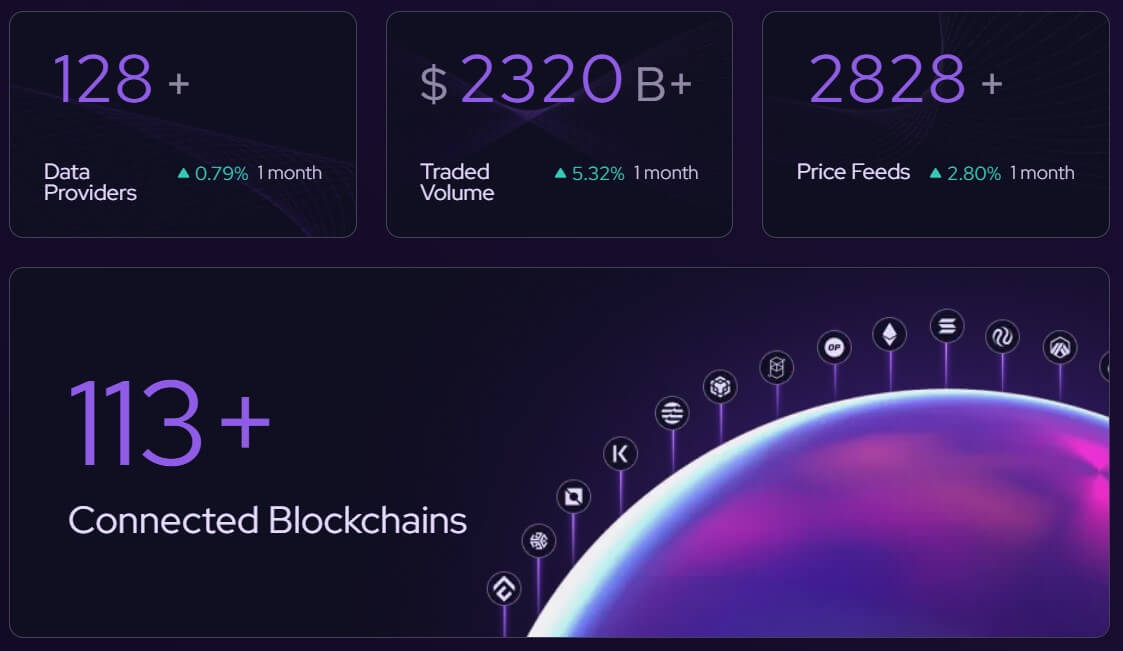
Pyth runs on 113 blockchains and serves as a distribution layer for first-party data. Unlike aggregators that pull prices from public websites (a method prone to manipulation), Pyth’s feeds come directly from trading firms, exchanges, and market makers that sign their own data.
Hoskinson specifically emphasized the institutional weight of this connection, noting that the U.S. Department of Commerce selected Pyth, in addition to Chainlink, to help verify and disseminate official macroeconomic data across the chain.
He noted:
“Pyth now also has access to US government data, and soon [so will] every person in the Cardano ecosystem.”
For a blockchain that has long positioned itself as a regulatory-friendly platform for nation states and corporations, direct access to government-validated economic indicators is a powerful tool for attracting Real World Asset (RWA) issuers.
It allows builders to design structured products that were previously impossible – think of a stablecoin vault that hedges its exposure using real-time Euro/USD exchange rates, or a synthetic asset that tracks the S&P 500 with sub-second accuracy.
The liquidity decoupling and the future roadmap
However, advanced sanitation does not automatically generate liquidity, and this remains the central tension in the Cardano story. Although the Pyth integration produces the engine for a Ferrari, the current market depth resembles a go-kart track.
A critical examination of the on-chain data reveals a stark gap between the capabilities of the new infrastructure and the capital available to deploy it. As of December 12, data from analytics platform DefiLlama shows that Cardano has less than $40 million in stablecoin liquidity.
To put that figure into perspective, it’s a fraction of the billions of capital available to competitors like Ethereum.
Hoskinson addressed this implicitly, describing Pyth as “just the appetizer” in a broader menu of upgrades that includes “bridges, stablecoins and custodial providers.”
He hinted that the network is preparing for “multi-billion TVL,” which would in turn lead to significant trading volume on the network. Hoskinson added:
“We’re preparing for the next few million users. We’re preparing for billions of TVL. We’re preparing for a lot of MAUs and a lot of transactions. And we have a lot of competitive differentiators now.”
However, to reach these numbers, the stablecoin population must go from millions to billions. The Pyth integration is a necessary condition for this growth, but in itself it is insufficient.
Essentially, the network is betting that if it builds the “basement and foundation” first – as Hoskinson put it – liquidity will follow.
Operating speed
Meanwhile, the most bullish signal to emerge from this Pyth integration is not technical, but organizational.
The speed with which the Pyth proposal moved through the new Pentad and Intersect governance model suggests that Cardano has solved the most persistent bottleneck: bureaucracy.
For years, the network’s slow, methodological approach was cited as a reason for the delay in DeFi adoption.
The ability of the Pentad – a coalition representing the Cardano Foundation, Input Output, EMURGO, Midnight and Intersect – to identify a market standard like Pyth and fund its integration quickly indicates that the new governance structure is functioning as an effective executive.
Hoskinson explained:
“The great thing about the Pentad structure is that we can all speak with one voice.”
This governance alpha is important because Pyth is likely only the first of several necessary upgrades. Hoskinson teased further announcements regarding “the good stablecoins” and custody partnerships, framing the current moment as the foundation for massive scaling in 2026.
He concluded:
“Cardano is no longer an island. The cavalry has come.”
The integration proves that Cardano can change its minds and infrastructure to meet market demands. The plumbing has now been repaired. The question for 2026 is whether the “cavalry” Hoskinson mentions will provide the capital needed to fill the pipes.