
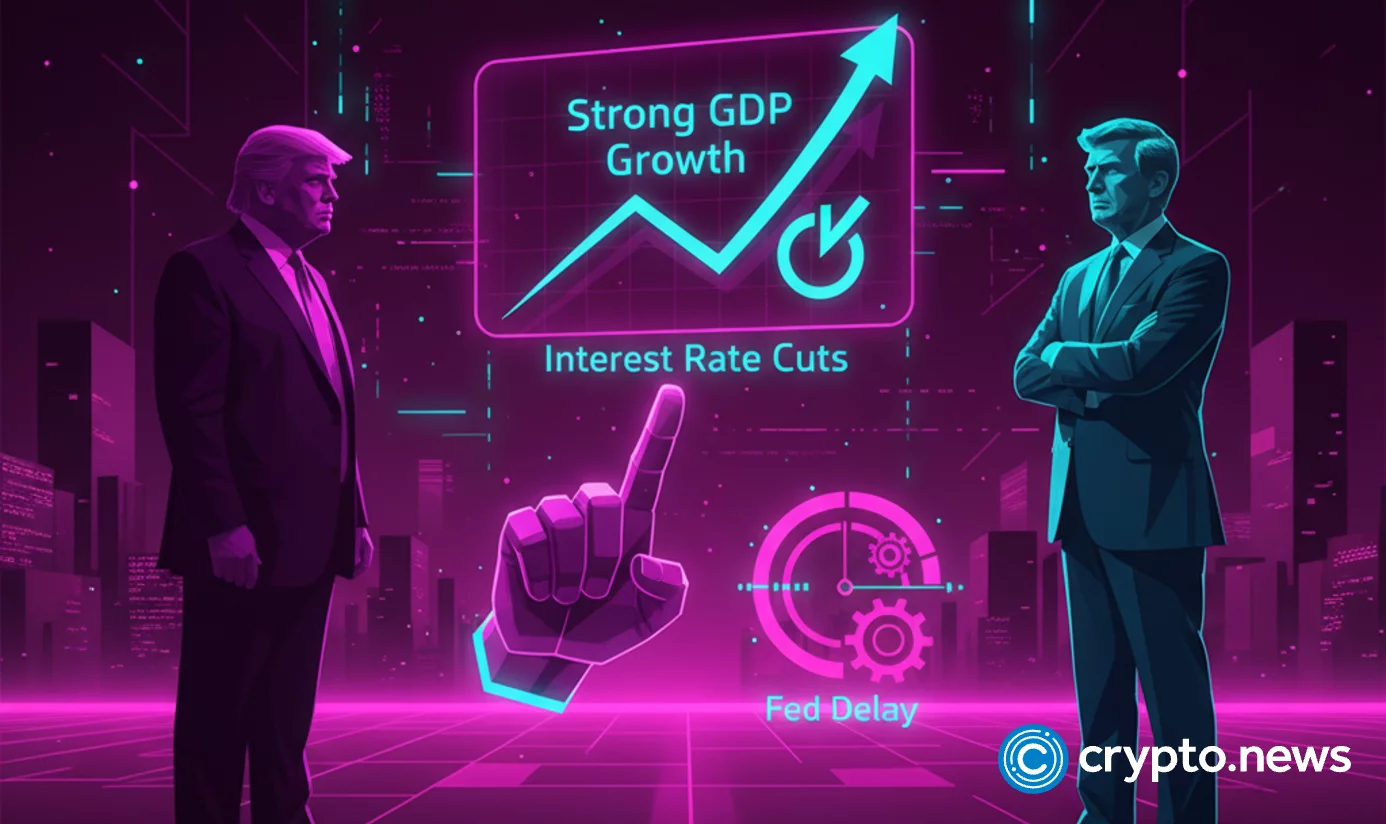
Trump is pushing for faster Fed rate cuts after 4.3% GDP growth, with Kevin Hassett citing AI-powered productivity gains as evidence that inflation risks remain contained.
Summary
- Trump demands lower interest rates despite 4.3% GDP exceeding 3.3% forecast in Q3 2025. He argues that strong growth should be rewarded and not slowed down.
- NEC veteran Kevin Hassett backs the cuts, pointing to AI-led productivity and tariff-driven trade gains as signs that inflation is manageable.
- With Powell’s term set to expire in May 2026, markets are looking at Trump’s likely Fed choice and its implications for future US monetary policy.
President Donald Trump has called for interest rate cuts following stronger-than-expected US economic growth, arguing that robust economic performance warrants looser monetary policy, according to public statements.
Trump calls for interest rate cuts
The call follows GDP growth in the third quarter of 2025 of 4.3%, surpassing the expected 3.3%. Trump criticized the Federal Reserve’s approach, arguing that a strong economy should result in lower interest rates to promote additional growth.
Trump’s stance contrasts with the Federal Reserve’s current focus on controlling inflation. The president has stated that strong markets should be rewarded with lower interest rates, and that raising interest rates during periods of growth undermines economic potential.
Kevin Hassett, former director of the National Economic Council, has done just that expressed support for lower interest rates. In an interview with CNBC, Hassett stated that the Federal Reserve has not adjusted quickly enough to accommodate economic growth. He cited productivity gains in sectors influenced by artificial intelligence as evidence that inflationary pressures remain under control.
Hassett also pointed to trade policies, including tariffs, as factors contributing to reducing trade deficits and overall economic growth. He stated that these factors support the case for the Federal Reserve to lower interest rates to support economic expansion.
The interest rate debate comes as the Federal Reserve prepares for leadership changes. Jerome Powell’s term as Fed chairman ends in May 2026, and Trump is expected to announce a replacement. Hassett has been mentioned as a potential candidate given his alignment with Trump’s position on interest rates.
Hassett has emphasized the importance of the Federal Reserve’s independence and a consensus-based approach, saying the Federal Open Market Committee should base decisions on data rather than speculative concerns about inflation.
The direction of US monetary policy will likely depend on the attitude of the new leadership. Market participants are monitoring developments regarding interest rate policy and leadership appointments at the Federal Reserve.