
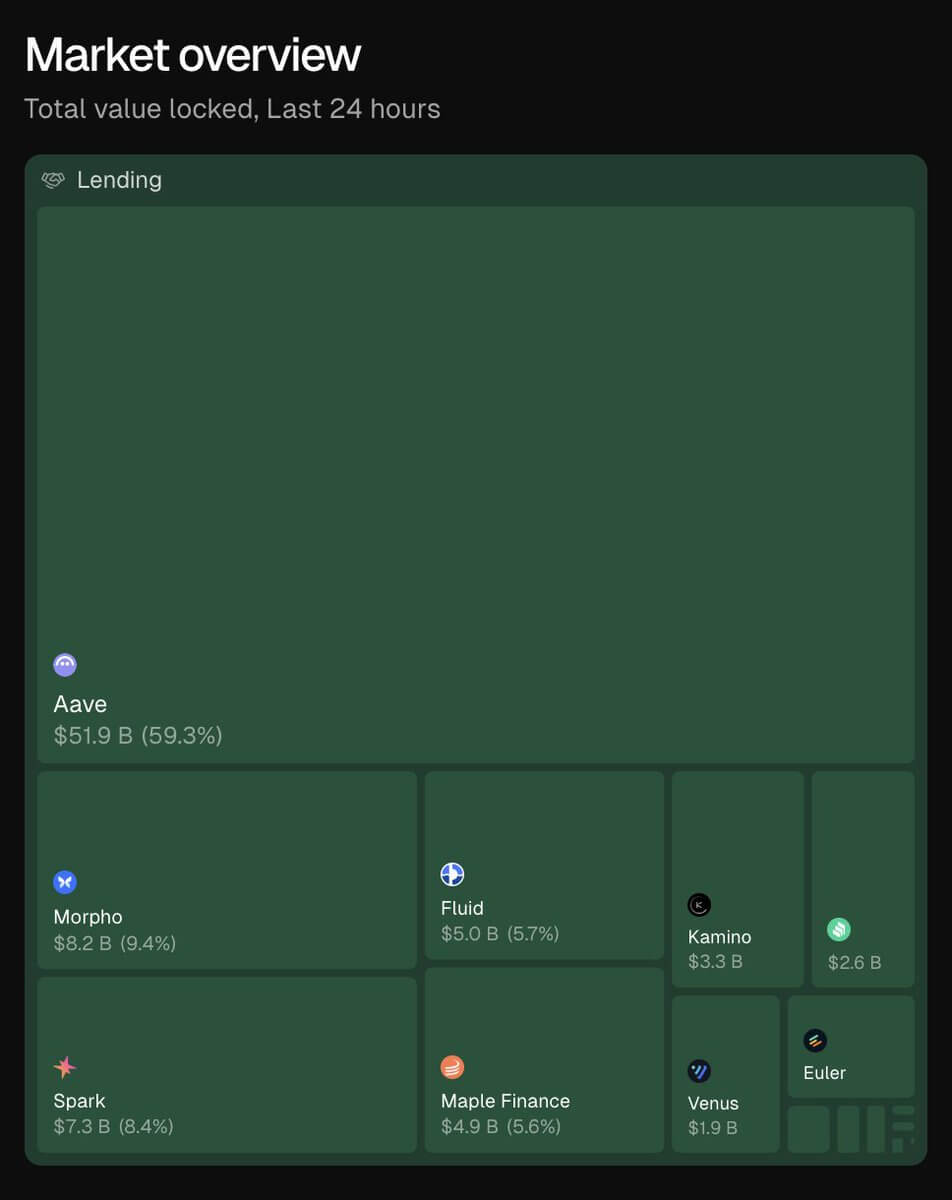
The battle for control of Aave, the $52 billion decentralized lending giant, has escalated from a debate over interface economics to an open civil war over the legitimacy of governance.
What started as a dispute over $10 million in annualized swap fees and brand ownership has evolved over the past 24 hours into a bitter procedural fight between the protocol’s Decentralized Autonomous Organization (DAO) and its development arm, Aave Labs (also known as Avara).
At the center of the storm is one Snapshot The voting will take place from December 22 to December 26. The vote proposes transferring Aave’s “soft assets,” including its trademarks, domain and social data, from Aave Labs to the DAO.
However, the mechanism of the vote itself has created a crisis. The proposal was not put to the vote by its author, but by the entity it seeks to regulate: Aave Labs.
This has forced the industry to choose between two competing visions of the future: the democratic idealism of the DAO, or the ruthless efficiency of the corporate entity that built the throne.
The outcome will determine not only who controls the protocol’s URL, but also whether a decentralized collective can effectively run a multi-billion dollar software company.
‘Shameful’ tactics and hijacked proposals
The chaos started when the proposal “ARFC: Token Alignment” appeared on Snapshot.
While the said author was Ernesto Boado, co-founder of BGD Labs (a major service provider for the protocol), Boado immediately disavowed the action, claiming that his identity was used without permission to force a premature vote.
In a sharply worded rebuke, Boado declared:
“To be clear, this is, in ethos, not my proposal. Aave Labs (for whatever reason) unilaterally submitted my proposal for a hasty vote, with my name on it, and without even notifying me. If I had asked, I would not have approved it.”
Boado, who is widely respected for his technical contributions to the Aave Protocol, described the move as a violation of governance standards. He said:
“It was not my intention to table the vote while the community was still having a healthy discussion about it, with valuable points being continually raised. It violates all codes of trust with the community. Public administration is supposed to be for, even if difficult at times, open discussion. Trying to rush a vote is a shame.”
Meanwhile, the acceleration of the vote has also drawn sharp rebukes from board administrators such as Marc Zeller, founder of the Aave Chan Initiative.
Zeller described the maneuver as a “hostile takeover attempt,” noting that it took place during the holidays — a notorious period of low participation for institutional voters — and that snapshots were taken before the opposition could mobilize.
He pointed out:
“Official Aave communications channels only relayed this debate after escalating to Snapshot.”
However, Aave Labs and its founder, Stani Kulechov, have defended the move as a necessary acceleration of a stalled governance process.
Kulechov stated that the community has shown significant interest in the proposal discussion and that it was therefore “time for token holders to step in and vote.”
He also dismissed the procedural complaints, arguing that five days of forum debate were enough and that the community was tired.
He wrote:
“People are tired of this discussion and voting is the best way to solve this, this is governance [at the] end of the day.”
The case against ‘pure’ decentralization
As delegates focus on procedural flaws, a growing chorus of industry veterans are stepping up to defend Aave Labs, arguing that the DAO’s push for “ownership” is a fundamental misunderstanding of why Aave succeeded in the first place.
Nader Dabit, director of developer relations at EigenLayer, issued a blistering critique of the proposal and reframed the narrative from liberation to self-sabotage.
He said:
“The recent proposal is framed as decentralization, but in practice it would hamper the entity most responsible for Aave’s success, and almost looks like a coordinated power grab.”
Dabit’s argument runs up against an uncomfortable truth of the DeFi sector: despite the rhetoric of decentralization, market dominance is almost always the result of centralized execution.
He argued that Aave would have been outcompeted several years ago if it had been run exclusively by the DAO. He noted:
“The protocol worked like a DAO. Labs operated like a business. That division of labor and resources has worked extremely well, while competitors with ‘purer’ governance models stalled, failed or disappeared.”
The core of this defense is operational reality. Building world-class software is hard; building it by committee is almost impossible.
Dabit claimed that DAOs are “incapable of providing competitive software, or even being competitive in anything that tries to resemble a real, real company.” This is because every decision would require a governance proposal, which would result in “every rapidly changing opportunity.” [dying] in a forum thread while competitors are actually executing.”
Dabit also stated that by stripping the company of its assets and revenue streams, the DAO will destroy the incentive structure that retains the talent. He warned:
“Handicapping Labs and treating them as if they shouldn’t share any benefits of the protocol is bad for the DAO itself in the long run. Weakening that relationship doesn’t decentralize Aave, in fact it makes it much worse.”
This view suggests that the $10 million in annualized interface revenue that the DAO is trying to capture, which is money currently flowing to Aave Labs via swap routing fees, is the price of competence. It is the R&D budget that keeps the engineers working and the products shipped.
The $52 billion gamble
As voting progresses over the Christmas holidays, the stakes are much higher than the specific statutes of the “Token Alignment” proposal. The market is watching to see whether Aave will cannibalize its own growth engine in the name of ideological purity.
The DAO’s argument is legally and ethically sound: the protocol creates value, so it should own the brand. The $10 million in revenue leaking through the interface belongs to token holders. If Aave Labs wants to run a business, it should do so as a service provider, not as a landlord.
However, the counterargument is pragmatic and financially fatal. Over the years, Aave has achieved a ‘natural, well-functioning balance’, resulting in a 60% market share of all crypto loans.
Uprooting this arrangement to resolve a philosophical dispute over “ownership” risks creating friction in a machine that currently prints money.
If the measure passes, the DAO will have to prove it can manage the complexities of trademarks, legal packaging and software monetization without the unified vision of a CEO. If it fails, the community must accept that “decentralization” in the world of high-finance cryptocurrency has a limit, and that limit is the front door.
For now, all the issues have caused AAVE’s price to falter. According to Crypto Slates According to data, the digital asset has fallen around 20% over the past week and was trading at $157 at the time of writing.