
Several projects that raised capital through Kaito’s community-driven launch pad are facing steep losses from their token generation events, reigniting questions about post-TGE performance, valuation discipline, and whether the early “alpha” around the platform has faded.
According to data shared by market participants, a number of projects supported by Kaito have suffered heavy setbacks after their launch.
Play AI, which debuted at a fully diluted valuation of about $50 million, is now valued at almost $2.1 million.
Hana Network dropped from a launch value of $40 million to about $10.5 million, while Novastro fell from $50 million to just over $1 million. Bitdealer dropped from $35 million to about $2.8 million.
The pattern has heightened concerns about how early-stage valuations on socially-driven launch pads will translate once tokens begin trading openly.
Kaito Launchpad faces questions as multiple tokens sink after TGE
The weakness was not limited to recently launched projects. Several tokens that previously campaigned within the Kaito ecosystem have also seen prolonged declines.
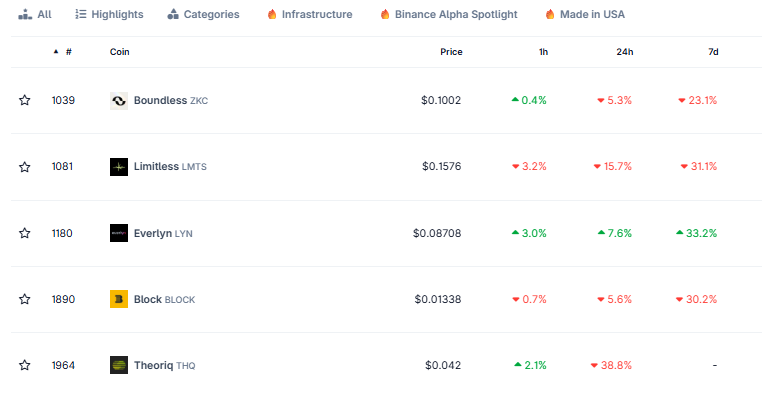
Boundless’ ZKC token is trading around $0.0995, down nearly 90% since its launch in September.
Limitless’s LMTS is down over 46% since October, Everlyn’s LYN is down over 71%, and Block’s BLOCK token has lost nearly 70% from its launch levels.
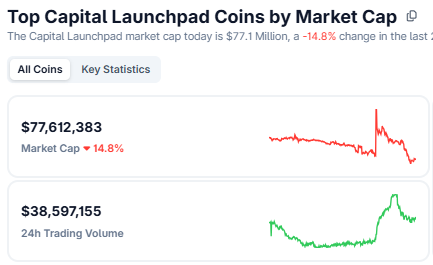
Notably, the tokens launched under Kaito Capital Launchpad, which aggregates these offerings, currently have a combined market capitalization of approximately $77.1 million, down almost 15% in the past 24 hours, with a daily trading volume of approximately $38.3 million.
Kaito operates an AI-powered information platform focused on ‘InfoFi’, where user-generated content, engagement and on-chain activities are converted into structured data.
The launch pad, also called Yapper or Capital Launchpad, allows Web3 projects to raise money and attention before and after their TGEs.
Projects set their own terms, including ratings and vesting schedules, while the community helps raise campaigns by staking, voting, and collecting reputation points earned through content creation.
As campaigns falter, pressure mounts across the Kaito ecosystem
Allocations are typically allocated during a preference phase before the remaining slots are opened on a first-come basis.
There has been increasing criticism of the way some of those campaigns have turned out. Analysts have pointed out that full token unlocking at TGE is a major contributor to sharp sell-off.
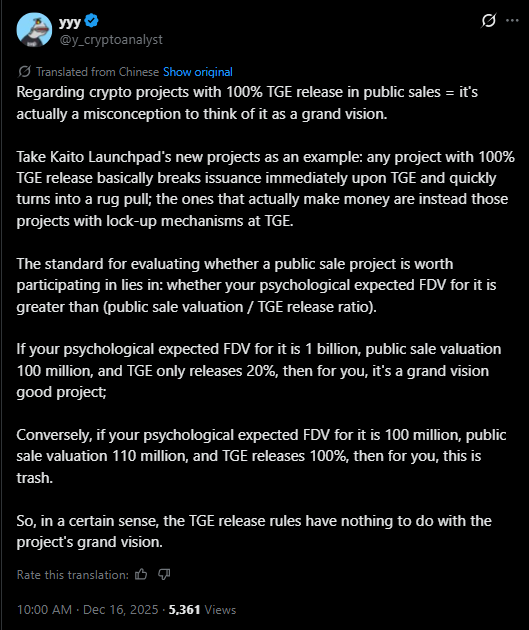
One crypto analyst noted that projects that release 100% of the supply at launch essentially release all the issues into circulation at once, leaving little cushion against immediate selling pressure.
Others highlighted that public sale valuations often showed little gain once tokens started trading.
Relationships with the Creator have also become a focal point.
Community members tracking campaign results said dozens of projects changed reward terms or delayed distribution after the campaigns ended, while others launched without clear timelines or structures.
Only a minority would have delivered rewards as originally communicated. These disputes have created more friction between creators and project teams that relied on Kaito’s engagement engine for visibility.
The broader shift in sentiment has weighed on Kaito’s own mark. KAITO is trading around $0.50, down more than 56% in the past three months.
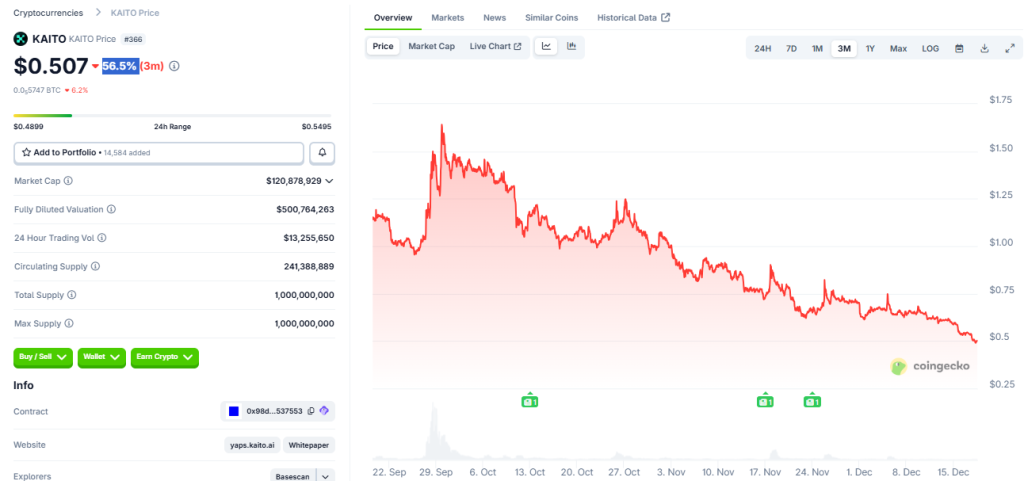
The token is now about 83% below its all-time high of $2.88, although it is still slightly above its all-time low.
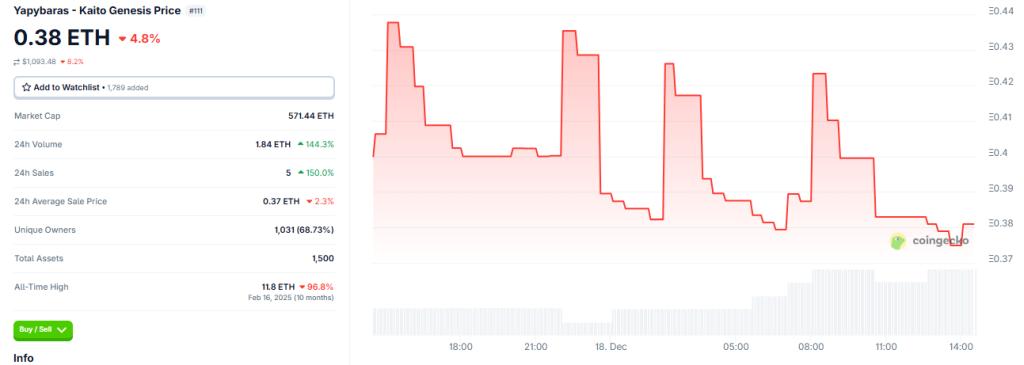
The decline was accompanied by visible tensions within the ecosystem. Yapybaras NFTs linked to the platform fell to around 0.38 ETH, and upcoming token unlocks planned before December 20 have contributed to short-term caution.
At the same time, some holders have pointed to recent platform updates aimed at tightening verification, reducing low-quality content and increasing transparency around participation rules.
TLDR:
– AI is driving the cost of content to near zero, as we see on all major social media platforms – with bot-generated content a widespread problem beyond X
– Moving from KOL backdoor deals to a more inclusive model for widespread creator leads
– This… https://t.co/STM1F5z2LC
— Kaito A.I
(@KaitoAI) December 15, 2025
Kaito recently outlined changes focused on on-chain identity checks, stricter reputation thresholds, and new authentication methods designed to reduce manipulation and bot-driven engagement.
The company said its system is evolving in response to feedback, and further adjustments are expected.
The post Kaito Kickstarter Projects Suffer Massive Post-TGE Crash – Is the Alpha Gone? appeared first on Cryptonieuws.