
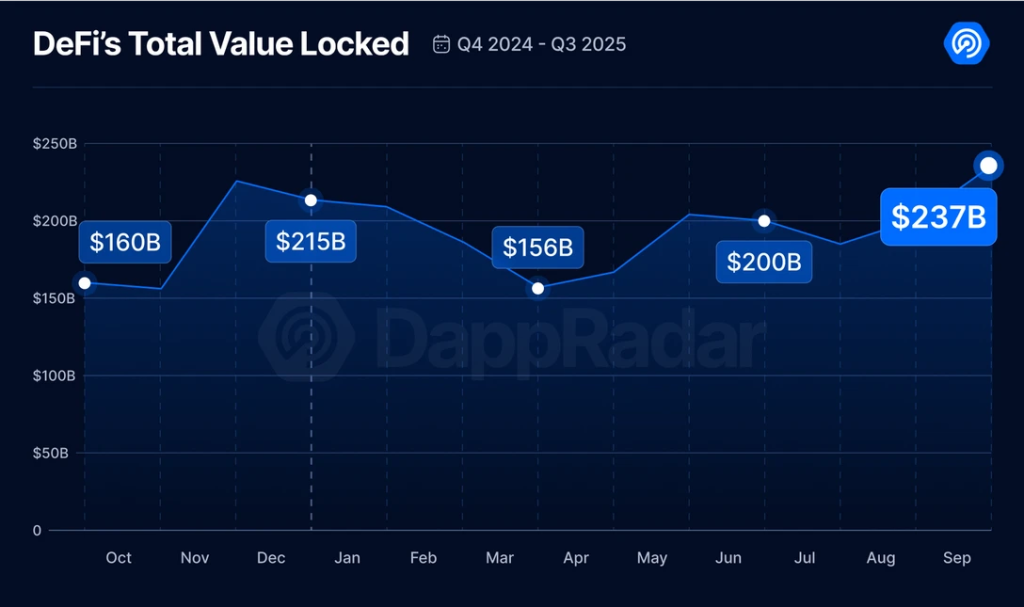
Decentralized Finance (DeFi) reached a new milestone in Q3 2025, closing the quarter with a total value locked (TVL) of $237 billion.
However, on-chain data tracking active wallets on a daily basis shows that retail is exiting the market as activity fell 22% in the third quarter.
The Report ‘State of the Dapp Industry Q3 2025’ from DappRadar reveals that despite a decline in user activity, technological development continues to drive the DeFi market to record highs.
According to DappRadar researcher Robert Hoogendoorn: “the rise of stablecoins is really putting DeFi in the spotlight of the traditional financial world.”
Stablecoins push DeFi to $237 billion TVL – but where have the users gone?
DappRadar analysts noted that of the $237 billion DeFi TVL, Ethereum, which has historically dominated the DeFi sector, held over 49% of the entire sector’s value in the third quarter of 2025.
Despite maintaining its leading position with $119 billion in TVL, Ethereum experienced a 4% decline. Solana retained his second place, but suffered the biggest defeat among the top 10 chains.
Solana’s TVL fell 33% to $13.8 billion, largely due to waning momentum around Pump.fun and memecoins.
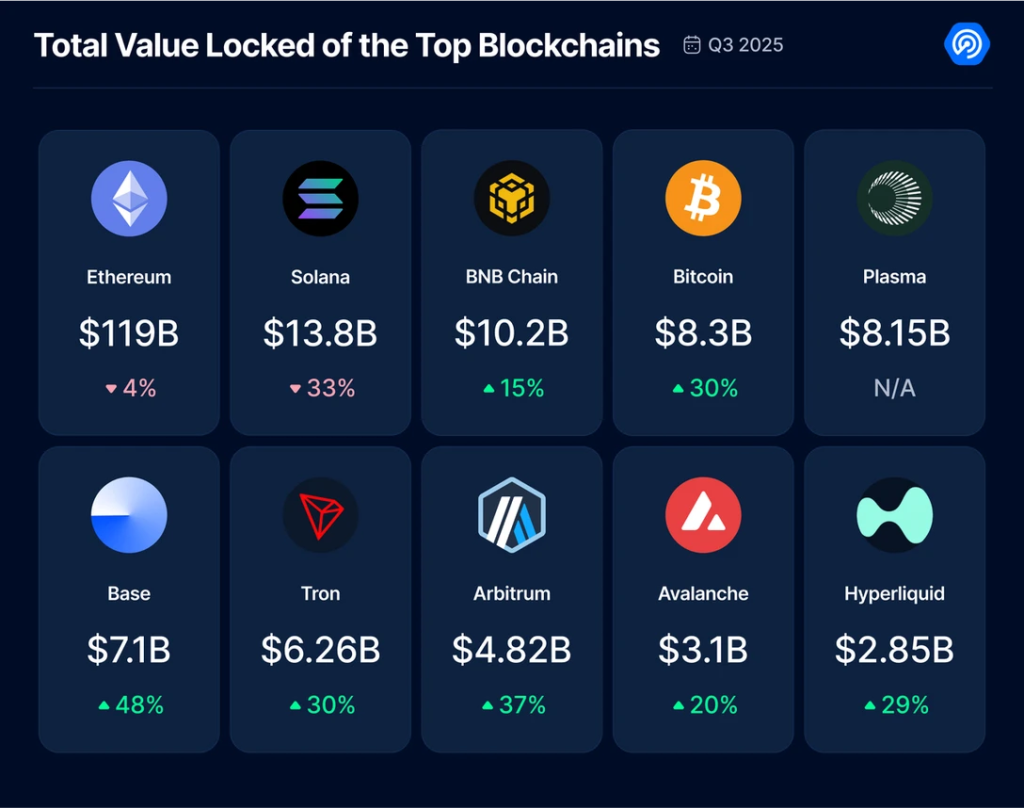
“More encouraging is the performance of other growing ecosystems, including BNB Chain, Plasma, Base, Tron, Arbitrum, Avalanche and Hyperliquid.”, added Robert.
BNB Chain generated a lot of attention with the launch of Aster, a perpetual decentralized exchange (DEX).
Hyperliquid, specifically designed for perpetual on-chain trading, has gained popularity throughout the year, increasing its TVL by 29% to $2.85 billion.
A growing pattern has emerged where decentralized exchanges are gradually matching the characteristics of their centralized counterparts.
While DeFi TVL reached its highest recorded level, the dapp industry witnessed a 22.4% decrease in the number of daily unique active wallets.
18.7 Million Daily Wallets Remain in DeFi: Is Retail Quietly Leaving Crypto?
During the third quarter of 2025, the sector was average 18.7 million portfolios daily, down from early 2025 levels through the second quarter, raising concerns about a possible exit from the retail market.
Throughout the quarter, every category experienced reduced wallet activity, with the social and AI categories absorbing the heaviest impact.
The AI category lost momentum during the quarter, with the average active wallet declining 4.8 million in the second quarter of 2025 to 3.1 million in the third quarter of 2025.
Virtuals Protocol, the launch pad for AI agents, is an example of this downward trend. The protocol attracted 10,000 active wallets daily in the second quarter of 2025 and processed millions of transactions.
Currently it is supports between 1,000 and 1,500 active wallets and handles an average daily volume of approximately $100,000.
In addition to AI, the Social category suffered heavy losses. Social dapps attracted 3.8 million active wallets daily in the second quarter, but that number has more than halved to 1.57 million by the third quarter of 2025.
NFTs have been gaining market share and are now in second place with 18.5%. The NFT market has seen an increase in trading volume by 2025.
First quarter data shows 7 million NFTs were sold, followed by 12.5 million in the second quarter. In the third quarter of 2025, more than 18.1 million NFTs were sold, generating a trading volume of $1.6 billion.
Between the second and third quarters, NFT sales increased 158%. The spike in trading volume can be attributed to OpenSea’s campaign for the upcoming token, designed to reward the most active traders, as well as increased PFP adoption led by CryptoPunks, Moonbirds, BAYC and Pudgy Penguins.
However, wallet participation only increased 28.6%indicating stronger conviction from existing participants rather than an influx of new users.
$434 million stolen in Q3 as hackers exploited Multi-Sig wallets despite record TVL
Despite record DeFi TVL and widespread growth, digital threats from malicious actors persist. During the third quarter of 2025, hackers stole more than $434 million worth of cryptocurrency.
The largest attacks involved social engineering and exploits, including an incident in July where a hacker exploited a malicious contract on GMX V1 to manipulate internal accounting protections, resulting in a $42 million loss.
Days later, CoinDCX suffered a $44 million loss due to a server breach.
Most recently, in September, the social project UXLINK experienced a multi-signature exploit that resulted in $21.7 million in stolen assets.
Post DeFi TVL Hits Record $237 Billion as Daily Active Portfolios Drop 22% in Q3 – Retail Exit? appeared first on Cryptonieuws.