
Strategy, formerly known as MicroStrategy, is considering a pivot that would fundamentally change the risk profile of the world’s largest corporate Bitcoin treasury.
For a decade, the company sold Wall Street on a unique proposition: It was a digital vault that offered unencumbered exposure to Bitcoin without the risks of custody or counterparty risk. That stance is changing as it is now exploring an entry into the crypto lending market.
On December 2, Strategy CEO Phong Le said this Bloomberg the company was in talks with banks about lending out its assets. However, he warned that the company was still waiting for major financial institutions to come forward before making a decision.
He said:
“We have had many constructive discussions. These were mainly: we are thinking about offering Bitcoin services – custody, exchange, lending, etc. You are the largest corporate holder of Bitcoin in the world; what is your advice to us, and should we work together?”
While seen as a corporate maturity, this move exposes the company to rehypothecation risks that contradict the “cold storage” ethos that has built its $55 billion reserve.
Nevertheless, the pivot signals that Strategy is evolving from a passive holding company to an active credit department.
This shift is driven by the need to justify the valuation premium in a market where spot ETFs have commoditized access to Bitcoin.
The yield trap
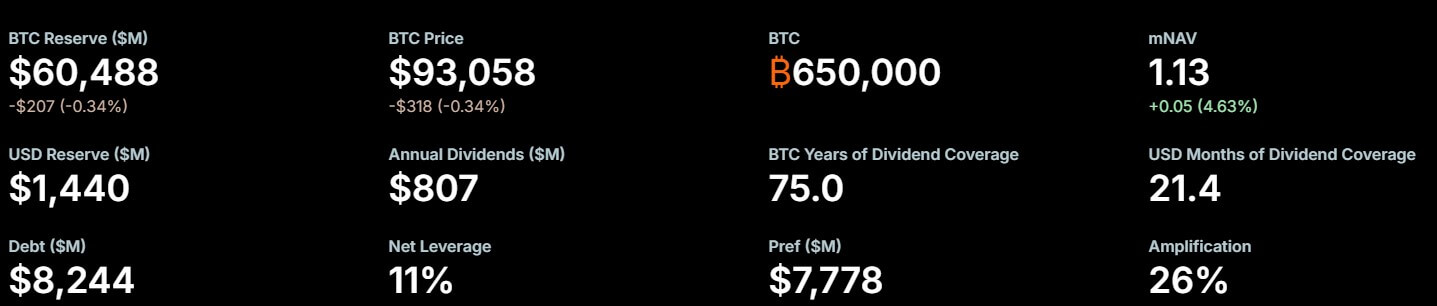
Strategy currently owns 650,000 BTC. Historically, this inventory has sat unused in the company’s coffers.
Lending them out would therefore generate income. However, it introduces a paradox, as the primary institutional demand for Bitcoin lending comes from market makers and hedge funds looking to short the asset.
To understand the risk, one must look at the mechanics of trading.
In the institutional market, the demand for borrowing Bitcoin is rarely about holding it, as it is almost exclusively about selling to hedge derivatives exposure.
By injecting its vast reserves into the credit market, Strategy would effectively lower the “cost to borrow,” a key problem that has typically discouraged short sellers.
Consequently, Strategy would essentially be supplying the stock used to bet against the price increase of its own reserve by opening a credit bureau.
Furthermore, this step introduces counterparty risk to a balance sheet previously defined by its simplicity.
In particular, the crypto lending market collapsed spectacularly in 2022 after lenders like BlockFi and Celsius misjudged the risk of lending to opaque borrowers.
While Le insists that Strategy will only work with top banks, the premise remains that Bitcoin will leave its vault.
So in the event of a bank failure or a credit foreclosure, Strategy would transition from a property owner to an unsecured creditor.
Defending the premium
Meanwhile, Strategy’s search for yield appears to be tied to its declining stock valuation.
The company’s model is based on trading at a premium to its net asset value (NAV), allowing it to issue shares at high prices to buy more Bitcoin. That premium, once as high as 2.5x, has cooled. On December 3, Strategy’s multiple to NAV (mNAV) was 1.15.

In a candid admission, the company recently admitted that it would consider selling Bitcoin if the mNAV falls below 1.
This creates a potential “reflexivity loop” in the market: if Strategy’s stock price falters, the company could be forced to liquidate Bitcoin, driving down spot prices and sending the stock price down further.
To avoid this, the Michael Saylor-led company must offer investors something the ETFs can’t: returns.
Additionally, the company recently raised $1.44 billion in equity to cover dividend obligations on its preferred stock, highlighting the cash flow pressures associated with maintaining the current capital structure.
Considering this, lending out the Bitcoin stack is one of the few ways to finance these payouts without diluting common shareholders or selling off the underlying asset.
A busy trade
As Strategy enters the lending arena, it will face a market that is significantly different from the collateral-less “Wild West” of 2021.
According to Milky Way digitalStablecoin issuer Tether currently dominates centralized lending with a book of $14.6 billion.
However, Tether lends stablecoins (USDT), which increases leverage for buyers. The strategy would be to lend Bitcoin, fueling supply for borrowers.

The sheer size of Strategy’s 650,000 BTC reserve significantly dwarfs the collateral pools of competitors like Nexo and Galaxy and could potentially disrupt the market. If even a fraction of that supply reaches the credit bureaus, the cost of borrowing Bitcoin could collapse, crushing returns across the sector.
Essentially, Strategy is betting that it can transform itself from a passive unwinder into a sophisticated financial operator. But to do so risks trading the clarity of ‘digital gold’ for the opacity of structured credit.
For investors who bought Strategy as a proxy for pristine collateral, the vault door is starting to look worryingly open.