
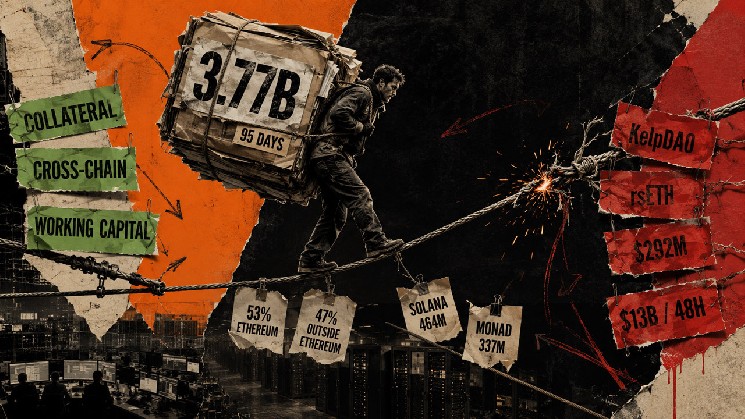
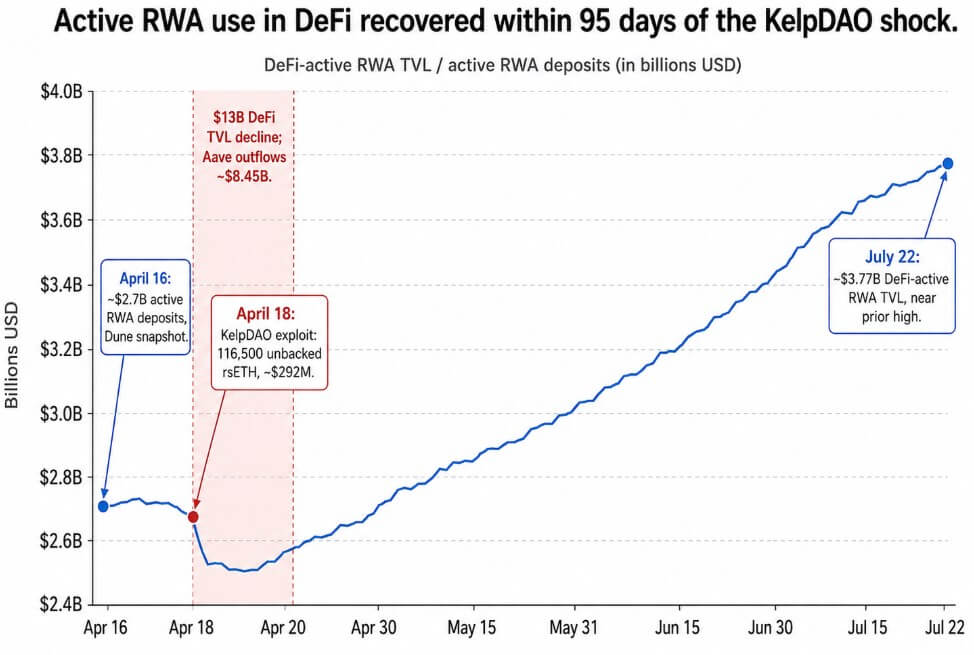
Active use of tokenized real-world assets in DeFi has returned to around $3.77 billion, close to the level seen before an April 18 exploit caused a $13 billion drop for DeFi as a whole in 48 hours.
According to DefiLlama’s tracking, that recovery is about 95 days from the shock to July 22.
The failure consisted of a compromised authentication setup that allowed attackers to spoof a cross-chain message and release approximately 116,500 unbacked rsETH, worth approximately $292 million, through KelpDAO’s LayerZero multichain infrastructure.
Aave accepted the token as collateral, the attacker borrowed against it, and the resulting run drained $8.45 billion from Aave within two days, spreading to the credit markets with little or no exposure to rsETH.
By posting a tokenized fund as collateral on Aave, Morpho, or Kamino, the token can back a loan, provide a vault, or run through a cross-chain strategy, converting a static balance into working capital.
Dune’s own formulation describes this as a flywheel: each integration makes an asset more useful, more use attracts capital, and new capital promotes further integration. Maple’s syrupUSDC and syrupUSDT are good examples, now deployed in Ethereum, Solana, Monad, Base, Arbitrum and Plasma.
DefiLlama is tracking about $51.9 billion in total tokenized RWA value, and only about 7% of that is in the active DeFi figure mentioned above.
The chains behind the recovery
Ethereum still anchors the recovered market, holding about $1.98 billion, or 53% of the active total. The balance spreads across syrupUSDC of about $415 million, syrupUSDT of about $323 million, gold-backed
About 47% of the active value now resides outside of Ethereum. Even after factoring out Provenance’s unusual $212 million blockchain-native stock position, that non-Ethereum stake still amounts to almost 42%.
Solana has the most diverse non-Ethereum market, with approximately $464 million active. Reinsurance token ONyc accounts for $166 million, private credit token PRIME for $144 million and syrupUSDC for $79 million, in addition to tokenized stocks such as SPYx, TSLAx, NVDAx and QQQx serving as collateral through Kamino.
Monad has emerged as a new implementation center with approximately $337 million. Almost all of it is in three products: syrupUSDC of $174 million, VUSD private credit of $110 million, and aHYPER’s delta-neutral fund exposure of $46 million.
Avalanche shows how a single institutional allocation can activate a chain: The $261 million in active RWA value comes almost entirely from JAAA, the Janus Henderson CLO fund, deployed through Grove Finance.
Plasma tells a similar concentration story, with about $211 million in assets and $206 million of that in Maple’s syrupUSDT alone.
Private credit is the largest active category, led by Maple’s two credit tokens alone, which hold approximately $1.3 billion on each chain on which they are listed. JAAA adds roughly $412 million in CLO exposure, reinsurance token ONyc and Ethereum’s reUSD together contribute more than $330 million, and gold-backed XAUT contributes approximately $235 million.
Tokenized Treasury and money market funds lag that pace, with USTB having about $137 million in assets and WTGXX about $67 million.
Dune’s analysis in April shows that credit made up just 17% of tokenized asset value at the time, and accounted for about 80% of DeFi deposits, as higher-yielding collateral supports lending and looping strategies that low-yield assets cannot as easily match.
A market can post $3.77 billion in active Total Value Locked (TVL) and still remain thin, focused, or difficult to exit in a stressed situation, exactly the profile that allowed a compromised bridge to suck the markets dry without direct exposure to it in April.
LayerZero has since said its verification network will no longer sign as the sole required attestor on any channel, and Aave’s board is coordinating with partners across the market to restore rsETH support and cover any resulting bad debt.
These steps close the specific gap that the April exploit exposed. Whether the rest of the recovered market’s bridges, wrappers, and collaterals capture price chain risk with the same accuracy remains unresolved.
The next stress test
In the bull scenario, credit markets continue to tighten collateral standards, risk-weighted asset issuers spread their stakes across more chains and asset types, and active TVL rises above $4 billion, while credit, reinsurance, and equity collateral all increase together.
In the bear scenario, another bridge or collateral onboarding failure forces protocols to lower supply limits or freeze markets, and the value of active RWA retreats to $2.5 billion to $3.2 billion as capital withdraws from aggressive composability strategies.
The makeup of the market—how dispersed, how liquid, and how carefully the new $3.77 billion is underwritten—will decide whether the resilience demonstrated by the quick recovery holds up the next time a bridge or collateral list fails.