
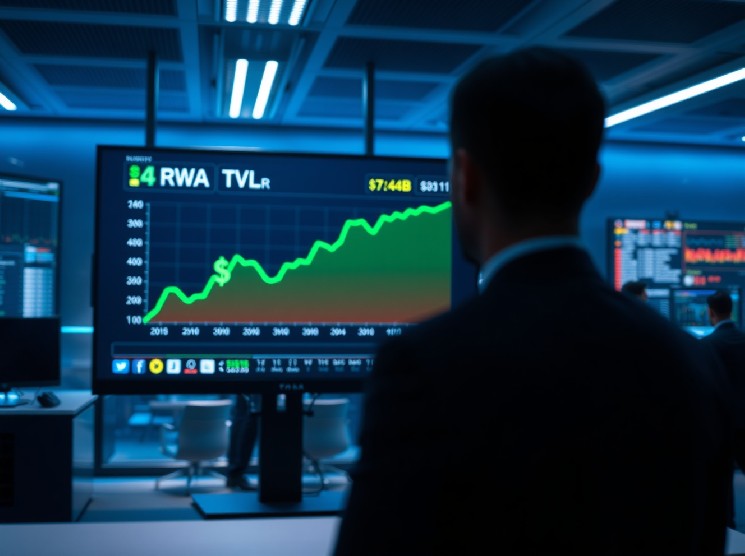
Total value under lock (TVL) in the decentralized finance (DeFi) sector, dedicated to real-world assets (RWAs), increased by approximately 200% year-on-year, reaching $7.44 billion in the second quarter of 2024. This data, reported by Cointelegraph and sourced from Token Terminal, highlights a significant difference from the broader DeFi market, which experienced a decline in total TVL of approximately 15% over the same period.
RWA growth is outpacing DeFi’s broader decline
The sharp increase in RWA TVL underlines growing institutional and private interest in tokenized versions of traditional financial instruments, such as US government bonds, private credit and real estate. While the broader DeFi ecosystem has faced headwinds due to market volatility, regulatory uncertainty and a decline in speculative activity, the RWA niche has attracted steady capital inflows. Token Terminal’s data shows that the sector now accounts for a significantly larger share of total DeFi TVL, a trend that has been building since late 2023.
What drives the wave?
Several factors contribute to the expansion of the RWA sector. The tokenization of US government bond products by platforms like Ondo Finance and Maple Finance has provided yield-seeking investors with a trusted, low-risk alternative within the DeFi ecosystem. These products offer returns that are often competitive with traditional money market funds, but with the added benefits of blockchain-based transparency and programmability. Additionally, increasing involvement from major financial institutions, including BlackRock’s BUIDL fund, has lent credibility to the asset class and encouraged further adoption.
Consequences for investors and the market
For DeFi participants, the growth of RWAs represents a maturation of the space, bridging the gap between traditional finance and blockchain technology. It provides a way to generate stable returns that are less correlated with the volatile movements of cryptocurrencies such as Bitcoin and Ethereum. For the broader market, this trend indicates that DeFi is evolving from purely on-chain, crypto-native applications to a system capable of handling regulated, real-world financial assets. However, the industry also faces challenges, including regulatory scrutiny, the need for reliable oracle infrastructure, and the risks associated with the underlying off-chain assets.
Conclusion
The 200% increase in DeFi RWA TVL to $7.44 billion, against the backdrop of a shrinking broader DeFi market, marks a pivotal moment for the sector. It shows that while speculative activity may decline, demand for tangible, return-generating assets on blockchain rails remains strong. The continued growth of this sector will likely depend on the ability of protocols to navigate regulatory frameworks and maintain the trust of both private and institutional users.
Frequently asked questions
Question 1: What are Real-World Assets (RWAs) in DeFi?
RWAs are tokenized representations of traditional financial assets, such as US government bonds, corporate debt, real estate or commodities, that are issued and traded on blockchain networks. This allows them to be used within DeFi protocols for lending, borrowing or earning returns.
Question 2: Why did RWA TVL grow while the overall DeFi market declined?
The decline in overall DeFi TVL is largely attributed to a downturn in speculative crypto markets and a rotation away from riskier, volatile assets. RWAs, on the other hand, offer more stable, yield-bearing opportunities tied to traditional financial instruments, which attracted capital from investors seeking safer returns during the market slowdown.
Question 3: Is the RWA sector safe for investors?
While RWAs provide exposure to traditionally lower-risk assets, they come with unique risks, including dependence on third-party custodians, legal frameworks for asset ownership, and the accuracy of data oracles that feed information to the blockchain. Investors should conduct thorough due diligence on the specific protocols and the underlying assets before allocating capital.