
Fees on the largest DeFi lending protocols and decentralized exchanges fell as much as 65%, a broad contraction that lenders and credit market operators attribute to debt unwinding after the early June sell-off, rather than a structural break in on-chain lending.
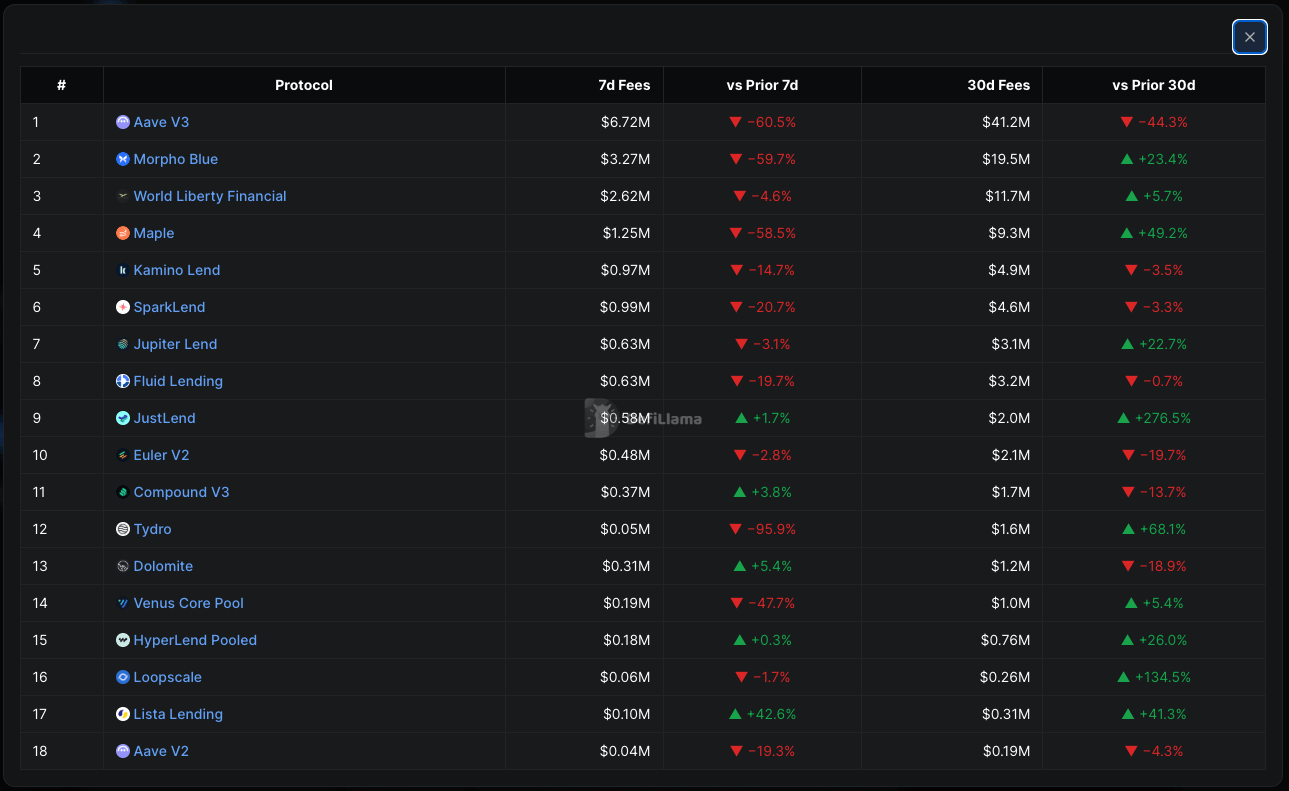
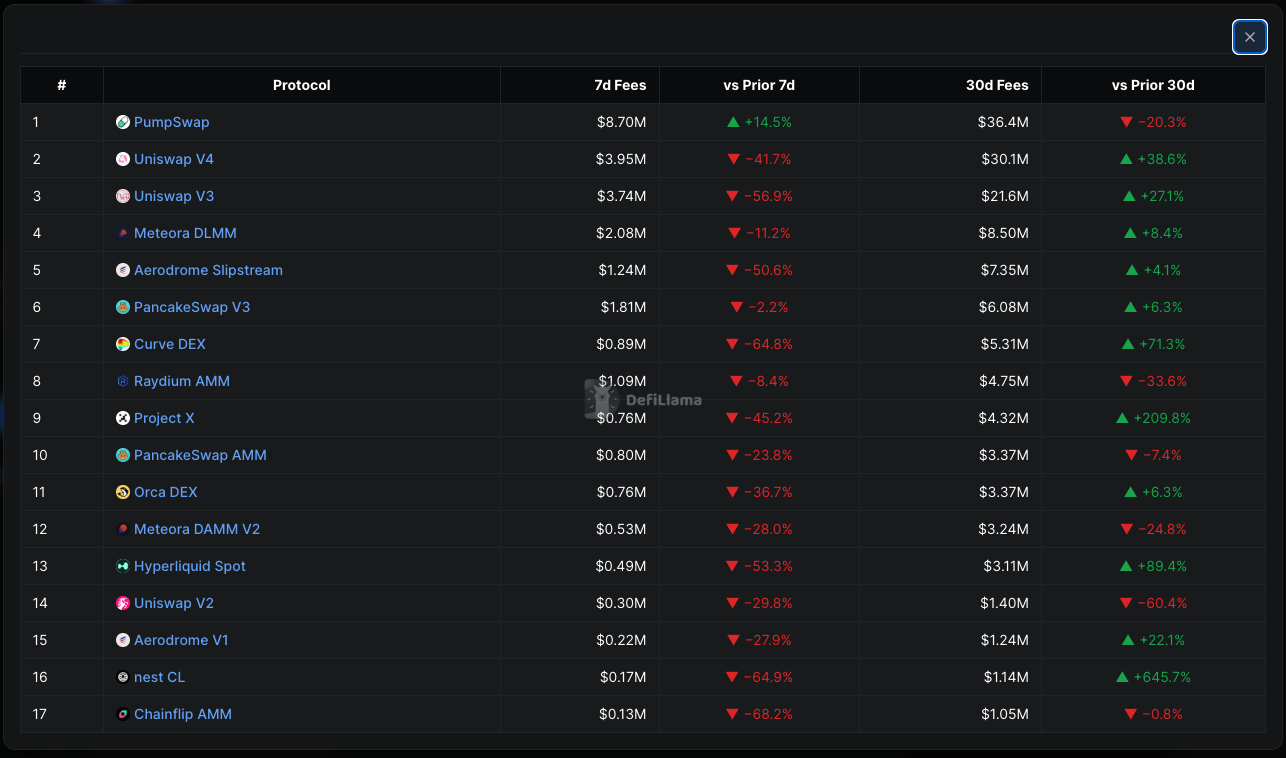
Seven-day rolling fees on Aave V3, TVL’s largest decentralized lending protocol, are down 60% from the previous period to $6.72 million per DefiLlama. Morpho Blue’s fees fell 60% to $3.27 million and Maple Finance’s fees fell 59% to $1.25 million. The drop was just as steep on the exchanges, with Uniswap V3 fees falling 57% to $3.74 million and Curve DEX falling 65% to $891,000.
The weekly numbers look like a route. The 30-day figures do not. In the following month, Morpho Blue’s rates increased by 23%, Maple’s by 49%, Uniswap V3’s by 27% and Curve’s by 71%, DefiLlama data shows. The gap between a steep weekly decline and a higher monthly decline indicates a debt reset.
Fees for onchain variable rate lending and trading platforms move with the amount of leverage and risk appetite in the system.
The week against which the contraction is measured included the early June sell-off and one of the toughest liquidation days of the year, when unwinding positions and rising interest rates generate excessive fees, Himanshu Sahay, co-founder of Arch Network, a fixed-rate onchain lending platform, said in rejecting the framework outright.
“Crash weeks generate excessive fees as debt levels decline and loan rates rise. This past week was the quieter, tapered aftermath, so the equation reads like a collapse as it gets closer to a mean reversal,” Sahay said.
The mechanism is structural to the product, he added: “Fees for these protocols track how much leverage there is in the system, so as usage drops, rates and fees drop along with it. That sensitivity is a natural tradeoff of onchain variable rate credit.”
The carry-trade compression
The reason that the contraction hit all cohorts at the same time is familiar to anyone who looks at traditional credit. Returns are a function of what borrowers can do profitably with capital, not just how much is available to lend, says Misha Putiatin, co-founder of Symbiotic, a collateral markets platform.
“Borrowers pay interest because they expect to deploy that capital in strategies that generate higher returns, a so-called carry trade. Right now, there is still a large amount of capital available to borrow, but there are fewer attractive, scalable opportunities to deploy borrowed money, especially as liquidity providers are generally risk averse after the KelpDAO hack and STRC-depeg,” Putiatin said.
When the supply of loanable capital exceeds productive demand, Putiatin said, borrowing costs fall and loan returns shrink. The pattern explains why protocols with different architectures and borrower bases moved together: when carry opportunities dry up across the asset class, each location absorbs the same compression at about the same rate.
A leverage cycle, not a structural break
Jacopo Buriollo, founder and CEO of Megawatt Finance, which finances energy infrastructure on-chain, interprets the move similarly.
“The recent collapse in DeFi lending fees looks less like structural weakness and more like a reduction in leverage premiums,” he said. “Following the post-exploitation liquidity crisis, stablecoin lending rates normalized as capital returned and risk appetite cooled. The bigger lesson is that DeFi lending is still too dependent on reflexive leverage cycles.”
The shrinkage was not uniform, which further undermines the collapse value. SparkLend, the MakerDAO affiliated lender, fell 20.7% to $989,000 in seven-day fees. Euler V2 fell just 2.8% to $477,000. Compound V3 was the only protocol with positive momentum, rising 3.8% to $368,000. Compound’s resilience suggests its borrower base, which skews toward USDC working capital positions, has weathered the week’s deleveraging, while SparkLend’s milder decline may reflect its integration with DAI liquidity reserves.
The market does not promote structural problems. The AAVE token is up about 23% over the past seven days, per CoinGecko, while UNI is up 31%.
All three operators pointed beyond the leverage cycle to real-world assets as the next source of onchain returns.
“The next phase of sustainable onchain returns will come from financing productive, cash-flowing real-world assets, including energy infrastructure, where returns are driven by economic activity and not just speculative loan demand,” Buriollo said. Putiatin made the same argument, arguing that the sector is “much better positioned to find our footing as new sources of returns come on board from RWAs and other renewable sources.”