
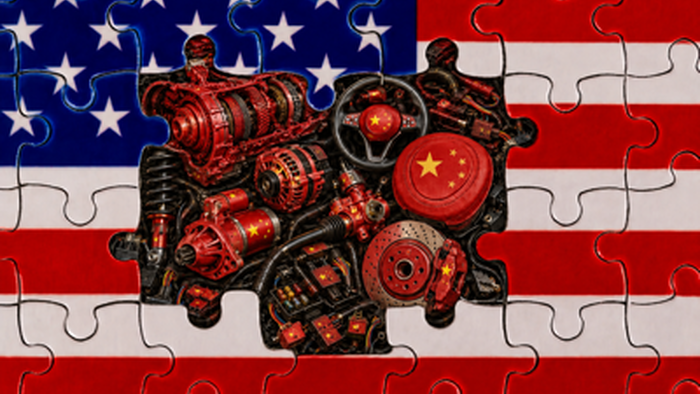
For good reason, U.S. policymakers have resisted opening the domestic auto market to a flood of cheap, gasoline-powered Chinese cars and EVs. Such a move would crush Detroit into even more misery. It would accelerate the hollowing out of the nation’s industrial base (something Europe willingly did), further degrade suppliers, and weaken the country’s ability to convert truck production lines to tank production in wartime.
However, while Chinese-made cars remain absent from U.S. highways, there has been a flood of Chinese auto parts, from airbags to transmissions to starters to steering systems and many other components, according to a new Wall Street Journal report citing data from consulting firm AlixPartners.
According to AlixPartners data, Chinese companies hold ownership stakes in about 10,000 suppliers nationwide. The exposure is an eye-opener for lawmakers, as the urgency to decouple critical supply chains from China remains a national security priority under the Trump administration.
“They’re [China] deeply integrated into the industry,” Michael Dunne, CEO of automotive consulting firm Dunne Insights, told the outlet.
Examples of this alarming deep integration include Ford’s Mustang GT, which uses a six-speed manual transmission from China; Toyota’s Prius plug-in hybrid, with about 15% of parts sourced from China; and GM’s Chevrolet Trax, Blazer EV, and Equinox EV, which contain approximately 20% Chinese parts.
Several automakers have been dialing back their parts exposure to China in recent years. Tesla has required suppliers to remove China-made components from U.S.-built vehicles, while GM says China now accounts for less than 3% of its direct material spending for U.S.-made cars. Still, government data show that at least 40 models for sale in the U.S. have alarmingly high levels of Chinese components.
What’s increasingly clear is that over the last 15 years, Beijing has been taking aggressive market share in the global auto market to become a dominant player. AlixPartners data show that in 2012, only one Chinese company ranked among the world’s top 100 auto suppliers. Now that figure is expected to reach 22 by 2030.
Lawmakers have been briefed about ways to eliminate Chinese auto parts from the U.S. market, which has only put pressure on the domestic supplier network.
In late April, more than 50 House Republicans, led by Rep. Mike Kelly (R., Pa.), penned a letter to Treasury Secretary Scott Bessent, Commerce Secretary Howard Lutnick, and U.S. Trade Representative Jamieson Greer, urging them to block Chinese automotive and battery companies from manufacturing in the U.S.
Juergen Simon, a partner at AlixPartners, told the outlet, “This shows the incredible speed at which the competitive environment has changed.” He noted that Chinese suppliers were once avoided due to concerns about quality and performance, but that is no longer the case.
The race to clean up decades of globalism that crushed America’s industrial core is well underway with the Trump administration. It appears the move to rebuild the nation’s auto supplier network and eliminate China from that ecosystem could be nearing.