
Authored by Gregory Copley via The Epoch Times,
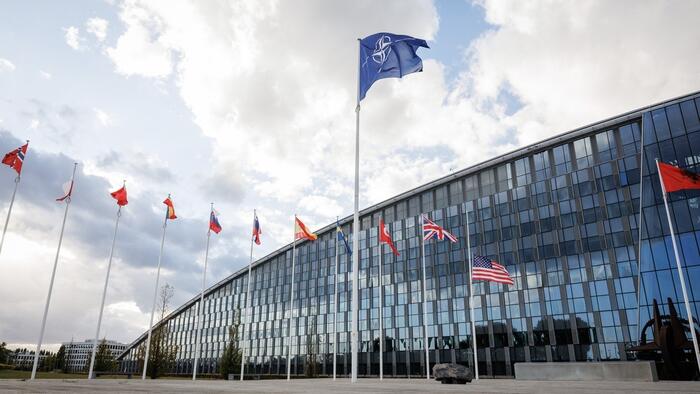
Western focus was, in 2026, on whether U.S. President Donald Trump would fulfill his threat to withdraw the United States from NATO. Eastern and Southern focus was on whether the Shanghai Cooperation Organization and the BRICS alliance were even functioning.
In the U.S.–NATO standoff, it may take more complex political maneuvering for Trump to achieve a breakup of the alliance. Certainly, he could withdraw the U.S. military from European basing, but Congress in 2023 approved legislation that would prevent any president from withdrawing the United States from NATO without approval from the Senate or an act of Congress. The measure, spearheaded by Sens. Tim Kaine (D-Va.) and, ironically, Marco Rubio (R-Fla.)—now Trump’s secretary of state—was included in the annual National Defense Authorization Act signed by President Joe Biden.
It may be more feasible for Trump to have the United States leave aspects of the military component of the North Atlantic Alliance, as French President Charles de Gaulle did in withdrawing from the NATO integrated military command structure—but not the North Atlantic Alliance—in 1967. Other members of NATO may themselves go beyond that to abandon NATO in order to form a new alliance, but that is a separate issue.
Of real, but as yet unexplored, interest is that other alliances have been forced to the sidelines because Trump initiatives, and time, have rendered them ineffective.
Among the most important of these are the Shanghai Cooperation Organization (SCO) and BRICS. Secondarily, the informal Quad alliance against China—of India, the United States, Japan, and Australia—is quietly becoming less tight.
The SCO, which emerged in 2001 from the 1996 Shanghai Five security arrangement, now has 10 member states, most of which harbor suspicions about other members of the SCO. It was meant to contain a mutual security clause to require members to support other members under attack from outside. SCO membership includes Iran, and that clause has proven to be unenforceable as the wars against Iran continue. So the SCO is now effectively inoperable, except as a showcase with an expensive bureaucracy.
Similarly, BRICS—which began as a working group of Brazil, Russia, India, China, and South Africa—was designed to circumvent U.S. domination of global trade systems by finding alternatives to trading using the U.S. dollar. The BRICS membership had expanded by 2026 to 10 states, adding Egypt, Ethiopia, Iran, Saudi Arabia, and the United Arab Emirates. But it failed to shake the United States’ ability to control and sustain a global sanctions regime against political leaders who used the U.S. dollar in ways deemed inimical to U.S. interests.
BRICS achieved some new trading modalities that avoided the use of the U.S. dollar, but this did little to weaken the U.S. currency, or strengthen the currencies of BRICS members. But that was to be expected. This journal, as early as 2008, was discussing the end of the globalist, multinational framework of financing the international logistics chain based on the U.S. dollar. It discussed a return to bilateralism of trading methodologies, including barter and countertrade, which had, even in the 1970s, been a normal practice.
The past year-plus has seen the promoters of BRICS—as a defensive mechanism against the United States—becoming incapable of creating a new trade finance system. A proposed BRICS currency has come to naught; the currency of China has weakened to the point that it is hardly tradeable. And so on.
At what point is the Trump administration prepared to push for the complete breakdown of “opposing currencies,” not just of the BRICS states’ proposed new currency, but even of the euro and sterling?
Has all of this saved and bolstered the U.S. dollar? By default, yes; there is still no viable alternative to the use of the U.S. currency for major world trade.
But is Trump yet through with his plans to diminish, and perhaps totally dispense with, the United Nations? He has certainly hit key aspects of the U.N. that were heavily dependent on U.S. taxpayer contributions. The U.N. itself has been making itself less relevant and less forceful; it has taken an extremely polarizing, leftist position on many international issues and, at the same time, has been disregarded by the United States and other powers.
This, in turn, has made it less useful to Beijing, which entered the U.N. on Oct. 25, 1971, displacing the original founding member, the Republic of China, also known as Taiwan. China then began a sustained campaign to use U.N. agencies for political influence. So some of Trump’s anti-U.N. activities were clearly designed as moves against China.
What is the impact of the diminishing role of the U.N.? It has become less trusted as an instrument to impartially mediate interstate conflicts, and this makes its International Criminal Court (ICC)—to which the United States is not a signatory—also less trusted. The attempt to use the ICC as a key body to create “international law” out of thin air has now become discredited, or less of an influence. The World Trade Organization is also increasingly disregarded, as are regional bodies, such as ECOWAS in West Africa, and the Organization of American States.
So to what extent was the “rules-based world order” a creature of this utopianist U.N. thinking, or was it merely a reflection of a pax Americana?
If Trump wished to move heavily against the U.N., his best timing might be before the U.S. midterm congressional elections in November. But could he make it stick?
Views expressed in this article are opinions of the author and do not necessarily reflect the views of The Epoch Times or ZeroHedge.