
$XRP General ledger validator Vet has argued this $XRP will lead the next phase of decentralized finance (DeFi).
In a post on X, Vet stated that traditional DeFi still has “a long way to go” before traditional finance is replaced. Meanwhile, he believes $XRP was built to achieve a more sustainable transition.
According to him, the $XRP The protocol’s design is better suited for high-end financial use cases, especially those aimed at replicating or replacing core TradFi systems.
He pointed to well-considered design choices within the $XRP Ledger that prioritizes stability over aggressive return opportunities. He says these tradeoffs make the network more robust for financial applications, even if they limit some of the benefits of other ecosystems.
Key points
- XRPL validator Vet says $XRP is positioned to lead the next phase of DeFi.
- He argues that XRPL’s design favors stability and real financial use cases over risky returns.
- Flare founder Hugo Philion pushed back, saying no protocol can claim superiority without scale.
- Critics highlight the low DeFi activity and absence of XRPL among the top DEX volume networks.
- $XRP‘s DeFi ecosystem is growing, with FXRP supply approaching 160 million and protocol usage increasing.
Flare founder pushes back against claims of ‘superiority’
The comments prompted a response from Hugo Philion, founder of Flare Network, who said the claims of superiority were premature.
While acknowledging his support for $XRP and XRPL, Philion criticized the tone of the argument. He noted that multiple protocols in the crypto industry, including those associated with XRPL, have faced bugs and challenges in their rollout.
He argued that no protocol can claim superiority without being tested on a meaningful scale. According to him, DeFi as a whole is still evolving $XRP‘s entry into space should be seen as part of the industry’s growth and not as a definitive leap forward.
XRPL’s design philosophy: less risk, fewer features
In response, Vet clarified that his argument is focused on risk management rather than competition. He explained that XRPL deliberately avoids features such as the complex ability to construct and deploy smart contracts, which are common in other ecosystems but can pose layered risks.
According to him, this lack of ‘multiplicative risk’ is a strength, not a weakness. By reducing exposure to cascading errors common in DeFi protocols, XRPL can provide a more stable foundation for institutional-grade financial applications.
You’re completely missing the point.
The $XRP protocol deliberately sacrifices some of the advantages that people use elsewhere, in exchange for not having the disadvantages that we also see.
We have no ability to compound multiplicative risks via smart contracts and no staking. That’s not serious…
— Veterinarian (@Vet_X0) April 20, 2026
Critics point to a lack of DeFi volume
Meanwhile, X user Tony Xu questioned XRPL’s relevance in the current DeFi landscape, pointing to its relatively low trading activity compared to leading chains.
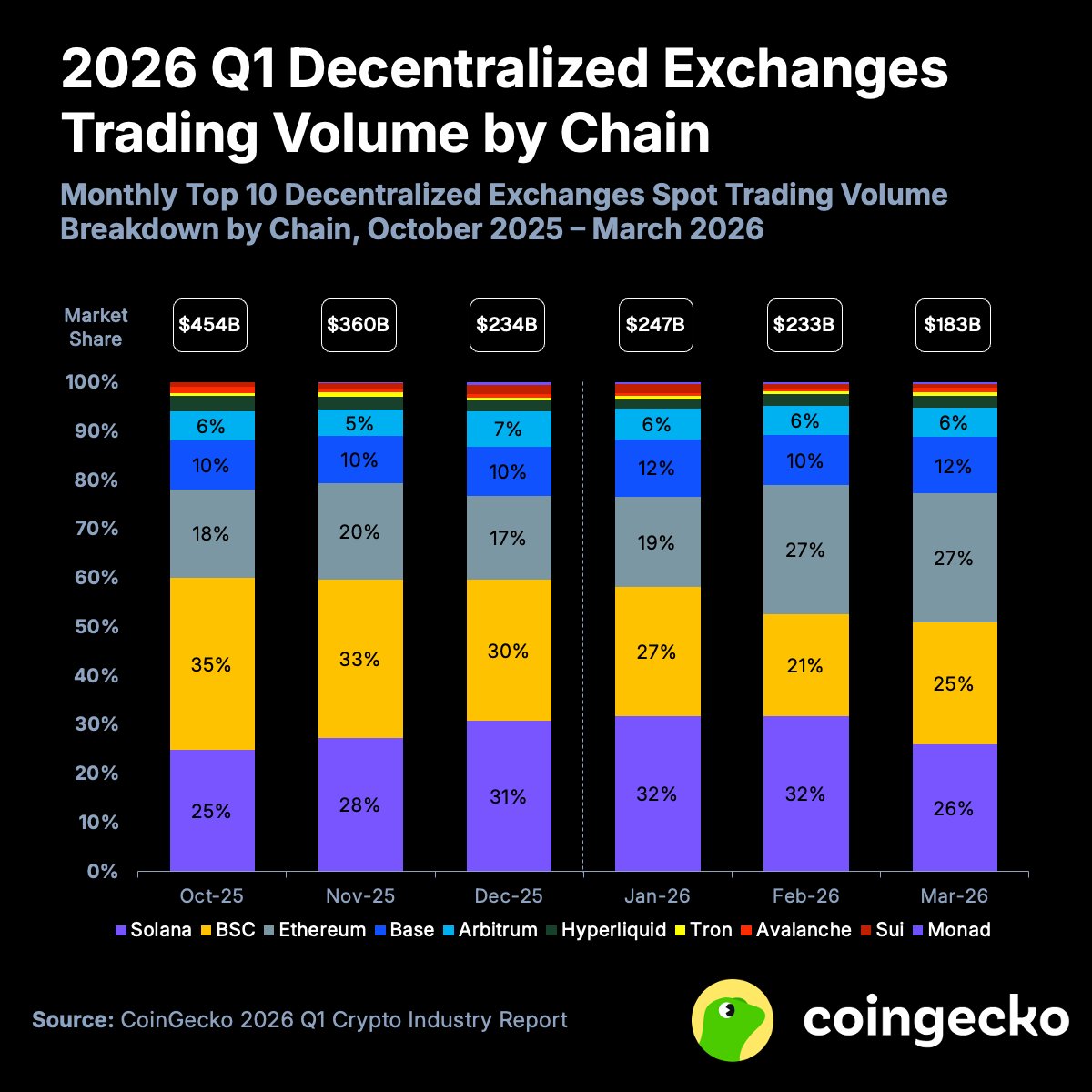
Citing data from CoinGecko, he emphasized that XRPL is not among the top networks in terms of decentralized exchange (DEX) trading volume.
The report shows that Solana retains the top spot despite a 26.5% decline, while BNB Chain is in second place with a 24.5% market share. Ethereum also remained a major player, briefly overtaking Solana in March.
Other chains such as Arbitrum, Tron, Avalanche, Sui and Monad were also among the top 10.
$XRP DeFi Push Approaches 160 Million FXRP Milestone
In the meantime, $XRPThe company’s DeFi ecosystem is only just beginning to develop, with staking features enabled through Flare Network.
FXRP supply is approaching 160 million months since launch, with adoption rapidly increasing.
More of the supply is captured in DeFi protocols such as Firelight, Kinetic, BlazeSwap and Upshift, highlighting its growing use for returns and liquidity. The initiative gives $XRP holders of new passive income options.
In short, DeFi continues to mature, and $XRP positions itself to compete despite arriving later than many of its peers.