
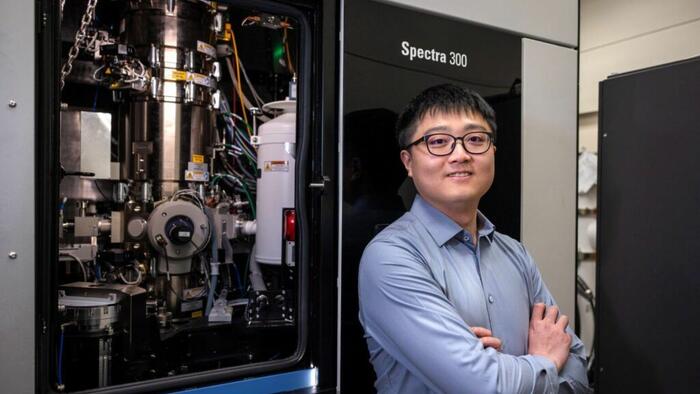
China is accusing U.S. federal authorities of “hostile questioning” by US law enforcement following the death of a groundbreaking Chinese semiconductor researcher who fell to his death inside a University of Michigan building last month, while American law enforcement and university officials remain tight-lipped about any federal involvement.
Danhao Wang, an assistant research scientist in the University of Michigan’s College of Engineering, died after falling from an upper level inside the George G. Brown Building on the Ann Arbor campus around 11 p.m. on March 19. University police responded to the scene and pronounced him dead. The incident is being investigated as a possible act of self-harm, with no indication of foul play or any ongoing threat to the campus community.
Chinese officials, including the embassy in Washington and the consulate in Chicago, have strongly linked Wang’s death to what they describe as “unwarranted” interrogation by U.S. law enforcement just before the incident. Beijing has lodged multiple “solemn representations,” accusing the U.S. of overstating national security concerns, engaging in political manipulation, and subjecting Chinese scholars to discriminatory practices that create a “chilling effect” on academic exchanges.
The Chinese Foreign Ministry and embassy spokespeople have publicly demanded a full investigation, a “responsible explanation” to Wang’s family, and an end to such alleged harassment. The embassy confirmed Wang died by suicide and has been assisting his family.
U.S. authorities have offered no confirmation or denial of any questioning. The FBI’s Detroit field office cited its longstanding policy of neither confirming nor denying investigations involving specific individuals. University police and administrators have released only basic details about the fall while the case remains active.
The University of Michigan, as we learned in June and November of last year, is full of China’s operatives. Danhao Wang could have been another one of them. https://t.co/Diw9HnUyiP
— Gordon G. Chang (@GordonGChang) April 7, 2026
Wang had worked in Prof. Zetian Mi’s lab since 2022, focusing on wide-bandgap III-nitride semiconductor materials and devices. His research centered on emerging wurtzite ferroelectric nitrides — advanced materials with unique polarization properties that could revolutionize electronics.
Groundbreaking Research
Wang’s most significant contribution was as co-first author on a landmark 2025 paper in Nature titled “Electric-field-induced domain walls in wurtzite ferroelectrics.” The work solved a long-standing puzzle: why these ferroelectric nitrides remain stable despite extreme polarization discontinuities that should theoretically tear the crystal apart.
Using transmission electron microscopy and density functional theory, the team discovered that when an electric field reverses polarization, “domain walls” form at the interfaces. These walls feature a unique buckled hexagonal atomic arrangement – never observed before – where dangling bonds with negatively charged electrons precisely compensate the positive charge buildup, stabilizing the material.
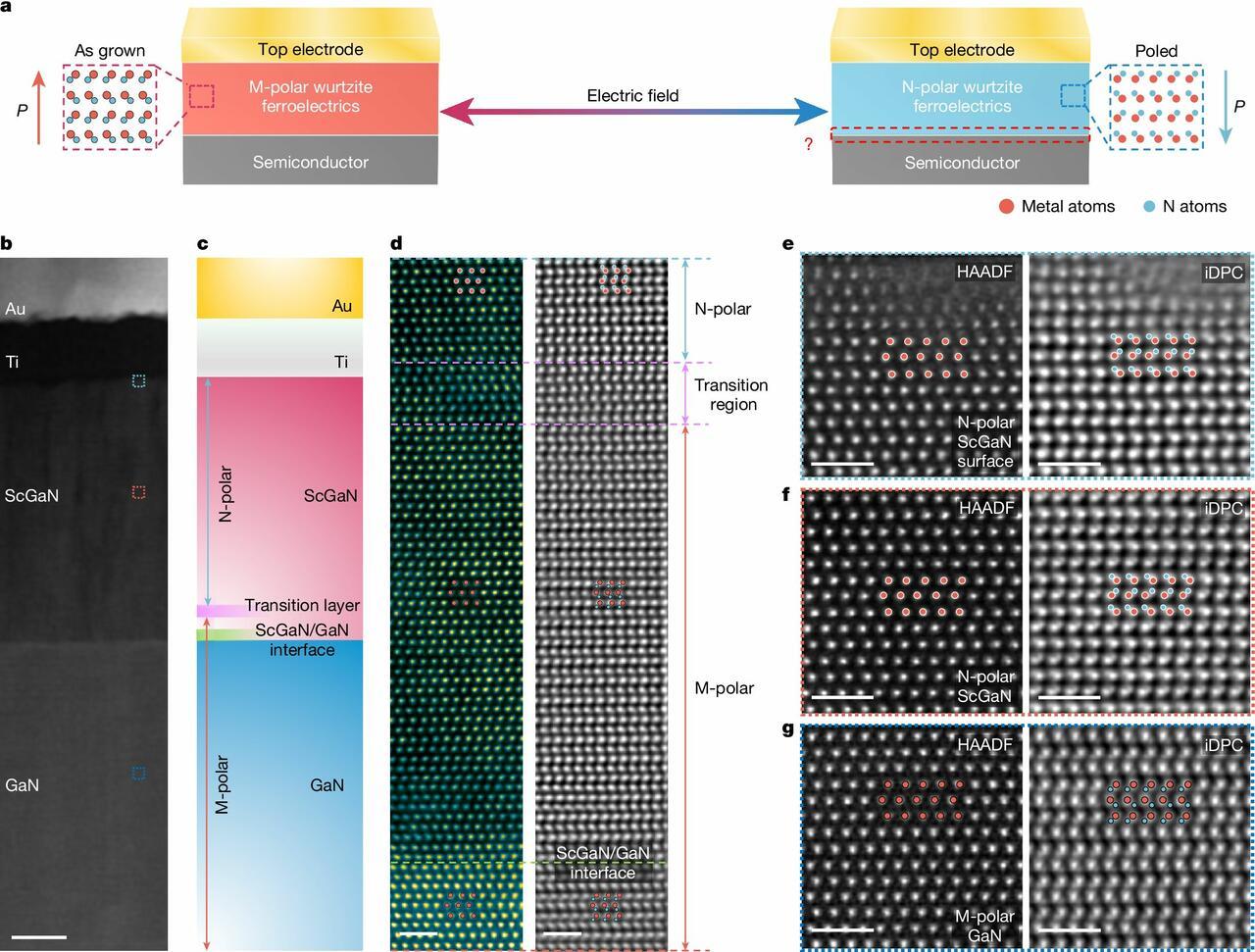
Critically, these domain walls also create highly conductive pathways – roughly 100 times more charge carriers than in standard gallium nitride transistors. The conductivity is electrically tunable: it can be turned on/off, moved, or adjusted in strength using the same field that controls polarization.
The breakthrough has sweeping implications for the semiconductor industry:
- Ultra-low-power computing and AI: Ferroelectric field-effect transistors (FeFETs) could integrate non-volatile memory and logic in the same material, slashing energy use in AI chips, edge devices, and data centers.
- High-power and high-frequency electronics: Domain-wall transistors promise superior performance in RF devices, power amplifiers, and next-generation power electronics.
- Neuromorphic and memory tech: The materials support brain-like synaptic behavior and energy-efficient non-volatile memory.
- Broader applications: Sensors, MEMS devices, quantum photonics, and hybrid optoelectronic systems all stand to benefit from the tunable ferroelectric properties.
University of Michigan Engineering Dean Karen Thole called Wang “a promising and brilliant young mind” whose work represented a landmark advance in uncovering the switching and charge compensation mechanisms of these emerging nitrides.