
Twenty-one crypto organizations have signed an open letter urging US universities to incorporate decentralized finance into their curricula, arguing that there will be a huge demand for crypto talent on Wall Street.
“Our goal with this letter is simple: to respectfully encourage higher education institutions in the United States to further integrate digital assets, blockchain, and decentralized finance into their business and law curricula,” said the open letter, which was published Wednesday.
The campaign was led by decentralized protocol aggregator 1Inch, with signatories including the Solana Policy Institute, Blockchain Association, DeFi Education Fund and crypto platforms such as Aave, MyEtherWallet, Delphi Digital and Messari.
While 1Inch acknowledged that DeFi is taught in some schools, it argued that current curricula treat it primarily as theoretical, and that students should gain a more practical understanding of a “critical part of the global financial ecosystem.”
“It is wrong to think, as some do, that DeFi and crypto technologies lack practical applications or somehow deviate from the public interest,” 1Inch said, noting that stablecoins eliminate cross-border payment friction, lending protocols provide return opportunities for investors and tokenized assets enable round-the-clock trading.
“The theoretical phase is over. Ideas have already become infrastructure.”
Commenting on Cointelegraph, 1Inch said it is pushing to teach more DeFi courses in the classroom as opportunities have expanded from developer roles to those in more corporate and legal roles.
“It’s no longer just hoodies; it’s suits and ties too,” 1Inch said, noting that Wall Street firms like Goldman Sachs and PwC are looking for crypto talent beyond tech-savvy programmers.
“The goal is to build on this greater DeFi understanding and practical knowledge not only among tomorrow’s developers, but also among CEOs and CLOs.”
The open letter calls for more “foundational education” in blockchain architecture and DeFi as a core module rather than an elective, with the course material touching on everything from automated market makers and liquidity provision to decentralized autonomous organizations and smart contract risk.
1Inch also suggested that students work directly with DeFi systems to “gain a realistic understanding of how DeFi works.”
The largest Wall Street firms are looking for DeFi experts
BlackRock, Fidelity Investments, Goldman Sachs, JPMorgan and Morgan Stanley recently posted job openings for DeFi-related positions.
This is also reflected in Google’s search statistics, according to 1Inch, which show that Google search volume for ‘Blockchain jobs’ grew by 84% between 2024 and 2026.
More specialized roles are increasing even faster, with “DeFi Developer Jobs” increasing by nearly 270% to 246,000 results, according to 1Inch.
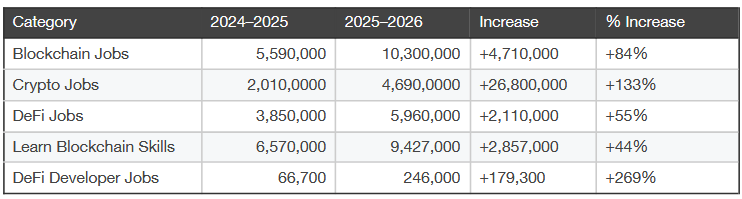
Google search data obtained by 1Inch on certain crypto-related job searches. Source: 1Inch
Related: Columbia professor says NYSE tokenization plan reads like ‘vaporware’
DeFi has historically had limited exposure to some US Ivy League colleges.
The Massachusetts Institute of Technology conducted an “MIT Digital Currency Experiment” in 2014, distributing Bitcoin (BTC) to students, while later offering courses on blockchain ethics and distributed ledger technology.
Harvard’s extension school also offers a blockchain innovation course, while Texas A&M offered a “Bitcoin Protocol” course to business and engineering students in 2023.
On Tuesday, Bitcoin bull Michael Saylor said the Florida Department of Education has approved Saylor Academy – a nonprofit education platform – to operate as Saylor University.
Saylor Academy is now Saylor University.
The Florida Department of Education has granted @saylordotorg university status, a significant milestone in our mission to provide free, world-class higher education for all.pic.twitter.com/SbimeofUkQ
— Michael Saylor (@saylor) March 17, 2026
The move will allow students to pursue tuition-free master’s degrees, including programs that teach Bitcoin and blockchain technology.
Magazine: What is a ‘network status’ and are there any practical examples? Big questions