
ugurhan
The year 2023 has seen Vertex Energy (NASDAQ:VTNR), producer and marketer of refined fuel products make noteworthy progress in regards to its renewable diesel project since the beginning of 2023. Its Q2 2023 revenues of $734.89 million beat estimates by $21.18 million representing an increase of 6.34% (QoQ). Performance management will be a key focus for the company heading into H2 2023.
Thesis
Vertex Energy has transformed from a local oil refinery company to a significant renewable fuel producer in the US. It completed its renewable diesel conversion project in H1 2023 and is expected to increase its yield profile into 2024. The recently erected Texas Tower mobile refinery planned for start-up in 2024 is also expected to lower carbon dioxide emissions and raise hydrogen production.
Challenging quarter
Despite growing its revenue by 6.34% (QoQ) to $734.9 million in Q2 2023, Vertex Energy has seen the same metrics drop 28.61% (YoY) from $1.03 billion in Q2 2022. The company incurred a net loss of $81.4 million dropping more than 250% (QoQ) after hitting a record net income of $53.9 million in Q2 2022.
Among the niche, high-value fuel products produced by Vertex are gasoline, renewable diesel, and jet fuel, which according to the company represented about 61% of its total production in Q2 2023.
I believe that the current economics of producing renewable diesel from soybean oil (feedstock) are not as attractive due to the challenging market conditions. The price of Soybeans has been marked by great volatility with the commodity trading at $12.73 per bushel from under $9 in 2020.
Macrotrends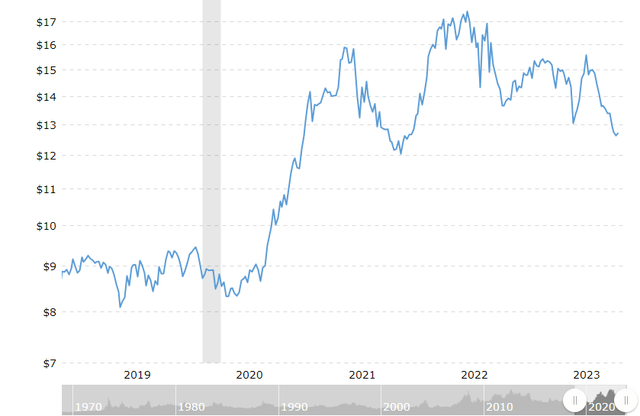
In its Q2 2023 earnings call, Vertex Energy explained that it was diversifying its feedstock supply to at least 8 different blends including distillers corn oil, canola, and crude degummed soy. The rise in demand for renewable diesel has also necessitated this diversification with the growing conversation around sustainability. As we know, after processing from fats and oils, the chemical composition of renewable diesel is similar to petroleum diesel as “it meets the ASTM specification for petroleum in the US and N590 in Europe.” Unlike biodiesel which is produced through transesterification and is blended with petroleum diesel for usage, renewable diesel provides a near-perfect alternative.
Demand for Renewable diesel
Consumption of renewable diesel in California (the largest consumer of renewable diesel in the US) from 2011 to 2021 has increased from 1 million barrels a year to 28 million barrels per year.
EIA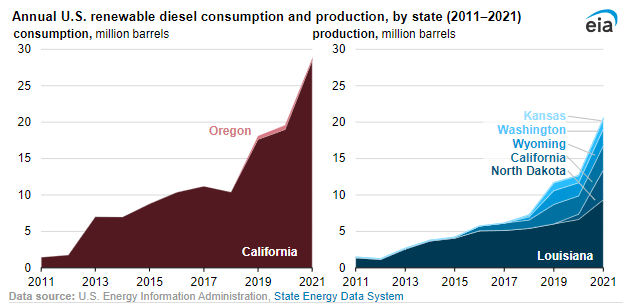
The enactment of the Low Carbon Fuel Standard (LCFS) in this State in 2011 has been a significant driver towards the adoption of biofuels. Fuel producers under this law in California are required to lower the carbon intensity of fuels while encouraging the production of renewable energy sources. In essence, producers of high-carbon fuel (above the mandated targets) are required to purchase credits from companies selling cleaner fuels. The state is quickly moving towards its zero emissions target and has encouraged other states such as Kansas, Washington, Wyoming, and North Dakota that also sell renewable diesel to California.
Estimates show that the production of renewable diesel is likely to hit 216 million barrels per year in 2024. At the same time, consumption is expected to reach 239 million, indicating a deficit of at least 23 million barrels per year. The production volume of renewable diesel and other biofuels (in 2023), according to the Energy Information Administration stood at 3 billion gallons per year. It has increased by 1.25 billion, a 71% (YoY) increase from 2022. In the US alone, the number of states now producing renewable diesel and other biofuels has increased from 6 to 11.
EIA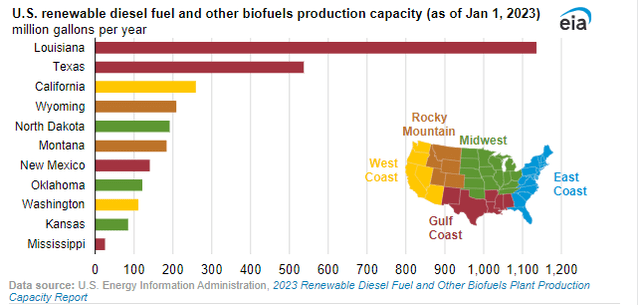
Production Milestones
In Q2 2023, Vertex Energy’s “conventional throughput volume” at the mobile refinery stood at 76,330 barrels/ day which was equal to 102% of its operating capacity. In Q3 2023, VTNR’s mobile refinery is expected to range at 74,000 b/d to 77,000 b/d. Additionally, the company attained a full production capacity of 8,000 barrels/ day of renewable diesel which it had planned in Q1 2023.
I believe this production is impressive considering VTNR purchased the 90,000 barrel/ day Mobile Alabama refining facility in 2021. It had then planned to renovate the standalone refinery assets to help in the future production of renewable fuels, a plan that seems to now be working.
Into Q3 2023, Vertex indicated that it had already commenced commercial sales of renewable diesel from its Mobile Alabama refining facility. In June 2023, the company sold its first 110,000 barrels of renewable diesel to Idemitsu Apollo Renewable Corp. This purchase followed an agreement by the two companies made in February 2022, where Idemitsu agreed to buy a maximum volume of 14,000 b/d from Vertex.
The Alabama facility whose first phase cost about $115 million has a planned production capacity in the range of 8,000 to 10,000 b/d (of renewable diesel). The standalone hydrocracking unit is the main process involved in this phase, and it was completed by the end of Q1 2023. It is noteworthy that locally sourced soybean oil was the only feedstock that was used in the production of renewable diesel.
By inference, the increase in the range of pretreated feedstock (such as meat tallow, corn oil, vegetable oil, together with soybean oil) to be used in the production of renewable diesel will enable the facility to operate at full capacity. Another important aspect to consider is that the feedstock to be used will be sourced locally, thereby creating local employment opportunities. Such an organization needs community support especially since the Mobile Alabama facility is still in its infancy. However, Vertex has been developing and sourcing alternative feedstock for at least 2 decades. It now has more than 500,000 tankers and stronger logistical capacity to improve its fuel production line in the long run.
Risks and Valuation
VTNR’s cash balance as of Q2 2023 stood at $48.5 million, a decrease of 44% (QoQ). The company’s total debt and lease obligations also stand at $466.1 million with accumulated losses (negative retained earnings) at $143.4 million in the quarter. However, with the net change in cash (in the 12 months to June 2023) at $45.9 million, it shows the company has enough money to last until June 2024.
Vertex Energy’s gross profit declined 92.8% (QoQ) to $5.2 million from $71.8 million in Q1 2023. The company also registered a net loss of $81.4 million for the first time since the quarter ending September 30, 2022. I believe that this decline was attributed to the decrease in VTNR’s refining margins when considered at market prices. Cost of revenues rose 17.79% (QoQ) even as the company explained that it incurred a $1/ barrel impact on its yields.
In this case, we may also consider the impact of hedging since the company explained that it encountered the $1 devaluation of its crude products. The price of jet fuel in the quarter also dropped by about $30 relative to that of crude oil. Overall, crude oil prices were reduced by $8 per barrel indicating a capture rate of 34%. On a similar front, energy company Blue Dolphin (OTCQX:BDCO) also announced a “significantly weaker refining margin” in Q2 2023 that lowered throughput volume, production, and sales. The refining margin (gross) dropped by almost 100% to less than $1 from a high of $15 at the beginning of 2023. The company’s gross profit in the 6 months ending on June 30, 2023, stood at $22.4 million against $23.4 million recorded a year earlier. Like VTNR, Blue Dolphin also claimed that a high jet fuel yield led to a drag on its capture rate in Q2 2023. However, I believe that the price of jet fuel is growing post-Covid while gasoline prices will soon move past their seasonal adjustment phase.
In regards to valuation, VTNR’s price-to-book (‘TTM’) ratio stands at 1.77 against the industry average of 1.67 (a difference of 6.33%). The forward price-to-cash flow ratio is 8.09 against the industry average of 5.11 (a difference of 58.40%). These metrics, in my view, show that the stock is slightly overvalued. Still, the company is looking at various tailwinds such as the growth in the renewable diesel output in H2 2023 and controlled hedging that should raise the shareholder value into 2024.
Bottom line
The increasing uptake of renewable biofuels across the US is a significant driver towards the growth of Vertex Energy. The company had a challenging Q2 2023 denoted by reduced gross profit and high net losses attributed to weaker refining margins. Still, I expect the company to overcome the hedging issues in 2024 due to favorable energy prices. For these reasons, I recommend a hold rating for the stock.