
The upcoming Bitcoin (BTC) halving, which halves the reward miners earn for solving Bitcoin transaction blocks to 3.25 BTC, is historically a bullish event. Recently, several miners bought more powerful equipment to increase their chances of winning the BTC after the halving.
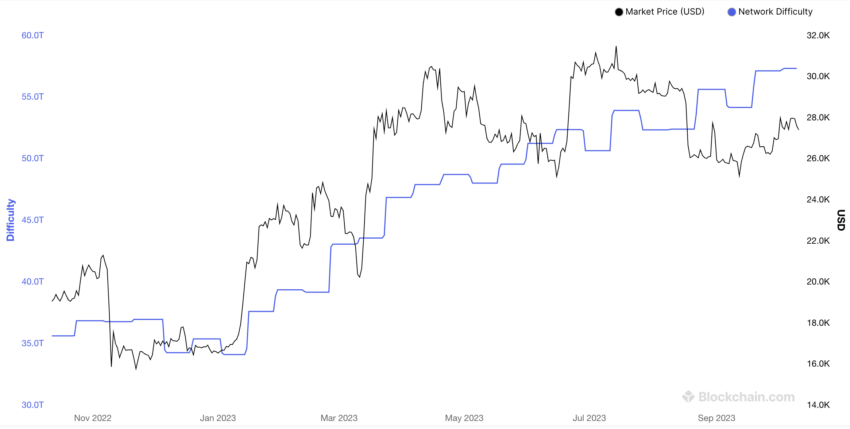
But Bitcoin’s algorithm makes it more difficult to solve blocks the more machines come online. As a result, miners must expend more energy to qualify for a reward.
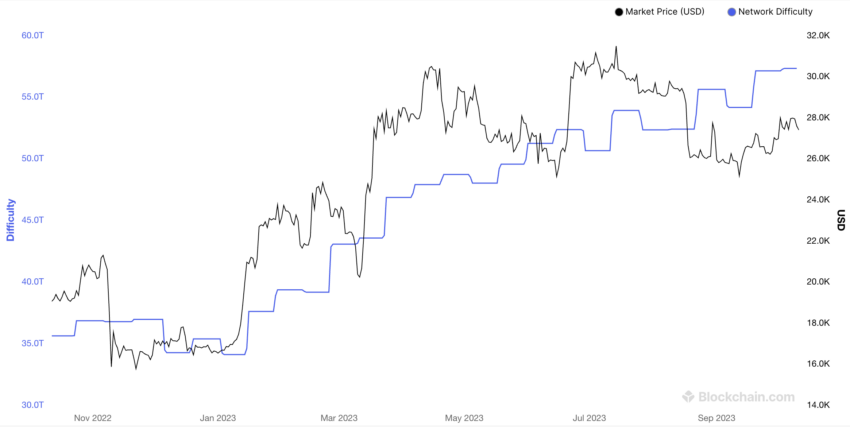
Bitcoin difficulty | Source: Blockchain.com
The verification process commenced the first time the Bitcoin network collected enough transactions to fill a block. Initially, a general-purpose computer could work out the hash of the block and earn a so-called block reward.
As businesses bought more machines to increase their chances, the algorithm made solving blocks harder. A puzzle that off-the-shelf consumers could once solve later needed specialized computers made by a few companies.
The energy consumption of these purpose-built computers, called application-specific integrated circuits, or ASICs, raise miner operating expenses. Profits can rise with Bitcoin’s price, but the converse is also true, requiring miners to plan for the worst.
The prolonged bear market in 2022 and 2023 saw several miners unable to service debt due to falling crypto prices. Some agreed to be acquired by bigger companies, while others diversified their businesses.
A few returned ASICs they pledged as collateral for loans they couldn’t afford. Some, like Core Scientific, filed for bankruptcy, as spiraling debts and falling Bitcoin prices forced a restructuring.
But those who made it through are now looking to the next major event on the Bitcoin calendar: the 2024 halving. A Texas-based mining CEO, Didar Bekbauov, told BeInCrypto of strategies his company, Xive, and others are exploring to ensure they are prepared for any post-halving Bitcoin price reaction.
How Bitcoin Rewards Keep Miners Well-Capitalized
Riot Platforms and Marathon Digital, two of the five major public miners, survived the bear market in different ways. Riot Blockchain rebranded as Riot Platforms in January, after expanding to include equipment manufacturer ESS Metron.
Read More: Best Crypto Mining Stocks to Buy or Watch Now
In its most recent quarterly earnings report, Marathon Digital secured a 1% increase in additional equity financing from Bank of New York Mellon Corporation, while Private Advisor Group LLC raised its stake in the Bitcoin miner to $495 million. In Q3, the company increased its Bitcoin output to 1,242, a 245% increase from September last year.
Riot, and another public miner, CleanSpark, produced 362 BTC and 642 BTC respectively last month, ending a quarter CleanSpark says exceeded expectations. Their output ensures these Bitcoin miners are well-capitalized and can continue operating in the event of a downturn.
Capital accumulation, it turns out, is a core strategy some miners are using to survive decline, Bekbauov confirmed:
“In addition to machines and facilities, big miners like Riot Platforms and Marathon also have some capital. On average, they’re keeping some Bitcoins and dollars, around $700 million, to survive if the Bitcoin price is low and the difficulty is high.”
BeInCrypto was not able to independently verify this number.
Bekbauov also believes that larger companies are exploring the possibility of acquiring smaller miners who may not survive the bear market because of insufficient capital, inefficient ASICs, or unoptimized power-purchasing agreements (PPAs).
What role do power-purchasing agreements (PPAS) play in the profitability of mining companies? It turns out that PPAS reduce risk for power producers and consumers by pre-negotiating prices based on expected energy consumption.
PPAs Also Keep Bitcoin Miners Well-Capitalized
Texas lawmakers recently opposed power-purchasing agreements that Bitcoin miners have struck with the Energy Reliability Council of Texas (ERCOT), arguing it exploits an aging system. Under the agreement, ERCOT pays miners for agreeing to switch off ASICs during periods of increased demand.
For example, between midnight and 16:00. on June 23, 2023, Riot earned over $42,000 for just agreeing to turn off its equipment. In 2023, the company saved $27 million by switching off 99% of ASICs and a further $18 million by halting mining and selling electricity to other consumers.
These revenues, coupled with $150 million-plus in Bitcoin earnings year-to-date, suggest Riot would survive the dual challenge of high Bitcoin difficulty and a low Bitcoin price. CleanSpark, which earned 6,904 Bitcoin in the fiscal year ending Sept. 30, is similarly well-capitalized.
By comparison, New York’s stricter approach to energy usage has made power-purchasing agreements less attractive. Greenidge Generation Holdings, a miner that uses natural gas to power Bitcoin mining, amended plans to expand in multiple regions after the passage of a moratorium banned the renewal of permits to convert fossil-fuel plants to Bitcoin mining facilities.
Kazakhstan, once a haven for cheap electricity following China’s mining ban, recently prohibited miners from using grid power that was not surplus. Miners’ peak consumption increased to more than 7% of the national demand, moving the grid from surplus into deficit and sparking mass protests.
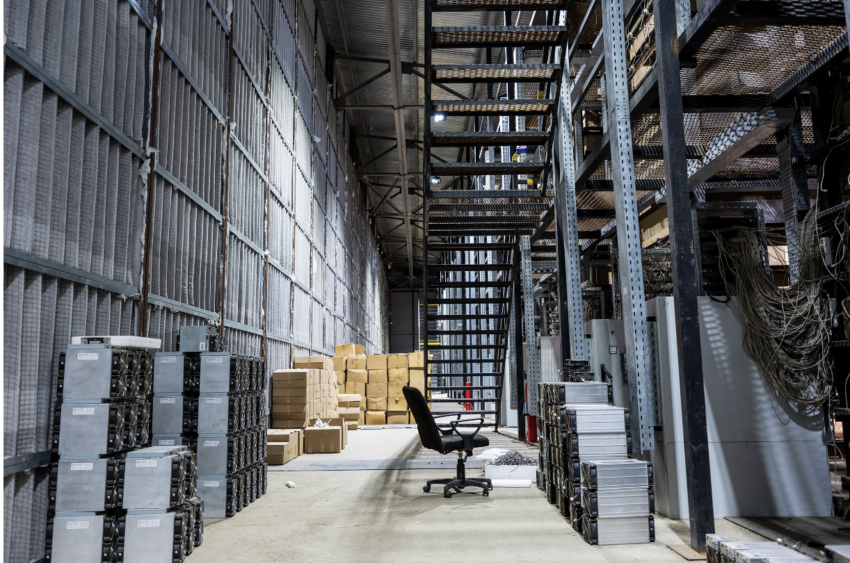
Stranded BTC.kz equipment | Source: MIT Technology Review
The move forced several miners, such as Enix and BTC.kz, to abandon the region. In doing so they left behind mining equipment and one of the more lucrative power agreements anywhere in the world.
ASICs Miners Need to Survive Halving Bear Market
Miners pushing to weather the post-halving bear market also need state-of-the-art ASICs. Older machines are less energy-efficient and produce fewer block rewards per kilowatt-hour of energy consumption.
Bitcoin infrastructure provider Blockstream recently bought a tranche of new mining rigs from Canaan, a Chinese equipment manufacturer. The company’s CEO, Adam Back, said they expect the halving to increase demand for these newer machines.
Read more: The 7 Best Cryptocurrency Mining Hardware for 2023
In August, CleanSpark purchased 45,000 Antminer S19 XP Bitcoin mining machines, which are currently the most efficient on the market.
According to Jaran Mellerud, a crypto mining analyst at Hashrate Index, machines must cost 6 cents per kilowatt-hour of energy for miners to break even. Miners with costs above 8 cents per kilowatt-hour will struggle to survive, even if the Bitcoin price remains the same after the halving.
Wolfie Zhao, a researcher at mining consulting firm BlocksBridge, echoed a similar sentiment,
“If you count in everything, the total cost for certain miners is well above Bitcoin’s currency price. Net profits will turn negative for many miners with less efficient operations.”
Read more: How To Build a Mining Rig: A Step-by-Step Guide
Alternatively, some miners can switch off some machines if Bitcoin’s price remains unchanged after the halving. This is a contingency Xive has already considered, Bekbauov said.
ETF Flips Bear Halving Scenario for Bitcoin Miners
But all the planning could turn more bullish if institutional Bitcoin investors get what they are looking for: a Bitcoin exchange-traded fund (ETF). While elusive for the most part, a spot fund could increase Bitcoin’s price to improve miner profitability and offset some of the halving’s bearish risks.
BlackRock, Bitwise, Franklin Templeton, Fidelity, and several others have applied to launch Bitcoin ETFs. If approved by the US Securities and Exchange Commission (SEC), these ETFs could increase institutional demand for Bitcoin and help miners survive, according to Bekbauov.
“BlackRock has $8 or $9 trillion of assets under management and many investors. If their application gets approved, it will allow many investors to invest in Bitcoin directly. Therefore, companies like BlackRock will need to have Bitcoins on their balance sheet.
“They will buy these Bitcoins from the market even as the halving decreases supply. If the demand goes up, then the price will go up. Any ETF approval can increase the demand for Bitcoin, so it’s a net positive.”
Smaller miners can also leverage expertise in managing data centers to explore other revenue streams, Bekbauov adds. For example, miners can efficiently operate artificial intelligence (AI) data centers using the same heat management strategies they employ for Bitcoin data centers.
Read more: How Will Artificial Intelligence (AI) Transform Crypto?
However, unlike in Bitcoin mining, where the end-user is established, AI data centers must secure business before they are built and populated, the Xive CEO concluded. The Bitcoin halving will likely occur in the spring of 2024.